|
|
By  David Craig, on August 1st, 2013 Let me try to predict the result of the Zimbabwe election – Robert Mugabe gets 150% of the vote: Morgan Tsvangirai gets 30% – Mugabe wins by 120%.
Mugabe will have done particularly well amongst the older generation – those aged over 100 (when average life expectancy in Zimbabwe is around 56). Amongst the elderly, Mugabe will have received around 400% of the votes.
Then this creature Mugabe and his equally corrupt cronies get another few years to complete the ruination of a once productive and wealthy country:

Meanwhile, on hearing the results – Mugabe 150%: Tsvangirai 30% – Mugabe’s great friend, South Africa’s President Jacob Zuma, will declare he is satisfied that this was a ‘fair and free election’. Here’s Mugabe with his best mate Jacob Zuma:

I bet they get on really well together. Maybe, once Mandela has gone, Zuma plans to repeat his hero Mugabe’s policies in South Africa, So, soon we’ll see mass starvation there too.
No doubt the dictators, kleptocrats and fools who make up the African Union will also confirm that the Zimbabwe election, giving Mugabe 150% of the vote, was ‘fair and free’ – if they can take a few moments off from stealing their countries’ money.

For as long as I can remember, we’ve been pouring aid money into Africa to help Africa develop. And in the last forty years, while Asia has changed beyond recognition, Africa has gone backwards.
It’s estimated that African kleptocrats siphon off ten times as much money into offshore bank accounts each year as the whole continent receives in aid. If we could cut this thieving by just 10%, we wouldn’t need to give any aid to Africa at all. If we could cut this thieving by 20%, Africa would have twice as much money as it currently receives in aid.

(Hopefully some readers can see similarities between the large gentleman in the cartoon and the laughable leaders of the utterly rotten African Union)
But, of course, it would be racist to suggest that Africa’s leaders are a bunch of corrupt, incompetent, lying, thieving, brutal, greedy, despotic fools. So instead, we cannot speak the truth and all the charities continue to pick our pockets of billions of pounds a year to give to large black men in shiny silk suits all with several palaces, private planes and extensive fleets of Mercedes.
Why will nobody tell the truth? With its massive resources, Africa should be one of the richest continents on earth, instead it’s the poorest. Africa’s poverty is self-inflicted. It’s a result of the greed, stupidity, corruption, nepotism, brutality and incompetence of the African ruling elites. Maybe it’s time for some tough love? Let’s cut off all aid to Africa in the hope that the people rise up against their repulsive rulers. Then, once there is some semblance of proper governance and a reduction in corruption, we could possibly resume aid.
Anyway, why bother having elections in Zimbabwe? Mugabe will still be winning them long after he’s dead.
By David Craig, on July 31st, 2013 Today’s story is all about the uselessness of our regulators, the sycophancy of our financial journalists and the arrogance and greed of our banks – in this case Barclays.
The utterly corrupt Barclays has been involved in scandal after scandal after scandal. There’s PPI mis-selling, of course. The LIBOR rigging. Massive bribes paid to Middle East rulers in return for them helping bail Barclays out in 2008. Tens of thousands of small businesses have been crippled by being mis-sold interest rate swaps. And we don’t yet know what other horrors have still to be revealed – rigging energy markets perhaps? Or rigging commodity prices? Tax avoidance? Handling money from drug cartels? Who knows?
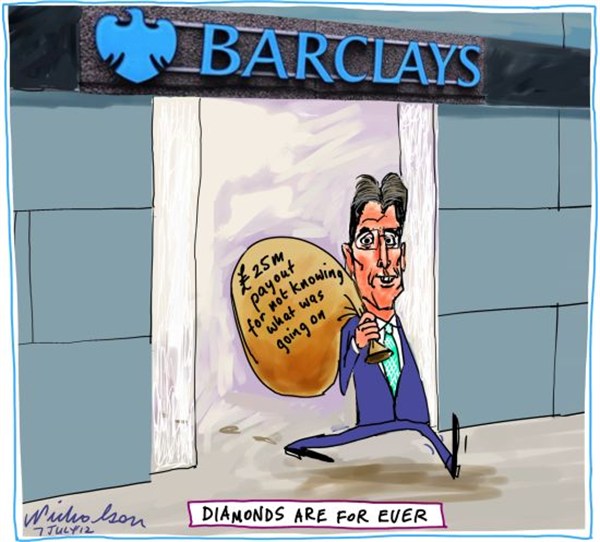
What has been Barclays reaction to these scandals? Pay massive bonuses to those responsible. There was Bob Diamond’s £25m pay-off:
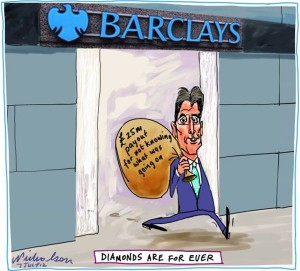 Then there were pay-offs to other bosses: Then there were pay-offs to other bosses:

As a result of Barclays paying so much in fines, compensation and of course bonuses, the Bank of England has instructed Barclays to raise more capital – about £12.8bn. In the next few months, Barclays will be raising £5.8bn from its shareholders.
Who are Barclays shareholders? Rich capitalists? Not really. Barclays shareholders are mostly you and I through the money we have invested in our pensions, life insurance and unit trusts.
Presumably crying crocodile tears while trying to contain his laughter, Barclays new boss, Antony Jenkins, said he was “disappointed” the bank had been forced to call on investors, but insisted the capital-raising would put the business in a strong position. “This is a package of measures that is appropriate for our shareholders going forward . . . I do believe this is in the best interests of our shareholders,” he said.
Barclays, supported by useless regulators and sycophantic journalists claims that ripping off shareholders is the only way to raise the money. But hold on a minute! There’s somewhere else Barclays could find the cash – from the salaries and bonuses of its own employees who have all benefitted from Barclays’ widespread corruption. Since 2009, Barclays has paid £11.05bn in bonuses. Crikey! That’s almost enough to fill the £12.8bn black hole in Barclays’ reserves.
Now, what if the BoE made a new rule that any bank with insufficient capital should be forced to freeze (or even reduce) salaries and cancel all bonuses till it had enough capital? What if the people responsible for Barclays needing more capital were those who had to supply the capital? Strangely, this possibility is never mentioned by our worthless regulators and grovelingly sycophantic financial journalists.
And so, the show goes on. Our bankers contemptuously continue their corruption and greed knowing they are untouchable and it will always be customers, shareholders and taxpayers who will pay for bankers’ greed, corruption and mistakes.
 (In case anyone is interested, in spite of my appeal yesterday, not a single person reading this blog could find the five or six quid to buy a copy of my latest book GREED UNLIMITED yesterday. Hey, ho. That’s the way it goes.) (In case anyone is interested, in spite of my appeal yesterday, not a single person reading this blog could find the five or six quid to buy a copy of my latest book GREED UNLIMITED yesterday. Hey, ho. That’s the way it goes.)
By David Craig, on July 30th, 2013 Here’s an old European joke:
Some years ago a small rural town in Spain twinned with a similar town in Greece.
The mayor of the Greek town visited the Spanish town. When he saw the palatial mansion belonging to the Spanish mayor, he wondered aloud how on earth he could afford such a house. The Spaniard replied: ‘You see that bridge over there? The EU gave us a grant to construct a two-lane bridge, but by building a single lane bridge with traffic lights at either end, I could build this place.’
The following year the Spaniard visited the Greek town. He was simply amazed at the Greek mayor’s house: gold taps, marble floors, diamond doorknobs, it was marvellous. When he asked how he’d raised the money to build this incredible house, the Greek mayor said: ‘You see that bridge over there?’ The Spaniard replied: ‘No.’
Here are two more old European jokes:

At least, these would be jokes if we in Britain weren’t having to borrow £53m a day (£19.3bn a year) to pay for the EU farce.
Oh, and here’s someone from a Club Med country applying to a Brussels bureaucrat for an EU grant:

(Less than a quarter of the people who visit this website have bought copies of my latest book GREED UNLIMITED. I wonder what I have to do to get the other 75% to 80% to put their hands into their pockets and fork out five or six quid for the book or less for the Kindle version?)
By David Craig, on July 29th, 2013 I’ve blogged on this before https://www.snouts-in-the-trough.com/archives/5748 There were some amazing “coincidences” in the Sunday Times Money section yesterday. In an article written by one of their key journalists, Ali Hussain, a financial adviser recommended savers put money in a unit trust called the Old Mutual UK Select Mid Cap Fund – a UK-focused fund that invests in mid-sized companies. Then in another piece featuring a picture of a happy family of supposedly “ordinary savers” we were told that “they have recently invested in the Old Mutual UK Mid Cap fund”. And, another coincidence I suppose, on the next page, there was a nice expensive ad placed by, yup you guessed it, Old Mutual Global Investors.
Unfortunately, I haven’t kept my old copies of the Sunday Times Money section. But I have a feeling that Mr Hussain frequently seems to include in his articles mentions of unit trusts run by the companies that have put the biggest ads in the Sunday Times Money section that week. It’s quite extraordinary how often this coincidence occurs.
This is the kind of picture unit trust managers like to portray to ordinary savers of their money growing:

But how realistic is this picture? Here are just a few good reasons to avoid unit trusts like the plague:
1. You lose about 5% of your money when you buy units (unless you buy through a fund supermarket)
2. Although the unit trust will often claim its management charge is only about 1.25% a year, in fact you’ll usually end up paying around 2.5% a year when you include other charges, commissions and dealing costs
3. You lose 5% of your money when you sell your units as the selling price is always about 5% lower than the buying price
4. If you hold your units for 5 years, you’ll pay about 22.5% in charges. If you hold for 10 years you’ll pay about 35%. As most unit trusts can only manage to achieve growth of 2% to 3% a year above inflation (if you’re lucky), although the fund value will look like it has gone up significantly, you’ll have lost money because of charges and inflation
5. Over the 5 to 10 years that we are advised to keep our money in unit trusts, about 80% of them fail to beat the overall performance of the market they are invested in
6. We probably now have around £600bn in unit trusts and are paying fees of about £18bn a year – an incredible £72m every working day – making our unit trust managers and salespeople very rich indeed
This is the kind of house probably owned by your unit trust manager:
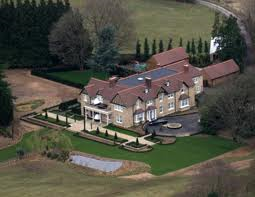
(Given that only 130 people have bought a copy of my latest book GREED UNLIMITED, this is not the kind of house I’m ever likely to live in)
So, what’s the solution for savers? With bank interest rates so low, we’re almost forced to put money into shares if we want to beat inflation. Fine. So, look at the sales bumf for a few unit trusts – it’s all available online. Look at the top 10 shares they hold (most of them usually hold the same shares). Then buy those shares directly yourself reinvesting your dividends in shares in the same companies. Nine times out of ten, you’ll beat most unit trusts as you’re not paying 22.5% to 35% of your money in fees to keep the unit trust managers in a multimillionaire lifestyle that most savers can hardly even dream of.
By David Craig, on July 28th, 2013 At www.snouts-in-the-trough.com, I’m always keen to provide readers with hopefully useful information. With much talk about pornography going around at the moment, I did wonder how much pornstars actually got paid.
For a mid-range actress, the rates seem so be something like:
- $800 for a girl-girl scene
- $1,000 for a guy-girl scene
- $1,200 or more for anal sex
- $4,000 or more for “double penetration”
Female porn stars can make about $88,000 to $100,000 a year doing two scenes a week. Pay for men tends to be around half that for females (hey! what about equality?) so the “average male,” can make comparable income to a female but must perform about four scenes a week. Apparently (and I have no experience of this), men can earn similar rates to females in gay sex movies.
One former pornstar is quoted as having said, “Exceptional females or those in very high demand, can make their careers last close to 10 years at $249,600 a year, doing about four films a week. Exceptional males, who can make their careers last the longest at 15 years, will make slightly more, about $268,800 a year, but have to perform almost every day at about 336 scenes a year.
Rates seem to be falling. A decade ago the average female performer would make about $100,000 a year, but for many this has fallen to as little as $50,000 (in spite of inflation) as there is increasing competition for jobs.
As for porn films made in Russia and Eastern Europe – it seems that pay per performance is only about €500 or less.
I tried to find a suitable picture to help illustrate today’s blog. But when I looked for “pornstars” on Google Images, there were plenty of suitably graphic pictures, but none that I would want on my website. I had to go through hundreds of photos of rather well-endowed men doing all sorts of things to women, that I’m not allowed to do, till finally I found this one:

It seems to have been taken from a French porn movie. The actors seem to be having sex “doggy style”. Or should that be “froggy style”? But I’ve no idea how much the participants got paid for their contributions to the film.
But looking more closely at the picture, I wonder if these really are Froggy pornstars or whether one of them – the one at the back – might not be that ghastly wrinkly old toad, former future French president, alleged pimp, alleged sex abuser, former head of the IMF – Dominique Strauss-Kahn:

By David Craig, on July 27th, 2013 By an extraordinary coincidence, there have been no less than three reports published in the last month claiming either that immigration is good for Britain or that old people are a burden for Britain or both at the same time.
First was a report by the OECD which laughably tried to prove that immigrants contributed more in taxes than they took in public services.
Then, last week the useless, sycophantically-obedient Office for Budget Responsibility produced a report concluding that the more immigration Britain had, the better off our economy would be. No doubt the head of the OBR, Mr Robert Chote, will get a knighthood or CBE for producing what is IMHO misleading government propaganda.
And yesterday, the OECD was at it again with yet another report – this time highlighting the supposed burden of the elderly. As one newspaper wrote – “Ageing population pushes welfare bill to crisis point. Britain’s rapidly ageing population threatens to push the NHS and state pension system to the brink of collapse, according to an international study that found almost a quarter of the UK economy is consumed by social welfare”.
Here’s a nice picture of immigrants camping out in the centre of London:

I wonder how the OECD and the OBR consider these people are contributing to Britain’s economy.
How come we get three similar reports at the same time? Coincidence? Or is it because our leaders and masters know that we are fed up of uncontrolled immigration: we are fed up of our hospitals looking like Third World butchers shops: we are fed up of our schools being unable to teach anything because too many children don’t speak English: we are fed up of our parks and streets looking like refugee camps and people are rightly fearful of what is going to happen from January 2014 when millions of Romanians and Bulgarians will be able to come to Britain and earn five to ten times as much on benefits here as they can get from working in their own countries?
Our leaders have handed over control of our borders to the corrupt, wasteful bureaucrats in Brussels who hate the idea of independent countries as they try to construct their European superstate. There seems to be a concerted campaign by the elites to justify opening up Britain as a dumping ground for almost anyone from anywhere in the world. Then when we’re swamped by 100,000 new migrants a year, our leaders will point to the three reports and try to claim immigration is necessary to support Britain’s ageing population.
Eventually, when our masters find out that immigration is actually costing us tens of billions a year, destroying our society and wrecking our economy, will this be their next great idea?

By David Craig, on July 26th, 2013 A couple of days ago, I blogged about the extraordinary number of supposed “charities” in Britain and suggested that the 874,829 employees and 945,278 trustees at Britain’s 180,281 charities probably did a lot better from our £58.65bn in donations than anyone actually needing charitable help https://www.snouts-in-the-trough.com/archives/5980
Since then, I’ve been looking at the average employee costs of a few of the better-known charities. Most charities seemed to come in at around the same level – the average cost of an employee (full time equivalent) including salary, NI and pension contributions is around £26,000. Save The Children seems to be lower than the average. Oxfam is a fair bit higher. But there’s one charity that really seems to be throwing donors’ money at its staff, rather than at the people it is supposed to be helping – the BBC Children In Need – where the average cost per person is an impressive £43,368 (click on chart to see more clearly)

I wonder why the BBC Children In Need staff are paid almost twice as much as staff in most other charities. Could it be because everyone working on anything connected with our bloated public broadcaster is overpaid and over-pensioned thanks to the enforced generosity of license-fee payers?
I have repeatedly argued that the BBC’s budget should be cut by 5% a year for the next 5 years and our clinically obese national broadcaster should be forced to stick to its charter – public service broadcasting – instead of making garbage in a pointless effort to compete with the increasing number of commercial channels.
Perhaps the inflated salaries and pensions of BBC Children In Need staff will further reinforce many people’s view of the BBC as a massive, self-serving, greed-ridden monstrosity that needs to be cut down to size. And if you want to give money to charity, I’d avoid giving it to the wasteful overpaid, bureaucratic parasites at the BBC Children In Need
By David Craig, on July 25th, 2013 I’ve been trying to make sense of Oxfam’s accounts to see how much/little of our money actually goes to charity. Here are some first thoughts.
Oxfam’s total income last year was £385.5m. But only £286.5m was actually used for what Oxfam and the Charity Commission call “charitable expenditure” – a reasonable, but not impressive 74.3%. Why so little?
Oxfam seems to have 3 main sources of funds – shops, public donations and government grants.
Its shops raise £89.9m, but cost £67.6m, leaving just £22.3m for charity. Not great, considering the people working in the shops are mostly volunteers.
It raises about £295.6m in donations with a cost for raising this money of £23m (7.8%). That looks pretty good. But £159.8m of these donations come from government, large institutions and public authorities. So, actually only £135.8m is raised at a cost of £23m (17%). Not great, but not disastrous either.
So we now know that of the £385.5m raised by Oxfam, £90.6m (shops – £67.6m plus fundraising – £23m) of this is spent getting the money in. That leaves about £294.9m to be spent.
Then we have to knock off about £31.9m for support and governance costs, leaving £263m – 68% of the £385.5m raised – available for charity work.
Now comes a bit of guessing. Oxfam’s staff costs are £59.5m in the UK and £42.3m overseas – total £101.8m. If we assume that say a third of these staff are in administrative and managerial functions and that two thirds are doing real charitable work, then the administration and managerial staff costs would be £33.9m. This would leave around £229.1m for charitable work (59.4% of the £385.5m raised).
Of the £229.1m available for charitable work, £90.6m is handed out in grants to other charities. As they will certainly have managerial and administrative costs of 20% or more, that’s another £18.1m not available for real charity. That leaves us with £211m – 54.7% of the £385.5m raised by Oxfam (click on chart to see more clearly)

Then there are a few other costs I haven’t included like the £48,000 expenses claimed by Oxfam’s top boss.
By my reckoning, only about 50% or less of the money given to Oxfam is actually used for real charitable work. That’s pathetic.
Then there’s one other not so small problem – how much of the money actually used for charity is lost to Third World corruption and incompetence? I’ll do a separate blog on that in the next couple of days.
All in all, you’re probably wasting your money if you give it to Oxfam and you’re probably wasting your time if you’re one of the 22,000 volunteers who help out at Oxfam.
(Tomorrow, I’ll have a brief look at the BBC Children In Need charity to see whether it might be more generous to its own employees than it is to the children it is meant to be helping)
By David Craig, on July 24th, 2013 There are many good reasons why the royal baby should be called Mohammed:
1. Looking on Mumsnet for the 100 most popular boys name in Britain, I found that Mohammed came in at number 19, Muhammed was 22nd and Mohammad was 63rd. This probably means that a boy’s name based on the name of the Prophet is already among the most popular boy’s names in Britain today
2. The Islamophiliacs who run our national broadcaster Al-BBC, would surely approve of the baby being named Mohammed as this would reflect the kind of open, tolerant, multicultural society so loved by the panjandrums at Al-BBC
3. Here’s a lovely picture of King Mohammed of Morocco. Our future King Mohammed could be just as “cool”

4. The boy’s grandfather has spent much of his life grovelling to Muslims, while showing little liking for Christians. So, surely he’d approve of the boy being named Mohammed
5. If we speculate that the royal baby will be king in about 60 years, we have to look at the religious make-up of Britain, not today, but in 60 years time. In the last decade, the number of Christians in Britain has dropped by 11% from 37.3m to 33.2m. At the same time, the number of Muslims has gone up by 80% from 1.5m to 2.7m. Even if these trends slow down a little, by 2073 we’ll have about 10 million Christians in the UK and closer to 15 million Muslims. So, a King Mohammed would better reflect the dominant religious group than a Harry or George or Edward or Charles or something like that
6. By the time King Mohammed gets the top job, Britain will no longer exist as an independent country. It will just be the Northwestern Province of the EU superstate. So we won’t need a king any more. Then King Mohammed can just become Sheikh Mohammed of the Northwestern Province
So come on Will and Kate. Show your open-mindedness: think of your child’s future as titular head of the EU’s Northwestern Province: understand that Muslims will be in a majority when your son becomes boss: seize this great opportunity – name your son Mohammed!
(Tomorrow, I’ll take a look at what Oxfam does with our £385.5m of donations and suggest why we shouldn’t give them any of our money)
By David Craig, on July 23rd, 2013 Charities in England and Wales raise and spend about £58.65bn a year. Of this, around £51.94bn (88%) is used for what the Charity Commission (the regulator for charities in England and Wales) classes as “charitable expenditure”. Looks good, doesn’t it? But let’s pry a little deeper into some more figures about the charitable sector.
There are an almost unbelievable 180,000 registered charities in England and Wales. Yes, 180,000. The population of England and Wales is around 56,600,000 – that’s a truly incredible charity for every 314 people!!!

These charities employ – wait for it – 874,829 people. Let’s assume the average cost of these people (including salaries, NI contributions, pension payments, office costs, computers, phones and so on) is a modest £25,000 a year (The average employee cost – just salaries and benefits – at the BBC’s Children in Need charity, for example is an attractive £43,368). This would mean that £22bn of the £58.65bn we give to charities is spent on staff costs. Some these staff may be doing charitable things like caring for children, answering helplines or conducting cancer research. But many of them will just be administrators, managers on high 5-figure salaries and executives on comfortable 6-figure salaries.
Incredibly, the Charity Commission allows charities to include staff costs under “charitable expenditure”. Perhaps it’s because doing this makes it look like most of our donations are being used for charity.
There are also 945,278 charity trustees. In theory, these trustees should not be paid. But some are and all can claim for their time and expenses. If we assume they claim on average just £500 per year each, that’s another £472,000,000 of our donations to charities going into someone’s pockets.
Each year, every charity has to provide a set of accounts and a report to the Charity Commission. If we assume this just costs £1,000 per charity – wow, there’s another £180,000,000 blown on administration. And we mustn’t forget the generous expense accounts enjoyed by many charity executives and managers. If each charity spent only £1,000 a year on such expenses – I’m sure many spend much more than this (the director of Oxfam, for example, runs up an annual expenses bill of around £48,000 – about £1,000 every working week) – there’s £180,000,000 more of our money gone up in smoke.
So, let’s look again at some figures. £58.65bn a year is collected by charities. Of this, about £6.71bn (11.4%) goes on governance and fundraising and a further estimated £22.5bn (38.4%) goes on staff costs. In all, about 49.8% of all the money we give to British-registered charities is spent by them on themselves, leaving just 50.2% for real charitable expenditure.
This is a very different picture to that painted by the Charity Commission which boasts that more than 88% of all donated money goes on “charitable expenditure”.
I don’t know what readers will conclude from this. But my conclusions are:
1. The number of charities should be slashed by over 90% from 180,000 to somewhere around 10,000 to 15,000
2. The number of staff working for these charities should be cut by at least 70% from the extraordinary 874,829 to perhaps 260,000
3. The number of trustees should be cut from 945,278 to maybe 50,000 at most
3. Making these obviously necessary cuts would release at least £15bn a year for real charitable expenditure
As far as I can see, it’s time to slash into Britain’s bloated, self-serving charities – cut the number of charities, cut the number of staff, cut all the chief executives and financial directors and marketing directors and trustees.
(Talking of charity – it would be nice if 4 or 5 of you could buy a copy of my latest book GREED UNLIMITED. It’s not because I want your money – I’m going to lose over £1,000 from doing the book – it’s just that it seems pointless for the books to be lying in piles around my home when people could be reading them)
|
|