|
|
By  David Craig, on May 16th, 2013 Regular readers will know that spending on the NHS has shot up from £45bn in 1997 to about £105bn today. Even taking account of inflation, when you add in Gordon Brown’s disastrously expensive PFI hospitals, the NHS budget has more than doubled.
Yet this week we’ve had newspaper headlines screaming about an impending collapse in A&E services. So where has all our money gone?
Here’s a chart of government healthcare spending as a % of GDP across the world (click on charts to see them more clearly):

The UK seems to be doing quite well and is near the top of the range.
So, here’s a chart of the number of hospital beds per 100,000 of population:

Whoops – at just 400 beds per 100,000 people, the UK is pitifully far below countries like Germany, Hungary, Lithuania and Austria which have nearer 800 hospital beds per 100,000 people.
And here’s a chart regular readers will know well – the number of NHS beds per NHS manager since 1997:

This has crashed down from about 8 beds per manager to around 3.8 beds per manager.
I’ll leave you to draw your own conclusions.
Oh, and here’s a lovely picture of the photogenic Sir David Nicholson, the man now responsible for the NHS. Though, with Sir David, as we know, he’s happy to take his big salary and even bigger pension but is never responsible for anything:

By David Craig, on May 15th, 2013 Apparently the Church of England (CoE) has conducted a “full and thorough investigation”, which “left no stone unturned”, into why priests were allowed to bugger choirboys for so many years without being stopped and without being reported to the police. The conclusion of this “full and thorough investigation”, which “left no stone unturned”, is that “the system” was to blame. It seems the CoE’s guidelines, drafted in 1999, placed archbishops under no obligation to report concerns to the police or social services. So, the CoE has concluded that nobody was responsible for anything, even though common sense suggests that if you know crimes are being committed (particularly crimes against children) and if you’re a holier-than-thou well-paid, well-pensioned senior cleric, you should do something. The CoE has now admitted that “the guidelines will have to be changed” but no archbishops will be fired.
Funny that. Because the conclusion of the Francis Report into the 1,200 people who died unnecessarily (often caked in their own excrement or vomit) due to appalling care at the Mid Staffordshire NHS Trust was also that all the deaths were the fault of “the system”. That’s why Sir David Nicholson, responsible for the Mid Staffordshire NHS Trust at the time of the scandal and now head of the NHS, saw no reason to resign. After all, he wasn’t to blame for anything – it was that darned, pesky “system”. As Sir David helpfully explained, ““It shows in Mid Staffordshire, that that was a big failing in the whole system”.
And when we had the massive scandal of MPs fiddling their expenses, we were told that nobody had broken the rules and that all the abuses were the fault of “the system”. Moreover, we were promised that “the system” would be changed. In fact, “the system” was changed by the ludicrously-named Independent Parliamentary Standards Authority (IPSA) and rules on MPs’ expenses were tightened. But since then MPs, ably assisted by PM David Cameron and Speaker John Bercow, have launched a series of furious and successful attacks on IPSA to have the rules loosened again. The result is that MPs are now claiming on average around £40,000 a year more each in taxfree expenses than they did before the expenses scandal broke.
I can’t quite recall the conclusion of Hutton Inquiry/Whitewash into the Iraq invasion catastrophe. But I have a feeling that nobody was to blame there for things like lying, sexing up dodgy dossiers, starting an illegal war and killing over 100,000 people. Once again, it was all the fault of “the system”.
What are we going to do about this terrible “system”, that seems to force so many senior bureaucrats and politicians to do so many terrible things to cover up their own incompetence and greed, protect their own careers and enrich themselves at our expense? Why can’t we prosecute “the system”? Why can’t we put “the system” in jail? If “the system” was locked up, then our politicians and senior bureaucrats would no longer be involved in scandal after scandal after scandal..
By David Craig, on May 14th, 2013 A couple of days ago, newspaper headlines were screaming about hospital nurses having to look after 8 patients each. Then we were told that in some areas of the country, nurses were having to look after 250,000 patients as there were no GPs on weekend duty. Clearly our journalists and politicians are all enjoying getting hot under the collar about the “great NHS disaster”. I don’t want to be a party-pooper, but here are a few facts – not the usual biased fact-free opinions.
Firstly, the NHS budget. This has shot up from around £40.5bn when New Labour took over in 1997 to over £105bn now. If you knock off the effects of inflation but include the cost of Gordon Brown’s disastrously over-expensive PFI hospitals, then the NHS budget has doubled in real terms in 15 years.
Secondly, staff levels. During the last 10 years there has been a massive increase in the numbers of NHS staff (I only have the figures for England and Wales up to end 2011, but they won’t have changed much since then. Click on picture to see it more clearly)
Woops. There are loads more doctors, nurses, technical support staff, administrators and, of course, managers. So, how the NHS can suddenly be short-staffed defeats me.
However, there are some factors which might be causing problems, in spite of there being so much more money and so many more staff than 10 to 15 years ago. For example:
1. The arrival of perhaps 5 million immigrants, many of whom may speak little English, will inevitably put a strain on services
2. Of the NHS’s 168 trusts, 22 controlling 60 hospitals are going rapidly bankrupt because they have been lumbered with huge expenses following dreadful PFI deals forced on them by Gordon Brown who wanted to build new hospitals without it looking like he was spending taxpayers’ money
3. The awful new contract New Labour offered GPs and hospital doctors gave them huge pay rises for working less hours. Duh!
4. The EU Working Time Directive has slashed the number of hours junior hospital doctors can work
5. About £12.75bn has been wasted on the worthless NHS IT system since I warned in my book PLUNDERING THE PUBLIC SECTOR in 2007 that the whole thing would be a costly disaster
6. Since 1997, average salaries for hospital chief executives have tripled (from about £80,000 in 1997 to around £240,000 now) and salaries for managers have doubled. That inevitably reduces the amount of money for frontline care
Some “experts”, usually when arguing for ever more money to poured into the black hole that is the NHS, also claim that an ageing and increasingly obese population is further straining the NHS. But they fail to mention that new, more effective drugs and techniques such as keyhole surgery are decreasing costs.
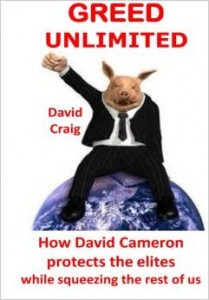
In my new book GREED UNLIMITED there’s a chapter called Is the NHS clinically obese? This argues that the NHS’s real problems have little to do with a lack of resources – financial or human – and have everything to do with political blundering and managerial incompetence.
I hope this helps throw some light onto the furious and biased arguments that we’ll all be exposed to by the media, politicians and self-proclaimed “experts” over the coming months and years.
By David Craig, on May 13th, 2013 Yesterday’s blog was fairly long, so I’ll keep it short today.
Just before the May 2013 council elections, our great leader David “Tony Blair” Cameron hinted that he might possibly maybe conceivably consider bringing in legislation before the 2015 General Election about a referendum on EU membership at some vague point in the future, often referred to by the Spanish as “manyana”. This was a pathetic attempt (just like parading Kenneth Clarke’s insults of UKIP supporters) to try to reduce UKIP’s vote. Sadly for David “Tony Blair” Cameron , this didn’t work. Then, just days later, Cameron said he couldn’t do anything about an EU referendum because of LibDem opposition. Pity he didn’t think of that when making his claims of a few days earlier.
However, David “Tony Blair” Cameron still has a clear message for us all: “if we want an referendum on the EU, then we should vote Conservative in the 2015 General Election”
There’s only one small problem. Here’s a short (1 min 14 secs) but absolutely damning YouTube video of a Conservative Party election broadcast just before the 2009 EU elections. In it, the leader of the Conservative Party, a certain David “Tony Blair” Cameron, explains why we absolutely need a referendum on our EU membership and tells us that if we want a referendum, we should vote Conservative in the 2009 EU elections:
https://www.youtube.com/watch?v=sQ2n7oMcSi0&feature=youtu.be
Was he lying to us then? Is he lying to us now? I don’t know. Enjoy the video!
And will he be making the same promise just before the 2020 General Election? No! Because by that time he’ll have lost his job as leader of the Tories, have retired from politics and will be earning a fortune (he hopes) working for one of the banks, hedge funds or the Big Four accountancies his government has allowed to avoid taxes for so many years.
Meanwhile, in that rotten hell-hole, our enemy Osama-Bin-Laden-protecting Pakistan, one bunch of venal, thieving, corrupt scum win an election against another bunch of venal, thieving, corrupt scum. Plus ca change.
By David Craig, on May 12th, 2013 A few months ago, the media were full of “shock horror” reports of Cypriots (and others) with more than €100,000 in Cyprus’ banks having over half their money confiscated to bail out the bankrupt country. And journalists and economists and other supposed “experts” were wittering on about whether such a thing could happen in Britain.
Well, it already has and is still happening. In fact, more British people have lost more money than most of those with money in Cyprus. The difference is that in Cyprus the appropriation of people’s money to save the bankrupt country from bankruptcy happened over just a few days, whereas in Britain, the process has been more insidious and has been happening over 6 years and will continue for several more years.
Britain is to all intents and purposes bankrupt. Our national debt was £700bn in 2010, is £1.15trn now and will be £1.4trn by the 2015 election. We can’t pay that money back. Moreover, our main banks are virtually bankrupt. They are exposed to $1.05trn of Eurozone countries’ debt, over half of this to countries (Spain, Italy, Greece, France) that are virtually bankrupt. Furthermore, many mortgage-payers are struggling to pay off their loans. If interest rates went up, house prices would fall, repossessions would rise and that would put further pressure on lenders. But the government no longer has enough money to bail out another failing bank.
So, to keep the whole house of cards from collapsing, the government is using a policy of what is called “financial repression”. That (not always accurate) fount of all knowledge Wikipedia defines “financial repression” as follows: “Financial repression is any of the measures that governments employ to channel funds to themselves, that, in a deregulated market, would go elsewhere. Financial repression can be particularly effective at liquidating debt”
Here are just some of the ways financial repression impoverishes us all:
1. By keeping interest rates artificially low (0.5%), the government lowers the interest it pays on its own debt thus avoiding bankruptcy. But it also means the £4trn we have in savings is losing money after taking account of inflation. In fact, if our £4trn is losing say 2% a year, that’s an incredible £80bn a year of our money that is evaporating without most people noticing this is happening because we still have our £4trn. The problem is that each year it buys £80bn less than it did the year before.
2. Low interest rates mean that the 200,000 or so people buying an annuity each year every year are getting paltry pensions – about half of what they would have got just before the financial crash. If the average pensioner is losing say just £3,000 a year compared to what they would have got in 2007, then that’s another £600m a year that is disappearing
3. Low interest rates and government overspending have trashed the value of the pound. It’s only gone down by about 10% against the euro and the US dollar since 2007. But against “real” currencies – Australian dollar, New Zealand dollar, Norwegian krone, Thai baht – the pound has lost about 40% of its value (see chart – AUSD/£)

The fall in the pound’s value supposedly helps boost exports by making British goods and services cheaper. But it also conveniently cuts the real value of the Government’s massive and unsustainable debt
4. By allowing inflation to comfortably exceed the joke target of 2%, the government further erodes the value of its own debt thus helping stave off national bankruptcy. Inflation of 3% a year reduces the real value of government debt by about £35bn a year
The genius of “financial repression” is that it saves overspending, underperforming governments from bankruptcy while impoverishing their citizens, without their citizens being aware of what is happening.
By David Craig, on May 11th, 2013 1. It has always been the intention to create a single super-state ruled by Brussels:
“The signatory states are determined to lay the foundations of an ever closer union among the peoples of Europe” Treaty of Rome 1957
“The process of Union is like the Rhine flowing into the sea. Anyone who stands in its way is crushed” Helmut Kohl 1994
“The creation of a single European state bound by one European constitution is the decisive task of our time” Joschka Fischer, German Foreign Minister 1998
2. Our masters have always known we would not accept their plans and that they would have to lie to us:
“Europe’s nations should be guided towards the super-state without their people understanding what is happening. This can be accomplished by successive steps each disguised as having an economic purpose, but which will eventually and irreversibly lead to federation” Jean Monnet 1952
“We are working discreetly …….. and all the time we are denying with our lips what we are doing with our hands” Arnold Toynbee – Historical researcher and founding father of the EU
“No government dependent upon a democratic vote could possibly agree in advance to the sacrifice that any adequate plan (to build the EU) must involve. The British People must be led slowly and unconsciously into an abandonment of their traditional economic defences, not asked” Peter Thorneycroft (later Lord and Chairman of the Conservative Party) 1947
3. Outsiders have been amazed at how we are giving up our freedom:
“The most puzzling development in politics during the last decade is the apparent determination of Western European leaders to re-create the Soviet Union in Western Europe” Mikhail Gorbachev
“How can you let a country with a great history for 20 generations, disappear as a province of a bureaucratic Euro-State run by Helmut Kohl? I don’t understand what is wrong with you!” Pat Buchanan (American Presidential Candidate) 1996
4. The future – some told us the truth:
“Here in Brussels, a true European government has been born. I have governmental powers. I have executive powers for which there is no other name in the world, whether you like it or not, than government” Romano Prodi EU Commission President
“The future will belong to the Germans….when we build the House of Europe. In the next 2 years we will make the process of European integration irreversible. This is a really big battle, but it is worth the fight” Helmut Kohl 1996
“Germany as the biggest and most powerful economic member state, will be the leader, whether we like it or not” Theo Waigel
5. Others have lied
“There are some in this country who fear that in going into Europe, we shall in some way sacrifice independence and sovereignty. These fears I need hardly say are completely unjustified” Edward Heath 1971
“We’ll negotiate withdrawal from the EEC which has drained our natural resources and destroyed jobs” Tony Blair 1982
“If there are further steps to European integration, the people should have their say at a general election or in a referendum” Tony Blair 1997
“Our policy has not changed and if there is any question of it changing we will tell you” Tony Blair April 2003
“I see no case for having a referendum on the new EU Constitution. We don’t govern this country by referendum” Tony Blair May 2003
“If you want a referendum on the EU, then vote Conservative” David Cameron 2009
By David Craig, on May 10th, 2013 Here are the latest salaries for the chief executives running bits of London:

Yup, there are a lot of them and they seem to be rather well-paid for their “public service”.
I’ve managed to find an amazing 408 chief executives in local authorities across the UK all earning similar amounts to this bunch (though there are probably a few more that I didn’t pick up on as I almost gave up in despair at this profligacy with our money).
Moreover, there are over 2,300 people in local government earning more than £100,000 a year. They cost us over £320,000,000 a year in salaries – an average salary of £139,000. As most will retire on inflation-protected pensions of about £100,000 a year (a pension pot of around £3,000,000), their pensions will cost us about £7bn.
These well-paid worthies include such non-jobs as: Bracknell Forest’s Director of Environment, Culture and Communities – £135,300 (culture in Bracknell Forest?): Bradford’s Strategic Director of Culture, Tourism and Sport – £140,000 (tourism in Bradford?): Enfield’s Director of Environment and Streetscene – £144,000 and in Thurrock (wherever that is) there’s a Director of Community Wellbeing (£145,000) and also a Director of Sustainable Communities (£142,000). (These are 2010 salaries, so they’ve probably gone up a bit since then)
Moreover, since New Labour were elected in 1997, the number of people working for councils earning over £50,000 a year went up by a factor of more than 12 times from 3,300 to over 40,000. Yet in the private sector, the number earning over £50,000 went up by only a factor of 3 times.
So, please don’t let anyone ever tell you that our council taxes need to go up to keep on providing services. Our councils have loads of money (our money). Unfortunately, they choose to spend it on inflated salaries and pensions for their staff rather than on services.
We are getting shafted by our overpaid, overpensioned council factcats and there’s nothing we can do about it.
By David Craig, on May 9th, 2013 Q “What’s a Greek urn?”
A ” Nothing, because he hasn’t got a job.”
Sorry for being so childish
By David Craig, on May 9th, 2013 In a new report on corruption around the world, 3,459 company board members in 36 countries worldwide, including 20 EU member states, were interviewed.
Around 90% of people in Croatia, which is due to join the EU on 1 July 2013, said “bribery/corrupt practices happen widely in business in this country.” The figure was 96% in Slovenia – which joined the EU in 2004 and which adopted the euro in 2007 – higher even than Kenya, on 94%. Greece and Slovakia came next on 84%, followed by the Czech Republic (73%), Portugal (72%), Hungary (70%), Spain (65%), Romania (61%) and Italy (60%).
Or there is another source of data on corruption – the Transparency International Corruption Perceptions Index https://www.transparency.org/cpi2012/results This rates 174 countries on their levels of corruption where 1 is the least corrupt country and 174 is the most corrupt.
According to this, Greece (at 94) is as corrupt as the moral cesspit India. Bulgaria (75) and Italy (72) are as corrupt as the stinkingly rotten Liberia. Romania (66) is as corrupt as that joke of a country Saudi Arabia and the putrid Brazil. Croatia (62=) and Slovakia (62=) are as venal as Ghana. The Czech Republic (54) is as bent as countries like Rwanda and Georgia. And Portugal (33) and Spain (30) are as tainted as Estonia and Botswana.
Thankfully, Denmark, Sweden, Germany, Finland, the Netherlands and the UK are amongst the least corrupt.
But the problem is that the least corrupt EU countries are those which are net contributors (they pay in more than they get out) while the most corrupt countries are net gainers (they take out more than they pay in). When many of the members of the “EU Club” are so institutionally corrupt, it’s hardly surprising that they continually vote to increase EU spending. After all, the more money that we “clean” countries pay in, the more money their rotten politicians, bureaucrats, business bosses and criminals can steal.
(btw I’d much rather people bought a few copies of my latest book GREED UNLIMITED than me having to throw them away as they’re blocking the door into my office at home and my wife keeps asking why I’ve sold so few)
By David Craig, on May 8th, 2013 Today, British savers with money in unit trusts, bank accounts, investments and pensions will hand over about £411m of their money to financial services insiders – salespeople, advisers, brokers and fund managers. That’s around £1m every minute. Then we’ll do the same tomorrow – another £411m – and the day after and the day after. The result – the people who have got hold of our money have much bigger houses, more luxurious holidays, fancier cars and a much better lifestyle than the rest of us. Are we mad? Or just financially illiterate?

We’ve put at least £60bn into what are called “structured products”, usually sold by the main high-street banks. These promise say 100% or 120% of any stockmarket growth over 5 or 6 years and guarantee to return all our money if the market falls a bit. When selling this financial garbage, the banks usually fail to mention that 80% to 90% of the benefits from buying shares comes from the yearly dividends paid, not from rising share prices. And these products don’t give savers any of the dividends.
We’ve got about £550bn in unit trusts. These will claim that their management charges are, for example, 1.3% or 1.4%. They may even admit that their Total Expense Ratio (TER) is 1.75% or 1.8%. But once you take account of the initial charge, the 5% difference between the price you buy units and the price you sell them and various dealing costs, you’re paying nearer 3.5% or more. If you hold your units for 5 years, you’re giving 17.5% to the fund manager. If you hold for 10 years, that’s 35% of your savings going into someone else’s pocket. Of course, you believe your fund manager will make your savings grow. But 80% of unit trust managers underperform the market – you’d have been better just buying the shares in 5 to 10 FTSE100 or European big companies directly yourself – Shell, GSK, Novartis, Roche, Unilever, Siemens etc.
And then there are SIPPs. Many people are choosing to save in a SIPP rather than an expensive old-fashioned pension with its rip-off fees. But then these SIPPs savers are putting their savings into funds where they’re getting charged about 3.5% a year. So they’re paying both the SIPPs fees (maybe 0.5% a year) and the fund fees – total 4% a year. The average growth of most funds is about 1.5% a year. So these SIPPs savers are losing 2.5% a year. Lose 2.5% a year over 20 years saving for your pension and you’ve given someone else 50% of your money. Save for 30 years …..Aaarrgggghh.
Come on people, stop letting greedy, poorly performing financial services spivs siphon off your savings.
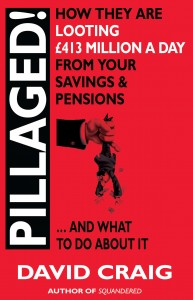
(I don’t mean to push my own books, but if you splashed out about six quid on my book PILLAGED, you’d probably save yourself several thousand pounds)
(btw, I do a talk called THE GREAT SAVINGS AND PENSIONS SCAM – and how to protect your money. I believe anyone attending will be able to save themselves and their family somewhere between £5,000 and £50,000. If any reader is a member of a club or some other group that might be interested in me giving this talk plus Q&A session, please get in touch)
|
|