|
|
By  David Craig, on January 21st, 2014 There’s a website called www.religionofpeace.com I can’t verify whether what the website publishes is true and unbiased. I rather suspect the site is quite biased. However, if their information is mostly correct, then it seems there’s a minor religious war going on that our mainstream press seems uninterested in mentioning and our cowardly leaders prefer to avoid discussing.
The Religion of Peace website claims to keep a running score on religious killings. The total for 2013 was:
Jihad attacks: 2801 (in 51 countries)
Dead: 16,710
Critically injured: 29,432
Just for the week of January 11 to 17 this year, the score was:
Jihad attacks: 48
Dead: 365
Critically injured: 629
For some really shocking information, there’s a page on the website devoted to apparent attempts to exterminate Christians in mainly Muslim countries https://www.thereligionofpeace.com/Pages/ChristianAttacks.htm Again, I have no idea how accurate these stories and figures are. But if even half of them are true, then there is a catastrophe going on.
So, what are our politicians and opinion leaders doing about the extermination of Christians? Nothing. Absolutely nothing. Yet when probably the greatest leader in the world today, Vladimir Putin, suggests that homosexuality shouldn’t be encouraged by adults amongst children in Russia, there’s total outrage from the media, the Guardianistas at the BBC and the luvvies, especially big-mouthed, corpulent blubber-mountain Stephen Fry.
We should hang our heads in shame that political correctness prevents us even mentioning the slaughter of Christians by followers of the Religion of Peace, yet even the slightest possibly derogatory comment on Mandelsonians results in total uproar in the media and from “opinion leaders”.
By David Craig, on January 20th, 2014 I’ve already written about the ludicrously large number of charities in Britain www.snouts-in-the-trough.com/archives/5980
Just in England and Wales there are an almost unbelievable 180,000 charities. Many of these will just be tax avoidance schemes which the useless overpaid, over-pensioned bureaucrats at the Charity Commission allow to continue as the more “charities” there are, the more people the useless Charity Commission will need to employ to monitor these “charities.
But many of these charities are real and they employ a staggering 874,829 people. Charities in England and Wales raise and spend about £58.65bn a year. Of this, around £51.94bn (88%) is used for what the Charity Commission (the regulator for charities in England and Wales) classes as “charitable expenditure”.

The average cost of these people (including salaries, NI contributions, and pension payments) is a modest £25,000 a year (The average employee cost at the BBC’s Children in Need “charity”, in comparison, is an attractive £43,368). This would mean that £22bn of the £58.65bn we give to charities is spent on staff costs.
Some these staff may be doing charitable things like caring for children, answering helplines or conducting cancer research. But many of them will just be administrators, managers on high 5-figure salaries and executives on comfortable 6-figure salaries.
Hopefully you’ve all seen the newspaper stories about the goings on at a charity called the Halo Trust. It seems that the “charity”, whose trustees include the actress Angelina Jolie, has sanctioned the payment of tens of thousands of pounds a year for more than a decade to fund the private education of chief executive Guy Willoughby’s four children.
Mr Willoughby, who founded the mine clearance charity, receives a financial package worth between £210,000 and £220,000 a year, according to the most recent accounts. The package includes the cost of sending his children to some of Britain’s most expensive private schools.

Assuming that the schools cost about £28,000 a year and that the fees will be paid for 8 years per child, Mr Willoughby’s school fees will have eaten up about £896,000 of donors’ money.
Mr Willoughby, 53, a former soldier and jockey, co-founded Halo in 1988 and has seen it grow into one of the UK’s biggest charities. Last year the charity, whose headquarters are in Scotland, had income of more than £26m, including £4m of taxpayers’ money from the Department for International Development.
Mr Willoughby defended the charity’s decision to pay his children’s school fees, pointing out that the Foreign Office and the Ministry of Defence paid for the private education of children whose parents had been posted overseas. Mr Willoughby said that, although he and his wife, Fiona, were based in Scotland, he travelled overseas for work, often to dangerous locations. However, on her personal website, his wife reportedly wrote: “We started a family, so during the next 15 years I rarely travelled while bringing up our four children.” Whoops.
Incredibly, the Charity Commission allows charities to include staff costs under “charitable expenditure”. Perhaps it’s because doing this makes it look like most of our donations are being used for charity, when this is clearly not the case. So the £896,000 or so of this gentleman’s four children’s school fees will all be classed as “charitable expenditure”. Well they certainly were charitable – to the charity’s boss!
So, wanna get rich quick? Start a charity.
By David Craig, on January 19th, 2014 The FTSE100 Index was launched in January 1984 at a base level of 1,000. It replaced the previous main measure of UK shares – the FTSE30. You may not hold shares directly, you may not even have any of your savings in things like unit trusts, investment trusts or ETFs (Exchange Traded Funds). But if you’re saving for a pension (and don’t inhabit the pension paradise of having a final-salary pension) then a large part of your money will be in FTSE100 shares. So, how well the FTSE100 performs matters to most people.
How well has the FTSE100 done? Well this graph tells you everything you need to know, doesn’t it? (click on chart to see more clearly)
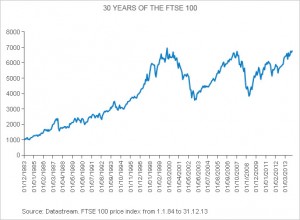
There were two gut-wrenching, bowel-bursting collapses – in 2000 and 2008. But still, over its 30-year life, the FTSE has gone from 1,000 to over 6,600. So any money in shares in 1984 would have increased by a factor of 6 times. Yippeee! We’re all rich and will have financially secure retirements. What? We’re not all rich? How can that be?
The answer, of course, is inflation. The daily number giving the level of the FTSE100 (and all other stock indices like the FTSE250, the Dow Jones, the CAC) is a nominal value – it’s not adjusted for inflation.
Here’s how the FTSE100 looks when adjusted for inflation. The blue line is the nominal value, the red line is adjusted for inflation.

It still doesn’t look too bad. Though the real purchasing power of money in shares would have doubled over the 30 years and sadly not gone up by a factor of six.
But let’s look more closely. One investment specialist, Fidelity (who make their money from encouraging us to invest in shares and unit trusts) described the situation ever so elegantly, “Over its 30 year life, the performance of the FTSE 100 Index can be split into two very different periods with strong gains over the first 17 years not destined to be repeated in the 13 years that were to follow.” I love the words “not destined to be repeated in the 13 years that were to follow”. In fact, the real value of the FTSE has plummeted in the last 13 years. (Oddly, over the same period, despite their shares losing about 30% of the real value, the total remuneration of FTSE100 executives has shot up from an average of about £1,000,000 a year to about £4,000,000 a year.)
The good folk at Fidelity also wrote “the past year has seen the FTSE 100 Index move tantalisingly close to its record high of 14 years ago.” While this is literally true, it’s also highly misleading as inflation has reduced the purchasing power of our money by over 30% during the last 14 years. So the FTSE100 would actually have to hit about 9000 (and that’s not going to happen) to really reach the level it was at in purchasing power 14 years ago.
The baby-boomer effect?
What I believe is happening is something no investment specialist, financial adviser or financial journalist would ever mention. If they mentioned it, they’d be out of a job. Fast! Because nobody would want to invest in shares any more.
What I think happened was that from 1984 till 2000 the baby-boomers (those born between 1945 and 1965) were at their maximum earnings and saving potential and were shoving money into shares either directly or through unit trusts and pensions. But as the baby-boomers move towards retirement, they start selling their shares to generate money to live off and as they buy annuities, their pension savings get taken out of shares and put into bonds. And the next generation, Generation Debt, burdened with massive mortgages due to ludicrously high house prices and student loans to be repaid, won’t be able to save as much as their parents. So, demand for shares is falling and their value will also fall for many years to come.
The US Government Accounting Office did a study estimating how much of baby-boomers’ money would be withdrawn from shares over the next 10 to 20 years and concluded that there was no need for investors to panic. A government department telling you not to panic is a bit like the captain of the Costa Concordia telling you to enjoy your dinner while he grabs his East European mistress and heads for the nearest lifeboat.
By David Craig, on January 18th, 2014 My thanks to a reader for pointing out yet more obvious reasons why Global Warming or Climate Change or whatever it’s called his week is a scam – “If the Sun was a goldfish bowl and the Earth a marble, the Earth would fit inside the Sun 1.3 million times. So we are a stone’s throw away from a heat source that is 1.3 million times the size of us but somehow we are expected to believe that “warming” is nothing to do with the Sun but man-made?”
“If you take the whole solar system, the Sun accounts for 99.86% of all the mass. So that means the rest of the planets and asteroids only weigh 0.14%. Of the remaining 0.14%, Jupiter, Saturn, Uranus and Neptune account for 99% of the 0.14%!”
“Who do you believe? Lying politicians and bogus government-funded “climate change” scientists or your own eyes?”
A scale picture of the solar system with accurate sizes
https://upload.wikimedia.org/wikipedia/commons/8/82/Solar-system.png

This is a picture of the Solar System. It’s not possible to show accurate distances as the Sun’s diameter is about 1,391,000 km and it is 147,000,000 km away from the Earth – so you’d need an awfully long picture (about 100 computer screens) if you were to show both the Sun and the Earth to scale on the same picture. The Sun is quite hot (15,000,000 degrees Celsius at the centre) and even though it’s rather far away, it only takes about 8 minutes and 19 seconds for heat from the Sun to reach the Earth.
It therefore seems beyond incredible that the Warmists totally dismiss any suggestion that variations in the Sun’s activity could have an effect on global temperatures and instead blame human activities – power stations, cars and cow farts.
Oh, and here’s a link provided by a reader to an article in the Spectator about the Ship of Fools – the idiot climatologists who tried to sail to the Antarctic to prove the ice was melting and had to call in environmentally-damaging helicopters to save them when their ship and a rescue ship both got caught in the ice that shouldn’t (according to their computer models) have been there www.spectator.co.uk/features/9112201/ship-of-fools-2
And solar scientists (not leftist, climate change fantasists) believe we may be heading for a mini ice age www.dailymail.co.uk/sciencetech/article-2541599/Is-mini-ice-age-way-Scientists-warn-Sun-gone-sleep-say-cause-temperatures-plunge.html#ixzz2qjkjFQL7 But over 600 or our 650 useless, expenses-thieving MPs backed Ed Miliband’s ludicrous 2008 Climate Change Act. So, even if Hell freezes over, our incompetent leaders will still claim we need to pay more taxes and have more wind farms to counteract Global Warming.
By David Craig, on January 17th, 2014 First you get a few junior management consultants with egos that are much greater than their knowledge or abilities:

Then you add in a consultancy partner/director who could sell sand in the Sahara:

Then you sell the client a reasonably-sized consulting project which might “only” cost the client say £1,300,000, but would ONLY cost the consultancy about £240,500

Of course, the consultancy has other costs like its offices and other administration. But even if you assume that for this project, the overhead expenses are £100,000, the consultancy is still making a profit of just under a million pounds on a project costing £1.3m. And, as most consultancies operate an “eat what you kill” bonus scheme, a goodly proportion of that profit will go straight into the pockets of the director/partner who sold that project.
But the fun has only just started. A first project with a client is usually only a “foot in the door”. Once you get into a client’s organisation, you can start finding all sorts of other things that need to be fixed and keep on selling more and more projects. And if you’re lucky, you can get the really big prize – convincing the client they need a massive (and massively expensive) new computer system with lots of bells and whistles and flashing lights and things that go “buzz” and “beep”.
With a private-sector company you can easily be talking about another £5m to £10m for a new computer system. With a government department full of useless overpaid, over-pensioned civil servants spending/wasting taxpayers’ money you’ll be looking at hundreds of millions of pounds and, in the case of our hopelessly mismanaged NHS, about £6bn. Oh, and at the end of the day, the computer system probably won’t work and will have to be scrapped – but the consultancy still gets its money.
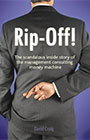
I revealed all this and much more in my 2005 book RIP-OFF The scandalous inside story of the consulting money machine and since then (to my amazement and disappointment) the management and IT systems industry has grown enormously – managers of large organisations have learnt nothing and consultants continue to be much richer than their clients
By David Craig, on January 15th, 2014 After writing about the EU for two days, I was going to change the subject today. But then a reader kindly sent me these photos of the European Parliament “hard at work”.
Here are a few photos showing our busy MEPs (click on pictures to see more clearly)

And here are a few more:

And these three MEPs look like they had a tough night in Brussels’ bars and restaurants (and brothels?) all at our expense:

Just more evidence that we ned to get out of this corrupt, worthless socialist nightmare. More evidence we all need to vote UKIP at every opportunity.
Title for my next book
Many thanks to those readers who sent in suggestions for the title for my next book. It looks like the winner is going to be the delightfully short and blindingly obvious DON’T BUY IT! It cost me £100 as I was too stupid to think of this myself.
By David Craig, on January 15th, 2014 When I worked selling management consultancy projects, we were very careful about the words we used with our clients. We would class key words into three main groups – power-selling words, neutral words and sales suffocators. For example, when flogging a million-pound project, we tended to avoid the neutral word “project” and would instead call what we were selling an “improvement plan” or even better a “transformation programme”.
Or, another example, when writing the blurb for one of my books, a publisher wrote that the book “examines” how the Government wasted trillions. But “examines” is a dead word. It’s lifeless. It makes the book sound like an academic study. It’s a sales suffocator. Much better to use something like “reveals” or “exposes” or even “lays bare” – those are power-selling words.

Similarly, our masters (politicians and journalists) abuse language to subtly (and often unsubtly) manipulate our opinions. A prime example is when they refer to the EU as a “club”. The word “club” is a bit like a power-selling word. It suggests warmth, belonging, meeting people with similar interests, friendship and equality.
Moreover, by referring to the EU as a “club”, our masters can make statements like “all members of a club should follow the same rules” and “you can’t have separate rules for one member“. These statements sound eminently reasonable – or would do if the EU was really a “club”. But the EU is most definitely NOT a “club” for several reasons:
1. It’s an attempt to build a socialist superstate – a club (usually) doesn’t increasingly encroach upon our freedoms, continually imposing new rules and grabbing ever more power for itself.
2. It doesn’t act in members’ interests – a club usually benefits all its members. The EU isn’t about what’s good for the UK taxpayer or what benefits Britain, it’s about the professional civil servants and politicians as it gives them the chance of perpetual gravy, of a life of luxury and power without the need to pander to local voters – it is nirvana for the governing classes and their public servant colleagues and they will all fight tooth and nail to grow it and protect it through any means they can
3. The parasites outnumber those who pay – in a club, most members pay the same for membership. In the EU, there are about 10 countries who pay in more than they take out and around 18 countries who take out much more than they put in. So, as every country has equal voting status, the majority – the parasites, freeloaders, passengers – will always vote for more taxes and more spending as that means more money for them
4. It’s undemocratic – in a club, you can usually elect the governing committee each year. But not in the EU. The people who rule the EU are the unelected commissioners (komissars?) who are appointed and then seem to cling onto their jobs for many years massively enriching themselves and accumulating ever more power for themselves and their cronies.
5. You can decide to leave a club – would the EU ever let Britain leave? It’s certain that if there were a referendum in the UK, the EU would pour many millions into a propaganda campaign to help the Europhiliacs. Moreover, the EU will make a series of threats like cutting off trade to Britain, refusing to cooperate with Britain on things like crime and defence and causing massive job losses in Britain. When you try to leave a club, the board or committee don’t usually spend members’ money attacking you and begin threatening you and trying to destroy your friendships and your life.
The EU is NOT a “club”. Please don’t get taken in by our weasel-worded, deceitful, lying, self-serving masters such as the (IMHO) utterly loathsome, recidivist, europhiliac liars like Peter Mandelson, Nick Clegg, Ed Miliband, Kenneth Clark, Neil Kinnock and those of their ilk.
(click on title to leave a comment or to see comments)
By David Craig, on January 14th, 2014  There has been much heat and noise about the supposed EU Referendum that honest, trustworthy, reliable David Cameron (shouldn’t that be “slippery, lying, vacuous?” Ed) has promised for 2017, two years after he loses the 2015 General Election. There has been much heat and noise about the supposed EU Referendum that honest, trustworthy, reliable David Cameron (shouldn’t that be “slippery, lying, vacuous?” Ed) has promised for 2017, two years after he loses the 2015 General Election.
I think most people know we won’t ever get an EU Referendum. Already the europhiliacs in the Lords, like Peter Mandelscum, are plotting how to defeat Cameron’s EU Referendum bill as Mandelscum seems to believe the British public shouldn’t be allowed to vote on such an important issue. Moreover, Barroso’s bitch Nick Clegg and the believer in giant socialist superstates Ed MIliband are totally against allowing a referendum, in spite of Clegg claiming to support a referendum in a LibDem ad campaign before the 2010 General Election.

But were we to have an EU Referendum, what question should we be asked to vote on? The question our masters would choose to ask us would probably be something like “Do you want Britain to remain in the European Union?” That’s pretty innocuous. It looks fair. And the result will, sadly for Britain, probably be a win for the status quo – staying in the EU. After all, most people tend to prefer the certainty of maintaining the current situation to the risk of major change.
However, we can thank the vice president of the European Commission, Viviane Reding (who probably expects to take over when Barroso steps down in October)for telling us the question the EU Referendum should be asking. In a recent speech, Ms Reding (a politician from the Lilliputian state of Luxembourg) made her position very clear: “We need to build a United States of Europe with the Commission as government and two chambers – the European Parliament and a “Senate” of Member States.”
Mrs Reding’s vision, which is shared by many in the European institutions, would transform the EU into superstate relegating national governments and parliaments to a minor political role equivalent to that played by local councils in Britain. Under her plan, the commission would have supremacy over governments and MEPs in the European Parliament would supersede the sovereignty of MPs in the House of Commons.

So the question we should be asked is actually: “Do you want Britain to continue to exist as an independent country?”
If we were asked that question, there would be a massive vote to get out of the corrupt, wasteful EU as fast as possible.
We will not get an EU Referendum from the ConLibLab ruling elite. So, what we are really voting on in every election – council, EU, General Election – is not the economy. After all, Labour doubled our national debt from £350bn to £700bn and then the useless, financially-incontinent Coalition will have doubled it again from £700bn to £1.4trn by 2015. That suggests there’s not much difference between the economic policies/incompetence (delete as appropriate) of any of the three major parties.
What we are voting on in every election is in fact the massively important “Do you want Britain to continue to exist as an independent country”. And that’s why we should vote UKIP at every opportunity.
By David Craig, on January 13th, 2014 I have a new book coming out in about 4 weeks. It exposes more than 100 tricks and traps that people like estate agents, car salespeople, financial services, marketers, on-liners, cold-callers and many others use to sell things to us and it also examines the psychological processes sellers use to convince us to buy what they are selling.
My publisher has just contacted me and said he thinks the title should be improved.
The original title was “WOULD YOU BUY THAT?”
The subtitle was “101 tricks and traps people use to sell to us….and how to avoid being taken in by them”
But my publisher didn’t like that. So I changed the title to the hopefully catchier one word title “SELL-OLOGY”
The subtitle then became “How people sell to us….and how to avoid being taken in by them”
I thought that was quite good. And I thought my publisher liked it. But suddenly that doesn’t seem to be the case.
Whoops! So, if any reader has any better ideas for a title (and perhaps subtitle) please click on the title of this post and leave your ideas as a comment or else email me at david.craig54@yahoo.co.uk
What can I offer you? How about £100 paid to the charity of your choice? And, if you wish, a mention in the introduction?
The tricky part with the title and subtitle is that they have to make clear that this is a book that exposes sellers’ tricks – there are hundreds of books explaining how to sell, but none exposing how we are sold to. The title and subtitle must make it clear that this is NOT a book teaching people how to sell (like the hundreds already available) but a book helping people against those who are trying to sell to them.
By David Craig, on January 12th, 2014 I’ve written about this before, but yesterday I learnt a bit more about how the jet ski rental scam works https://www.youtube.com/watch?v=zsPuoaktoAw
I was down at the main beach shooting the breeze with a couple of expats and in just a couple of hours we saw three groups of tourists lose a considerable amount of money when they were caught by the jet ski scam. Here’s how it works:
1. Some tourists (usually young men) decide to have some fun out on the water by hiring some jet skis.
2. They ask the jet ski boys how much it costs to rent a few jet skis. They are quoted a ridiculously high price and then manage to “negotiate” this down. Pleased with themselves, they take their jet skis and off they go whooping and yelling with excitement. The jet ski boys don’t mind dropping their prices as they know the big money will be made later.
3. Tourists come back to the beach and hand back their jet skis. The jet ski boys drive the jet skis up onto the beach and “notice” a lot of scratches and dents on the underside of the jet ski. Or there may also be some trimming which has broken off.

4. The jet ski boys point out the “damage” to the tourists and demand they pay for repairs. Typically they will ask for up to 100,000 baht (£2,000 – a huge amount of money here where the cost of living is about a fifth of that in the West and a monthly wage may be less than £400 per month)
5. While the tourists argue with the jet ski boys about the damage, one of the jet ski boys calls one of his friends in the police. Although you hardly ever see a policeman here, two large, extremely well-fed policemen mysteriously appear
6. Seeing the police, the tourists are relieved and believe the police will help them out of their trouble with the jet ski boys. And sure enough (as part of the charade) the police seem to be sympathetic to the tourists and they suggest that 50,000 baht (£1,000) would be quite enough to pay for the “damage”. (The police, of course, get a healthy cut of money extorted from the tourists)
7. At this point, many tourists will agree to pay and one of the young men will be forced to stay on the beach with the jet ski boys while his friend(s) go off to get the money. Or else, if the tourist is alone, he’ll be marched to the nearest ATM by a couple of jet ski boys to get the cash. I once saw a tourist try to escape the scam by running away, but with jet ski boys all along the beach, he was quickly caught and relieved of his money
8. If the tourists still refuse to pay, things can get quite nasty. They may be taken to the police station where they’ll waste hours waiting and filling in forms and being interviewed until they realise that the whole thing is futile and the only way they can get away is by paying up. Some tourists even get their passports confiscated and held till they hand over the money.
There seem to be two main versions of the scam:
The basic model – here the jet ski is in the water when the tourist rents it and so the tourist can’t see if there is any damage to the underside. But when he returns the jet ski and it’s driven up onto the beach, the damage can be seen
The advanced model – according to the expats I was talking with, there’s another version where the jet ski boys paint over all the scratches and marks with a water-based paint. Then when the jet ski is taken out, the water-based paint starts to come off revealing all the damage which was already there. Or else if some trimming is breaking off the jet ski boys glue it back on knowing it will soon break off as the jet skis crash through the waves at high speed.
So, next time you take a beach holiday and are tempted to hire a jet ski, please remember the jet ski scam – it might save you a lot of money.
|
|