Readers might be amused to learn that I have been censored for spreading “misinformation”. I posted part of my weekend blog questioning the need to vaccinate babies against the Chinese lab-leaked plague on a business networking site called “LinkedIn”.
Within an hour, my article was deleted by the LinkedIn thought-controllers and I got the following message:
“Your article doesn’t comply with our policies. Your article goes against our policy on misinformation. It has been removed.
Thank you for being part of the LinkedIn community
A time of fasting, prayer, reflection and community?
According to that not always reliable source of knowledge, Wikipedia, Ramadan (which ended on Sunday 1 May) is observed by Muslims worldwide as a month of fasting (sawm), prayer, reflection and community. Wikipedia doesn’t mention one other feature of this great festival – a tendency for the adherents of our favourite religion to murder each other and us.
I’m sure many readers are avid sports fans and so will be gasping to hear the final score for the 2022 Ramadana-ding-dong murdermania.
Here it is:
As you’ll see, the score for 2022 was pretty disappointing compared to 2021:
But 2022 was a lot better than 2020:
and 2019
and 2018:
However, during the years 2017 and 2016, the lads did really well:
I guess that was because during 2016 and 2017, the team from ISIS/ISIL really upped their scoring rate:
I doubt you’ll see these results reported in the sports sections of any of our mainstream media.
For the moment, things are comparatively quiet concerning religious murder and mayhem. But we’re already seeing an increase in scores by the ISIS/ISIL lads in Afghanistan as one group of bearded, sandal-wearing crazies (ISIS/ISIL) tries to murder another group of bearded, sandal-wearing crazies (the Taliban). Moreover, we can expect a massive resurgence of ISIS/ISIL activity in Africa over the next few years. So the Ramadan score should begin to rise again to wonderful 2016 and 2017 levels.
Are we any better?
For years we in the West have been able to distance ourselves from the murderous savagery in many Third-World countries. But given what is now happening in Ukraine, our civilisational and moral superiority seems to be evaporating.
First, a reader wrote that he couldn’t find any reference of the study of 1,305 children aged 5 to 11 which the European Medicines Agency (EMA) used as the basis approving giving the mRNA vaccine to children. So, here’s the link to the official EMA announcement which I quoted from in my blog:
This shows that my example was genuine. Unlike our lying politicians, lying supposed ‘scientists’, lying Big Pharma companies and lying media, I don’t make things up.
Now my weekend blog
Jabbermen are after our babies too
In my Thursday/Friday blog I questioned why the Covid Jabbermen were jabbing 5- to 11-year-olds. Then on Thursday afternoon this week, just after I had written my Thursday/Friday blog, Moderna announced that the company was asking the Federal Drug Administration (FDA) for Emergency Use Authorisation for their WuFlu supposed ‘vaccine’ on babies/children from 6 months old to 6 years old:
This is madness. Complete madness.
I then checked on the Pfizer vaccine. This has already been approved for 5- to 11-year-olds. Apparently Pfizer made a submission to the FDA in February for approval for use in babies/children from 6 months to 4 years old. I don’t know the current status of this submission.
Why are we vaccinating babies/children?
Obviously I’m no expert in anything useful. But I imagine there are three key questions which have to be addressed for any vaccine or supposed ‘vaccine’ to be used:
is the vaccine effective against some particular disease?
do the benefits of the vaccine outweigh the risks?
is the disease being vaccinated against widespread and hazardous to health?
Let’s try to briefly answer these three questions:
Is the vaccine effective against the Chinese lab-leaked plague?
From the little I understand, none of the vaccines actually reduce the likelihood of people being infected or infecting others. Ooops, that’s not so great.
All the vaccines do is reduce the risk of people needing hospitalisation when infected. They seem to have done this quite well during the first more dangerous variants of the Wuhan flu. But as new, less dangerous variants have become dominant, it appears questionable how useful the vaccines are. Moreover, we now know that the vaccines’ effectiveness declines after just a few months. Hence some people are on their fourth shot and a small group are even being offered a fifth shot.
Do the benefits of the vaccines outweigh the risks?
In the US they have the Vaccine Adverse Event Reporting System (VAERS) and in the UK we have the Yellow Card reporting system to the MHRA (Medicines and Healthcare Regulatory Agency). But what percent of adverse events actually get reported? To effectively report an adverse event in the UK you ideally need to see a GP. Good luck with that!
I know from personal experience that when I had a severe adverse reaction to the AstraZeneca jab – inflamed sciatic nerve which prevented me from being able to walk for over a week – the private GP I went to see dissuaded me from reporting this by claiming that nobody else had the same reaction. I later found out that my sister had precisely the same problem.
Here’s a link to the MHRA page about the latest Yellow Card reports:
It looks more like a PR release from the Big Pharma companies extolling how wonderful the miracle vaccines are rather than a serious scientific announcement. Moreover, it makes no attempt to differentiate the level of adverse events and the likelihood of vaccines being necessary by age group. It just claims that the benefits of the vaccines outweigh the risks even though we know that the Chinese plague is much more dangerous to older people so the risk/benefit ratio must be different for different age groups.
I have a feeling that the reporting process is so time-consuming and bureaucratic that most people don’t know how to report adverse events and most doctors can’t be bothered. Moreover, if you look at the MHRA page, I don’t think you’ll find any mention of the heart muscle inflammation (myocarditis and pericarditis) which has affected many athletes and killed almost 100 young, previously healthy athletes. Very odd!
Is the disease being vaccinated against widespread and hazardous to health?
We have a vaccine against rabies. If you’re travelling to some Third-World hell-hole, you might be advised to get a rabies shot. But we don’t vaccinate the whole population in the developed world against rabies as the number of cases is negligible.
From what I understand, the likelihood of children under say 11 years old suffering serious health problems from the Chinese lab-leaked plague are extremely small. From what little I understand, there is absolutely no healthcare justification for jabbing small children.
But look at all the antibodies!
It seems to me that our politicians, Big Pharma companies, joke ‘scientists’ and pig-ignorant media have approached the issue of vaccination from the wrong end. Big Pharma have developed some stuff which causes an increase in some kind of antibodies. Big Pharma then inject people with this stuff and shout excitedly “look at all the wonderful antibodies! Look at how effective our miracle vaccines are!” And the dumb-as-turds politicians and media swallow this nonsense.
The questions that should be asked are:
what is the risk of Covid causing harm?
is Covid so widespread and dangerous that we need to vaccinate people?
The answer to these questions is that we probably shouldn’t be vaccinating anybody under the age of 40 and probably not even anybody under the age of 50 except those with a serious medical condition which makes them vulnerable to respiratory infections.
More absurdity from our ludicrous rulers?
As media fury rages around whether a male/female/trans (IMHO) thingy/freak should be allowed to compete in women’s cycling, here to cheer us up is a male/female/trans (IMHO) thingy/freak explaining why it/ze should be allowed to compete in women’s swimming:
I’m afraid it’s jabs for kids again today because I believe this story is important.
I just wanted to do two things:
recap two issues from my Tuesday/Wednesday blog
look at a new assault on our kids by the jab-fanatics – Jabberman
Fooled by the vaccine fanatics? Yet again?
There are two issues which arise from my Tuesday/Wednesday blog:
Issue 1 – At what age should we be vaccinating?
In my Tuesday/Wednesday blog I questioned whether 3 vaccinated children aged between 5 and 11 catching the Chinese Wuhan plague compared to 16 unvaccinated children (out of 1,305 in a trial), really was a sufficiently large statistical sample to justify vaccinating tens of millions of EU children.
I suspect that our vaccine-obsessed rulers have painted themselves into a corner. Having bludgeoned us all into being vaccinated, often using mandates and other forms of coercion, they could hardly admit that the risks of vaccinating children aged 5 to 11 outweighed the benefits.
After all, if our rulers suggested that there was no point vaccinating 5- to 11-year-olds, people might start asking at what age should we not be vaccinating – is really 11 years old? Or could it be 12 or 13 or 20 or 25? And that would open an enormous can of worms as people began to question at what age did the benefits of vaccination outweigh the risks. Then the whole vaccinate vaccinate vaccinate strategy would start to fall apart.
Issue 2 – Does the research really justify vaccinating children?
The research used by the European Medicines Agency (EMA) to justify jabbing children was based on the fact that in a study only 3 of the vaccinated children caught the WuFlu compared to 16 children in the group which received a vaccine placebo. That allowed the EMA bureaucrats to claim that children who were not vaccinated were more than 5 times more likely to get the WuFlu than vaccinated children.
But let’s turn the figures round. There were 1,305 children in the study. I guess that about 652 got the real vaccine and another 652 got the placebo vaccine. So, out of the 652 vaccinated, 3 (0.5%) got WuFlu and 649 didn’t. But perhaps more interesting is the fact that of those with the placebo vaccine, 16 (2.5%) got the WuFlu and 636 (97.5%) didn’t.
Of course, I don’t know how long the study lasted and maybe many of those with the placebo vaccine got the WuFlu after the study ended. Our numerically-illiterate politicians and similarly numerically-illiterate mainstream-media journalists enthusiastically and sycophantically swallowed the supposed experts’ claims that unvaccinated children were 5 times more likely to get the WuFlu than the vaccinated. But nobody seems to have noticed that 97.5% of the children with the placebo vaccine didn’t get the WuFlu either.
Does a WuFlu infection rate of 2.5% of children, none of whom as far as I know had any serious medical problems from the WuFlu, really justify expensively (but profitably for Pfizer and Moderna) vaccinating tens of millions of 5- to 11-year-olds?
I don’t think so!
Carry on jabbing and jabbing and jabbing
On Tuesday this week Pfizer and BioNTech announced they have submitted an application to the U.S. Food and Drug Administration for emergency use authorization of a booster dose of their coronavirus vaccine for children ages 5 to 11.
The companies said in a press release that data showed that children under 12 had a “strong immune response” from a booster dose. A third booster shot after six months is believed to raise Omicron-fighting antibodies by 36 times.
Earlier this month, Pfizer released data from their lab study of a third dose. In the study, 140 subjects between the ages of 5 and 11, with no evidence of prior COVID-19 infection, were given a third 10-microgram dose of the Pfizer-BioNTech vaccine at least six months after their second dose of the shot.
One month later, a subset of 30 test subjects showed that the Omicron-fighting antibodies had increased 36-fold. Pfizer and BioNTech claimed that “a robust response was observed regardless of prior SARS-CoV-2 infection.”
So, here we go again. We have a supposed study commissioned by a body which benefited from ever more jabbing our kids claiming that we should carry on jabbing and jabbing and jabbing.
And how big was this latest study? Just 140 children of which only 30 apparently displayed a large increase in Omicron-fighting antibodies. I wonder what happened to the other 110?
Meanwhile another study seemed to suggest that developing natural immunity from previous infection was just as good as, if not better than, ever more costly vaccinations:
Using data from blood tests taken around the country, the CDC determined that 33.5% of Americans had COVID-19 antibodies that developed from infection, and not vaccination, in Dec. 2021. By Feb. 2022, that percentage had jumped significantly, up to 58%.
The biggest increase was in kids under 18 — by February, 75%, or 3 in 4 kids, had COVID-19 antibodies in their system.
Here’s the Pfizer big boss with his chum EU big boss Ursula Fond of Lying:
I wonder what this picture is telling us?????
So, watch out kids! The evil Pfizer Jabberman and the supine EU authorities are out to get you!
I just wanted to briefly compare two scientific studies of the effectiveness and effects of the mRNA ‘miracle’ v*ccines:
Effectiveness – the European Medicines Agency
Here’s what the European Medicines Agency (EMA) announced on 25 November 2021 when justifying giving tens of millions of children the mRNA v*ccine:
EMA’s human medicines committee (CHMP) has recommended granting an extension of indication for the COVID-19 vaccine Comirnaty to include use in children aged 5 to 11. The vaccine, developed by BioNTech and Pfizer, is already approved for use in adults and children aged 12 and above.
In children from 5 to 11 years of age, the dose of Comirnaty will be lower than that used in people aged 12 and above (10 µg compared with 30 µg). As in the older age group, it is given as two injections in the muscles of the upper arm, three weeks apart.
A main study in children aged 5 to 11 showed that the immune response to Comirnaty given at a lower dose (10 µg) in this age group was comparable to that seen with the higher dose (30 µg) in 16- to 25-year-olds (as measured by the level of antibodies against SARS-CoV-2). The efficacy of Comirnaty was calculated in almost 2,000 children from 5 to 11 years of age who had no sign of previous infection. These children received either the vaccine or a placebo (a dummy injection). Of the 1,305 children receiving the vaccine, three developed COVID-19 compared with 16 out of the 663 children who received placebo. This means that, in this study, the vaccine was 90.7% effective at preventing symptomatic COVID-19 (although the true rate could be between 67.7% and 98.3%).
The most common side effects in children aged 5 to 11 are similar to those in people aged 12 and above. They include pain at the injection site, tiredness, headache, redness and swelling at the site of injection, muscle pain and chills. These effects are usually mild or moderate and improve within a few days of vaccination.
The CHMP therefore concluded that the benefits of Comirnaty in children aged 5 to 11 outweigh the risks.
I ain’t no statistician nor am I a doctor, but I noticed two things:
the sample size of 1,305 children with 3 vaccinated children getting the Chinese plague compared to 16 unvaccinated seems to me to be rather a small sample on which to base the decision to vaccinate millions of children
in the list of “most common side effects” there is no mention of heart muscle inflammation (myocarditis or pericarditis)
It looks to my untrained eye that the euro-elites had already decided to vaccinate children as a measure of coercion and social control rather than a measure of the population’s health and just did the minimum study possible to be able to keep a straight face when they claimed “the benefits of Comirnaty in children aged 5 to 11 outweigh the risks.”
The heart inflammation problem
And now for a real scientific study of millions of people, not just 1,305 children.
Heart inflammation requiring hospital care was more common among people who received COVID-19 vaccines than those who did not, according to a new study of tens of millions of Europeans.
Rates of myocarditis or pericarditis, two types of heart inflammation, are above the levels in an unvaccinated cohort, pegged at 38 per 100,000 after receipt of a second dose of a vaccine built on messenger RNA (mRNA) technology in males aged 16 to 24—the group studies have shown are most at risk of the post-vaccination condition—researchers with health agencies in Finland, Denmark, Sweden, and Norway found.
“These extra cases among men aged 16–24 correspond to a 5 times increased risk after Comirnaty and 15 times increased risk after Spikevax compared to unvaccinated,” Dr. Rickard Ljung, a professor and physician at the Swedish Medical Products Agency and one of the principal investigators of the study, told The Epoch Times in an email.
Comirnaty is the brand name for Pfizer’s vaccine while Spikevax is the brand name for Moderna’s jab.
Rates were also higher among the age group for those who received any dose of the Pfizer or Moderna vaccines, both of which utilize mRNA technology. And rates were elevated among vaccinated males of all ages after the first or second dose, except for the first dose of Moderna’s shot for those 40 or older, and females 12- to 15-years-old.
Researchers pulled data from national health registers, analyzing 23.1 million people aged 12 or older.The analysis was of data from Dec. 27, 2020, to incidence of myocarditis or pericarditis, or the end of the study time period, which was Oct. 5, 2021.
“The risks of myocarditis and pericarditis were highest within the first 7 days of being vaccinated, were increased for all combinations of mRNA vaccines, and were more pronounced after the second dose,” researchers wrote in the study, which was published by the Journal of the American Medical Association following peer review.
Moderna and Pfizer did not respond to requests for comment.
Some previousstudieshave indicated that the risk of heart inflammation is higher from the companies’ vaccines, or certain doses of the vaccines, than from COVID-19 itself.
So it seems that EU leaders, by denigrating the cheap, UK’s traditional AstraZeneca v*ccine and preferring the much more expensive, experimental mRNA v*ccines due to their fury at the UK daring to leave their beloved Big Brother state EUSSR, have probably wasted billions of EU taxpayers’ money and have condemned hundreds or even thousands of their own citizens to completely unnecessary serious heart problems and even death.
It would be amusing if it wasn’t so serious.
What about athletes?
And here’ a chart of young athletes collapses and deaths:
I wonder if these collapses and deaths might possibly have anything to do with the experimental, largely untested ‘miracle’ mRNA v*ccines?
I saw a bit of a film on TV on Saturday evening. It was the third part of Peter Jackson’s Lord of the Rings trilogy – The Battle of the Five Armies.
The piece I saw featured the evil Azog the Defiler and his army of Orcs attacking the good guys. I couldn’t help noticing some very strong parallels with the situation in Ukraine. For a start, even though Ukraine wasn’t perfect as a country, Putin’s invasion really is a pretty clear case of Evil attacking Good. Moreover, Azog and Putin could almost be twins:
Furthermore, they both like to swagger around displaying their bare chests:
And they both like to lead armies of murderous monsters only intent on torture, rape and slaughter:
Putin’s corrupt and incompetent army?
Now the more serious bit. I found much of what follows on a website called “The Daily Kos”:
The feature of the Ukraine conflict which has most surprised Western military experts has been the underperformance of the supposedly ‘mighty’ Russian military.
But what most analysts have failed to factor into their predictions is the fact that kleptocracies cannot produce effective military forces. They can produce huge military forces which can overwhelm their enemies with unimaginable barbarity and sheer force of numbers while suffering massive losses because those at the top of the kleptocracy don’t give a damn about how many civilians and their own soldiers get killed. But in a kleptocracy there is so much corruption at all levels of society, that the military cannot be effective.
Putin’s army, like so much else in Russia, is an army run by a criminal mafia. Food and housing are almost worse than Russian prisons, ethnic gangs prey on fellow soldiers, officers run criminal enterprises. This is not the picture of an organization that would generate a lot of esprit de corps and trust among fellow soldiers.
The West was surprised when the Afghan army collapsed in just days even though it massively outnumbered the Taliban. But much of the Afghan army didn’t exist – many soldiers were just phantoms invented by corrupt officers so the officers could steal these phantom soldiers’ pay. And Afghan army officers were often enriching themselves by selling weapons and ammunition to the Taliban leaving their own troops unprotected and therefore not particularly enthusiastic about being killed.
Many educated or wealthier Russians find ways to avoid military service – bribes, lies, or whatever it takes. Most of those who do serve are desperately poor or are press-ganged into service as a punishment or because they don’t have the means to avoid service.
In the Ukraine, Russian soldiers often seemed more interested in carrying off their loot – computers, fridges, jewelry, fashion trainers and other stuff – than tending to their own wounded comrades. Considering that most Russian soldiers are from the lowest, poorest and least-educated levels of society or are even criminals and given how Russian officers treat those under their command and how senior soldiers extort and brutalize newer conscripts, it shouldn’t be a surprise that they rape, murder and loot when in the field.
These are not the actions and this is not the army of a military leadership that is worried about an imminent threat to the nation. The Russian military has been re-engineered to make embezzlement easier, not to make it more effective against NATO. Contrary to the propaganda coming from the Kremlin, the Russian top brass thought the odds of an invasion by NATO were less than zero. No need to have a military prepared to take on NATO as it really was not considered an actual real-world threat. Just maintain enough readiness to prey on weak and defenseless opponents and feel free to steal the rest to pay for yachts, villas, mistresses, and palatial dachas. As for the soldiers under your command? Screw them, like the rest of the Russian populace, they are only useful as a means to fatten politicians’, officials’ and military top brass’s bank accounts.
Then Putin screwed the pooch by invading Ukraine and forcing his clustrf#@k of a military, gutted by corruption and demoralized by brutality, criminality and internal violence to actually function in modern warfare against a well-trained and motivated opponent.
It turns out the army Putin created in his own image may be a great cash cow for Russia’s rulers, embezzlers and criminals, but it really sucks at being an army.
Back to slightly more serious stuff. But nothing too controversial. Here’s an aspect of our greedy, self-serving, net-zero-obsessed, incompetent government of which readers might not have been aware:
Yes Ministers?
One of the many ways for MPs to increase the amounts of our money they can pocket is by becoming government ministers. In the Westminster Parliament we have around 95 MPs who are also paid ministers. This means that more than one in four of the 360 Conservative MPs are also government ministers of some sort. In addition there are around 14 salaried government ministers from the House of Lords bringing the total of Westminster government ministers to 109.
This high number of government ministers at Westminster was something that even our parliamentarians were beginning to question. In 2010 the Public Administration Select Committee examined this issue. In its inquiry Too Many Ministers? the Committee found that the UK Government was an international outlier when it came to ministerial numbers; employing more ministers than India, Canada and South Africa.
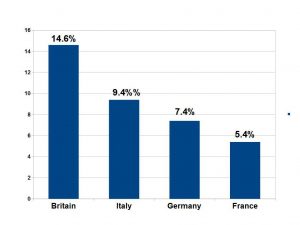
In 2011, the House of Commons Public Administration Select Committee wrote a report entitled Smaller Government: What Do Ministers Do? In this report, the Committee noted that Britain had many more paid ministers than most other European countries. With just under 15 per cent of British MPs, being paid ministerial salaries, British citizens benefit from considerably more government ministers than countries like Germany, Italy and France which also have around 600 members of their lower houses but where they had, in some cases (Germany and France), around half or even fewer than half the percentage of MPs being ministers compared to Britain:
Percentage of MPs being paid ministerial salaries in the larger European countries
The House of Commons Public Administration Select Committee was concerned about the effects on our democracy from having so many ministers:
Having too many ministers is bad not just for the quality of government, but also for the independence of the legislature. The Ministerial and Other Salaries Act 1975 limits the total number of ministers at 109 but this is regularly exceeded by appointing unpaid ministers. In addition, the existence of Parliamentary Private Secretaries (PPSs) who, while not ministers, are expected to support the Government in all divisions in the House, further increases the size of the payroll vote. Currently 141 Members— approximately 22% of the House of Commons—hold some position in the Government. This is deeply corrosive to the House of Commons primary role of acting as a check on the Executive as all government ministers are expected to vote with the Government.
As one former political adviser explained to the Commons Public Administration Committee, ‘if the Prime Minister has his way, he would appoint every single backbencher in his party to a ministerial job to ensure their vote’.
Appointing MPs to ministerial positions is also a good way for prime ministers to reward loyalty. So perhaps we’re very lucky that the Ministerial and Other Salaries Act (1975) limits the number of paid ministers to 109, though governments often exceed this number by appointing unpaid ministers in addition to the lucky 109 who are fully paid.
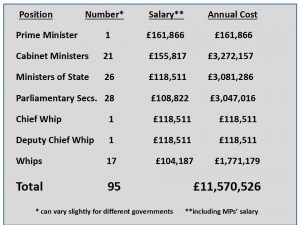
The Commons Public Administration Committee found three main problems with there being so many ministers in Westminster. Firstly, they were hugely expensive ‘placing a burden on the public purse’. The amounts we pay our 95 MPs who are also government ministers could seem quite generous to ordinary British taxpayers whose average salary is in the region of £24,600:
Cost of MPs who are also paid government ministers
Secondly, the Committee felt that having so many ministers reduced the ability of the House of Commons to hold the Government to account. As all ministers were expected to support the Government in the Commons, by making so many MPs into ministers, the Government ensured their support by creating what was called a ‘payroll vote’ – anyone either getting or hoping to get the benefits of a nice ministerial salary and other perks of office would be unlikely to jeopardise this by ever voting against the Government. As the Committee warned, ‘the temptation to create more and more “jobs for the boys” (and girls) is not conducive either to better government or better scrutiny of legislation’.
And thirdly, the Committee was concerned about the poor managerial qualities of many ministers. As one contributor to the Committee explained, ‘very few ministers have ever run anything. There is no way you are going to convert them into good managers’.
Former ministers and civil servants appearing before the Committee also expressed concerns about having such a large number of ministers when there really wasn’t enough work for them all. A former minister remarked, ‘I think there has probably been an increase in pointless activity’. And a senior civil servant seemed to be suggesting that the large number of ministers was more linked to the Prime Minister’s desire to hand out well-paid favours and ensure support rather than the number being driven by the real quantity of work to be done. The civil servant explained how officials spent far too much time trying to find things for the hordes of junior ministers to do:
The more junior ministers you have – and we have more junior ministers than ever – the more work you have to find for them. One of the biggest single frustrations of the political process within the civil service is just the number of junior ministers you have and the work projects that have to be designed and engineered at a political level.
The Committee also concluded that: ‘The ever-upward trend in the size of government over the last hundred years or more is striking and hard to justify objectively in the context of the end of Empire, privatisation, and, most recently, devolution to Scotland, Wales and Northern Ireland’. Given that there are another 28 ministers in the Scottish Parliament, 14 in the Welsh Assembly and 10 in the Northern Ireland executive, people from outside of politics might have imagined that this flourishing in ministerial numbers in the regional assemblies might have reduced the need for so many ministers in Westminster.’
The Government’s response to the Committee’s recommendation to cut the number of ministers was the usual bureaucratic ‘get lost’ that we should have become used to when any part of the public sector is faced with even the mildest suggestion as to how it might improve its performance and/or reduce its costs to the taxpayer.
The Government thanked the Committee for its work:
The Government welcomes the Committee’s interest in the role and appointment of Ministers, continuing that of their predecessor Committee whose report ‘Too Many Ministers’ (Ninth Report of Session 2009-10 HC 457) gave this Government considerable food for thought when making appointments in May 2010. The Government currently has 121 Ministers, including 95 in the Commons, and is keen that they perform their roles effectively and flexibly, rising to the challenges of the day particularly in the light of the necessary impetus to reduce the deficit.
But the Government rejected any suggestion that the number of government ministers could be reduced towards the level of comparable legislatures in other countries in order to save British taxpayers money:
The Government is grateful for the Committee’s views on these issues. As the Committee knows, the Government has been clear that it wants to strengthen Parliament, and to look at the issue of the size of Government and the balance between the two Houses in the round. It would not for example be appropriate to only consider the limits in the Ministerial and Other Salaries Act 1975. To this end, the Government will keep the number of Ministers under review particularly in the light of its proposals on House of Lords reform and changes to the number of Parliamentary constituencies.
However, the Government believes that a reduction to 80 ministers shared between the Commons and the Lords over the course of this Parliament as suggested by the Committee is unlikely to be a realistic aspiration.
Since then, all ideas of reducing the number of government ministers have been quietly shelved and the ministerial gravy train can keep trundling happily along, possibly more for the benefit of Westminster’s many ministers than for Britain’s increasingly impoverished taxpayers.
I don’t normally write about myself. That’s not the purpose of either my blog or my books. But I thought this little story might amuse or even help some readers.
Netflix crashes and burns
As readers will know, with the cost of living shooting up at much more than the official inflation rate of 7% to 8%, many households are reviewing how they spend their increasingly worthless money. And one of the first things many people are doing to reduce their expenses is to cancel newspaper, magazine and TV subscriptions. The US TV streaming service Netflix, for example, has recently lost around 200,000 subscribers and its share price has plunged by around 35%.
Though personally, I can’t understand why anyone would pay for Netflix. I had it available when I had to quarantine in a beachside hotel in a tropical paradise for a couple of weeks at the start of the Chinese WuFlu plague pandemic and couldn’t see the point of Netflix. After all, who wants their last words before their death to be “I wish I’d watched more TV”?
A Daily Telegraph price rise farce?
That brings me to my story. I have several subscriptions. One is to read the online edition of the Daily Telegraph. I have apparently been paying £80 a year for this privilege. I had no idea it was so expensive. I guess I must have bought a cheap ‘introductory offer’ a few months ago and then not noticed when that ended and the price shot up.
Two days ago, I received an email from the Telegraph informing me that they would be renewing my subscription for another year at a new price of £124 – an increase of £44 (that’s a price increase of a whopping 55%).
I tried to go into my online account to cancel my subscription, but the Telegraph doesn’t let you do this. Instead you are forced to phone their “friendly” staff at their call centre – a number that seems to be engaged most of the time even though “your call is important to us”.
Anyway, I did eventually get through on the phone and asked why prices were going up by 55%. Was the Telegraph giving all its journalists a 55% pay rise? Apparently not. Was the Telegraph giving all its other staff a 55% pay rise? Not that either. Was the 55% increase due to the rising cost of paper and other raw materials? No, because I only had a subscription to the digital (online) edition.
So I cancelled my online subscription from the day before the announced price rise came into effect – 5 May 2022. No problem.
An hour or so later, I logged on to my Telegraph account to read that day’s newspaper and a big message flashed up on my screen offering me a whole years’ digital (online) subscription for just £49 – almost a 40% reduction on the £80 I had previously been paying and £75 less than the increased price of £124 that caused me to cancel in the first place.
I guess many subscription services are panicking. They know that, if you cancel, you’re unlikely to come back. So, as soon as you cancel, they’ll bombard you with special offers just to keep you. After all, for the Telegraph, getting £49 a year from me is probably better than getting nothing.
Will this work with other subscription services?
Thus by trying to raise their prices by 55% from £80/year to £124/year, in my case the Telegraph succeeded in reducing their earnings by about 40% from £80 per year to just £49 per year.
Will this work with other subscription services? Will they too panic if you cancel and will they end up offering you an even lower price than you are currently paying just to keep you? Who knows? But I’ve just cancelled my subscription to the online edition of The Spectator – it will be amusing to see what, if anything, The Spectator offers to keep me as a customer.
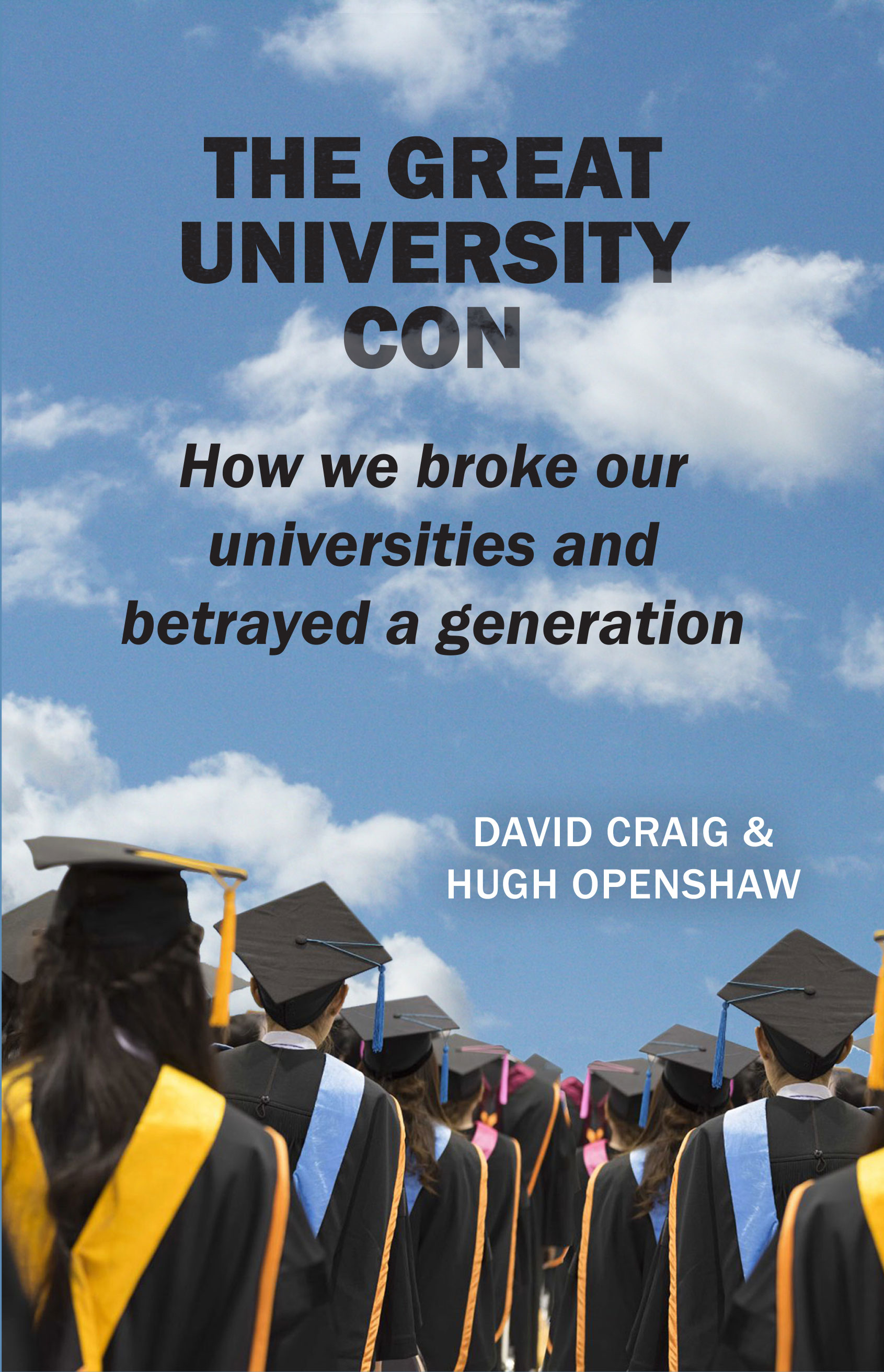
One other small point – there was a bit of a cock-up with my renewed Telegraph subscription and I had to ring the “friendly” staff at the call centre about 7 times to get it fixed. I’m a bit nosy and, given that I co-wrote the book THE GREAT UNIVERSITY CON How we broke our universities and betrayed a generation, I asked my interlocutors if they had a university degree. It turned out that about half of them had been to Uni and were now working in a newspaper call centre. Yet Mr Blair has told us that we need to increase the percentage of young people going to university from its current level of 53% to 70% in order to “have a more skilled, productive workforce”. Sorry, Tony, but do you really believe that call centre staff need university degrees and the £50,000 student debt which many university graduates will carry for the rest of their lives?
Spending your savings
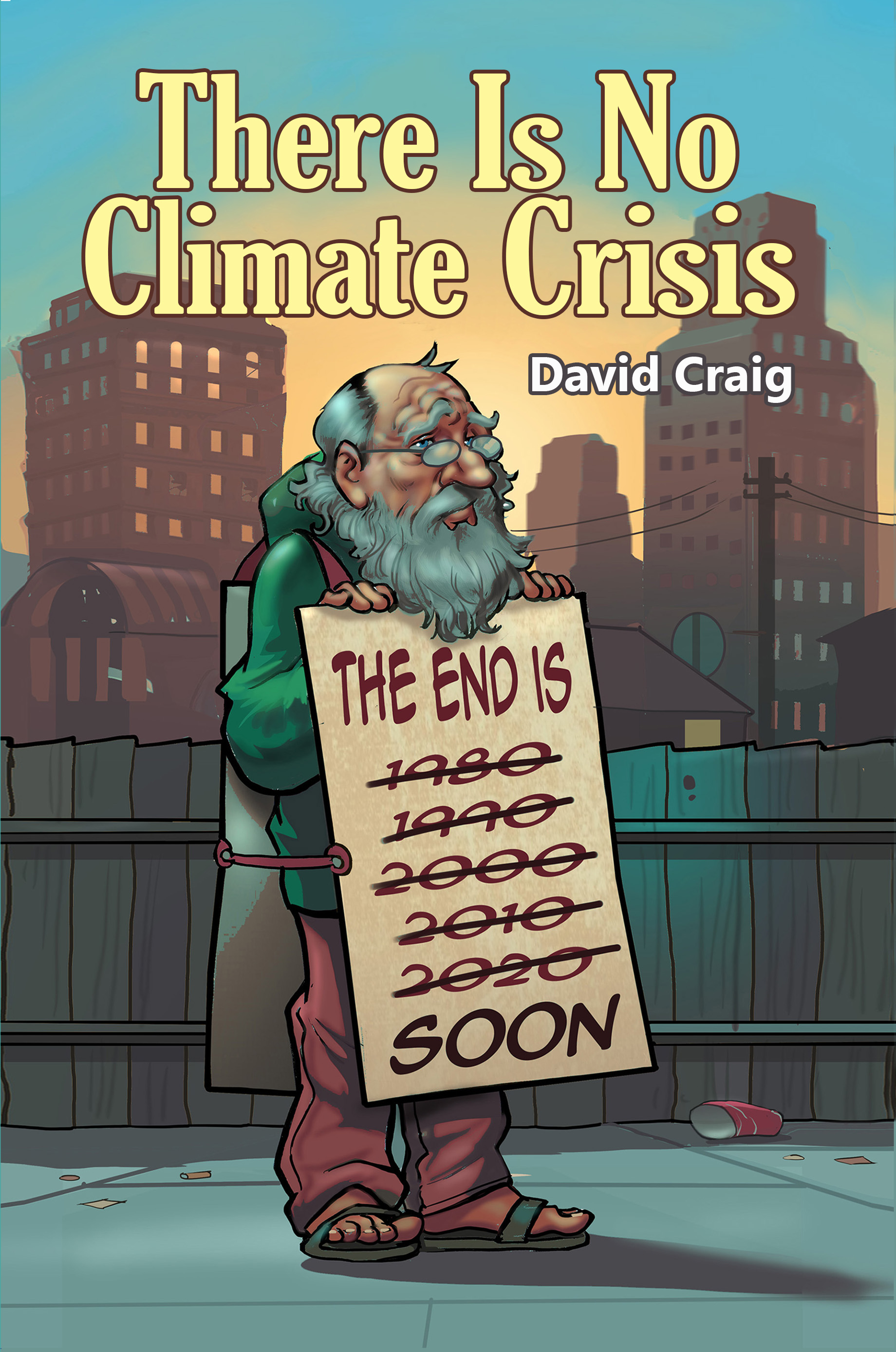
Oh, and if this subscription cancellation trick works for you, you could always invest some of the money you save in buying a couple of copies of the two best books exposing the nonsense of impending climate catastrophe – my latest book THERE IS NO CLIMATE CRISIS and Ross Clark’s THE DENIAL:
As you probably know, the once glorious island paradise of Sri Lanka is bankrupt and descending into a failed state. The three main reasons seem to me to be:
decades of utterly incompetent government
massive, unrepayable loans, especially from China’s Belt and Road debt colonialism/enslavement
alleged looting by the kleptocratic elites, especially the Rajapaksa family, whose three brothers just happen to control the country
Sri Lanka’s current President is Gotabaya Rajapaksa. His brother, Mahinda, is the country’s Prime Minister (and served as president from 2005-2015) and another brother, Basil, was finance minister until he resigned last week along with the rest of the cabinet:
So, for much of this century Sri Lanka has been very much a Rajapaksa and cronies’ family business rather than a serious, democratically-run country.
By 2015, investigators had already reportedly found around $2bn of Sri Lanka’s money stashed away in Dubai allegedly by members of the Rajapaksa family. At the time it was estimated by some nasty cynics that the Rajapajsas had stolen around $10bn as there were reportedly billions more hidden in banks in Switzerland and other welcoming jurisdictions which tend not to ask too many questions about where foreign money is really coming from.
You can be forgiven for suspecting that the enterprising Rajapaksa brothers have been busy since 2015 further adding to their alleged looted wealth.
Since his election for a second term in office, President Gotabaya Rajapaksa has faced accusations of economic mismanagement, embezzlement and corruption.
One report (the Spectator) says that Sri Lanka owes international lenders more than £21bn, with just £1.7bn in reserves. Another (Daily Mail) stated that Sri Lanka’s total debt stands at $35bn of which $4bn must be repaid this year including a $1bn sovereign bond.
The country has no money to import basic necessities like fuel, food and medicines. Shops and restaurants are closed and armed police patrol the streets. There are curfews in a couple of towns, the police have started shooting demonstrators and the Sri Lankan rupee (or whatever it is the country uses as a currency) is probably worth less than toilet paper. (Sorry, I don’t think they use toilet paper in Sri Lanka)
The price of vegetables has increased fivefold since 2021, while the cost of rice has doubled. There are shortages of almost everything and regular power cuts. Many residents say they are unable to eat more than one meal a day.
Meanwhile, Sri Lanka’s largest public medical body, the Government Medical Officers Association (GMOA), has declared a health emergency. Hospitals have run out of five life-saving drugs and the GMOA says there are shortages of another 180 medicines, as well as a lack of vital surgical and testing equipment.
I suspect that the three Rajapaksa brother have enough money stashed away to pay off all the country’s debts.
But in all the news reports I have seen from Sri Lanka, not many journalists have been terribly enthusiastic about bringing up the subject of the Rajapaksa brothers’ alleged looting. I guess it would be considered “racist” to mention it.
Just small fry by Third World standards
However, the $10bn or $20bn allegedly looted from Sri Lanka is just small beer by supposed ‘developing’ countries’ standards. After all, Sri Lanka is only at position 102 on the Transparency International corruption index. There are 72 countries which are even more corrupt than worthless basket-case Sri Lanka.
A really efficient Third-World kleptocrat will normally have stolen at least $50bn and often over $100bn. Yet idiotic Britain and the West continue to pour hundreds of billions in foreign aid into these totally rotten hell-holes while the rather more sensible Chinese Communist Party (CCP) uses its loans to colonise/enslave countries like Sri Lanka. I believe the CCP has taken over a major port in Sri Lanka for the next 90 years and maybe also an airport as Sri Lanka couldn’t cough up the interest payment on a Chinese ‘loan’.
Better off as a British colony?
Ceylon became the independent country of Sri Lanka in 1948. As with so many former colonies, for a few decades things weren’t too bad as it took the Sri Lankan elites a while to destroy the legacies of ‘evil’ British colonialism – a functioning justice system, effective schools and universities, reasonable healthcare and other elements of a civilised society. But by 1983, the Sri Lankans had enough of living in civilised prosperity and started a civil war which lasted till 2009 devastating much of the island.
I believe the Rajapaksas began their takeover of the country in about 2005 and things have pretty much gone even further downhill for most Sri Lankans (but possibly not for the increasingly wealthy Rajapaksas) since then.
Perhaps the collapsing Sri Lanka, like so many other former British colonies – Rhodesia, Kenya, Ghana, drug- and violence-ridden Jamaica, Crapistan, Bangladesh, etc etc – would have been better off if it had remained under British rule?
I wonder if one could make a new joke?
Question:What’s the difference between a British colony with a proper justice system, schools, universities, hospitals and reasonable prosperity and a corrupt, bankrupt, excrement-covered, impoverished, basket-case Third-World hell-hole?
I don’t know if you’ve noticed, but the (IMHO) repulsive, lying war criminal, Tony Blair, has thrust his way back into the fawning media. This week he’s getting media attention by claiming that 70% of all young people should go to university. At the moment the figure is already far too high at around 53%.
This is, in my humble opinion, stratospheric stupidity for at least two reasons:
we already have a massive oversupply of heavily indebted Uni graduates who will never get graduate-level jobs and thus never repay their £50,000 to £60,000 graduate loans
the extraordinary obsession with hiring only university graduates is destroying nursing, policing and the prison service
Too many graduates? Let’s produce even more!
Most graduates in serious subjects – science, technology, biology, engineering etc – will get well-paid graduate jobs. But they are in a minority as the greatest growth in student numbers has been in subjects like Media Studies, Psychology and various other Micky Mouse time-wasters
Here is a simple graph showing the number of entrants to law degrees, the number graduating and the number of training places available:
Hopefully, I don’t need to explain what this is telling us.
Oh, and I recently phoned a call centre and found that the guy I was talking to had a degree in Law. Well, at least he had a job. And a call centre is probably marginally better and more mentally stimulating than flipping burgers and asking people if they want a medium or large fries with their burger.
And here’s a simple table showing the number of students starting courses in Psychology, Social Work and Law compared to the number of training places available:
Subject
Starters
Psychology
27,115
Social work
24,610
Law
26,815
Total
78,540
Training positions available
15,700
Projected oversupply of law, social work and psychology graduates
62,840
This shows an oversupply of around 62,840 a year.
So, what is Bomber Blair’s solution to this massive oversupply? Send even more suckers to university to build up massive debts that they can never repay.
Destroying nursing, the police and the prison service?
But the most destructive consequences of too many graduates is the decision by the geniuses who run nursing, the police and (I believe) the prison service that all new entrants should have university degrees.
Wrecking nursing?
In 1986, under Project 2000, the NHS started moving nurse training away from hospital-based schools into colleges and universities. The next change was that nursing started to morph from being a (usually 18-month) diploma qualification to becoming a 3-year degree. Then in 2009, the Department of Health announced that by 2013 it would require all new entrants into nursing to be graduates.
At first the necessity for nurses to have a degree wasn’t too much of a problem as, until 2017, nurses were given bursaries to help cover their tuition and living costs. But in 2017, these bursaries were abolished and student nurses were forced to take out loans just like most other students. The result was an immediate drop of 23% in the number of people applying to study nursing. And it’s going to take many nurses an awfully long time to pay back student loans of tens of thousands of pounds on a nurse’s salary
There is also a mass of evidence around things like hospital-acquired infections and deaths due to poor care (think Mid-Staffs NHS Trust) which suggest that forcing nurses to have uni degrees wasn’t such a great idea. As a senior intensive care nurse explained:
“… many ‘graduate’ nurses feel they are too superior to clean floors and change beds. As a result, the incidence of lethal hospital infections is going through the roof. Indeed, many patients would be horrified by how today’s nurses even ignore essential routines such as regular hand-washing….. Student nurses were removed from the hospitals and trained in lecture halls, rather than wards. Many less glamorous but vital elements of nursing care – such as cleaning dropped off the syllabus and were replaced by empty, jargon-filled theorising about ‘holistic care’ and ‘cultural sensitivities'”
Destroying the police?
The College of Policing introduced a new career framework in 2020 which required all police recruits to either already have a degree or to acquire one while working as a police trainee on the Police Constable Degree Apprenticeship scheme.
You or I might wonder whether someone who has the academic inclination to study to degree level is really the right person to patrol a crime-ridden, violent, vibrant, multi-culturally-enriched inner-city housing estate. Or whether more practical skills might be more relevant. But this doesn’t seem to have occurred to our over-paid, over-pensioned top police bosses.
Anyway, we’re already seeing the effects of preferring recruits with degrees rather than those with qualifications from the University of Life. In 2021 around 9.1% (2,567 out of 28,173) of new police recruits quit before completing their training. Some of them quit within just a few weeks of starting because they were shocked by the violence and didn’t want to work weekends and nights. Many more (sorry, I don’t have the numbers) quit within a couple of years of completing their training.
One police boss with a bit more brains than his colleagues tried to warn his top brass that policing was not “an extension of university” and therefore insisting on police having or gaining a degree might not be appropriate for policing Britain’s knife- and gun-crime-swamped streets.
Putting paid to our prisons?
Prisons used to be (I believe) a major employer of people who had formerly served in the military. But, of course, that has all changed as prison bosses wanted to move with the times by deciding that university graduates would be much better suited to looking after violent, dangerous and devious criminals than ex-service personnel. I could go on by describing the almost catastrophic damage being done in our prisons by prison bosses’ decision to prioritise graduates over former members of the military. But I’m sure you all have sufficient imagination to picture the utter chaos this decision has caused in our prisons.
If not, there is a book – INSIDE PARKHURST – by a former prison officer warning us of the problems the prison service’s enthusiasm for university graduates is causing.
If the subject of Britain’s disastrous fixation with increasing the number of people going to Uni really interests you, you could always buy a copy of my book THE GREAT UNIVERSITY CON How we broke our universities and betrayed a generation
Though I’d much prefer it if you bought a few copies of my latest book THERE IS NO CLIMATE CRISIS:
You can always use it for propping up a wonky table or as a draught blocker under a door if you don’t want to read it.
As all the usual handwringers and their progressive, holier-than-thou UK-haters in the mainstream media howl and scream about the UK Government’s plan to screen illegal migrants in Rwanda, I thought I might bring you a short, heart-warming story of migration, diversity and multi-cultural enrichment from Ireland.
The story features a Mr. Yousef Palani. As you might have guessed, Mr Yousef Palani is not a native-born Irishman. He came to Ireland from some religiously-backward, Middle-East hell-hole and was, like so many migrants, given leave to remain in Ireland and lots of Irish taxpayers’ money so he could enjoy his stay in the former Celtic Tiger country.
Mr. Yousef Palani has become famous because he has just been charged for allegedly murdering two Irishmen and trying to murder a third. I believe that all three crimes took place in the week before Easter. All three men attacked by the multi-culturally enriching Yousef Palani were gay men who Palani met through dating websites for gay men:
Both murdered men suffered “significant” injuries, said An Garda Síochána, Ireland’s police force.
But what are “significant” injuries? The Irish media have been quite coy about this. But one media outlet reported that our friend, Yousef Palani, beheaded at least one and probably both murder victims. Moreover, I have been told (but have been unable to verify this) that Mr Palani also castrated both men. If this is true, we don’t know whether the castrations took place before the beheadings or after. And, although the Irish police will know, you can be sure that we’ll never be told. After all, such information may harm community relations.
It seems that for some strange and unfathomable reason – I can’t imagine what this could be – Mr Yousef Palani wasn’t particularly tolerant of people of the LGBT+++ persuasion
Mr Yousef Palani will, of course, get free legal aid in Ireland as he is (surprise, surprise) unemployed.
The usual progressive, virtue-signalling, migrant-hugging do-gooders obviously think it’s wonderful to bring as many people as possible from the world’s most primitive, horrendous hell-holes to Ireland:
After all, we all want more diversity and enrichment, don’t we? We all know that ‘diversity is our strength’:
But there may be some cynics who wonder if this really is such a great idea after all.
Thank heavens for GB News
Just in case you haven’t seen it, here’s a 10-minute video clip from the magnificent Neil Oliver from Saturday 16 April in which he dares to question many of the Shibboleths of our progressive, globalist, diversity- and inclusivity-obsessed superiors:

 David Craig, on May 2nd, 2022