|
|
By  David Craig, on November 13th, 2012 A major industry in Thailand is extracting money from foreign (Farang) tourists. The main people involved in this sector of the Thai economy are, of course, bargirls, barboys and ladyboys. The process for making Farang considerably poorer seems to have three main stages.
First and most obviously money is made by providing sexual services for Farang men who can’t get such things at home, either because they don’t have a willing partner or because their partner would rather do some knitting than pleasure their men.
But this is only the start. While with their Farang boyfriends, Thai bargirls, barboys and ladyboys will explain three things. 1. They have to work to provide money for their family. This will generally be true as Thai children feel a strong sense of duty to their parents who are usually impoverished rice farmers from Isaan province. 2. They have to work in a bar to get the kind of money needed to support themselves and their family. This will also be true as most will have little education. 3. If their Farang boyfriend sends them a little money each month then “me no need work bar – me stay room wait you”. This will definitely not be true. Any well-organised bargirl can hope to have three or four Farang all sending her money ostensibly so that she doesn’t have to work in a gogo bar any more. However, she will keep on working as Farang men can’t be trusted so she’ll always be on the lookout for new providers in case one of her existing ones drops out.
Like professional footballers, Thai bargirls only have a limited working life to provide for themselves, so they have to maximise their earnings. A third way to extract cash from their Farang is to invent a series of special events which all invariably require more cash to be sent. These can range from “buffalo die, hit by car, papa need money buy new buffalo” to “mama sick – need money pay doctor” to “grandma die – need money bury grandma”.
All Thai girls know that Farang men are more stupid than buffalo. After all, a buffalo will somethimes think with its brain, whereas Farang men only think with their cocks (which can often be quite small and therefore not so good for thinking with). But even though Farang men more stupid than buffalo, a girl has to be careful with which stories she feeds to each of her Farang providers. For example, if she tells a Farang provider one year that “grandma die, need money bury grandma” and the next year that “grandma velly sick – need money pay doctor” even the stupidest Farang might wonder at grandma’s remarkable recovery from her death the previous year.
By David Craig, on November 12th, 2012 As the head of the Public Accounts Committee MP Margaret Hodge prepares to question Britain’s most prolific tax-avoiding companies, we find out that her family company doesn’t pay Corporation Tax either. You couldn’t make it up.
So, as our useless governments are exposed as having helped our largest companies avoid paying tax while squeezing the rest of us, here’s an article I wrote about 7 months ago for MoneyWeek explaining the blindingly obvious – Corporation Tax is past its useful shelf-life and should be scrapped.
It’s time to scrap Corporation Tax
By David Craig
Recent revelations of how little tax major companies like Starbucks, Amazon, Google and Facebook pay have got many ordinary taxpayers fuming in impotent rage. Yet we should remember that any tax only has a limited useful shelf-life. For a time it will raise revenue. But most taxes outlive their usefulness because they cause changes in behaviour as people find ways of avoiding paying them.
In Britain, we’ve had many taxes that have come and gone. There was Henry VIII’s Beard Tax introduced in 1535. Avoidance was easy – you just shaved off your beard. In 1662 Charles II brought in an early type of poll tax, the Hearth Tax. It was considered too difficult to count how many people lived in each home, so instead the tax was based on the number of chimneys. The result was that enterprising citizens started combining several fireplaces into a single chimney. A few hundred people are thought to have died from the ensuing fires. In 1696 William III brought in a Window Tax leading to many homes bricking up some windows. 1795 saw the introduction of a tax on wigs and wig powder. Result – wigs became less fashionable. And around 1800 the government started a Hat Tax. Each hat had to have a stamp sewed into it showing that it was legal. The penalty for forging these stamps was death, which might give some people odd ideas about how to deal with today’s companies that avoid Corporation Tax.
Corporation Tax came in with the 1965 Finance Act. Prior to that, companies and individuals paid the same income tax with an additional profits tax levied on companies. But perhaps, like so many taxes before it, Corporation Tax is getting past its sell-by date – as companies become increasingly international or operate through the Internet, they find ever more ways of avoiding paying. During the Gordon Brown boom of 2000 to 2007, the amount of Corporation Tax paid by small companies shot up by over 130 per cent. But at the same time, even as their profits and bonuses soared into the stratosphere, financial services firms only paid a modest 27 per cent more, while our largest, often international, companies handed over just 5 per cent more.
Larger companies, banks and of course celebrities have a bewildering variety of ways to pay as little tax as possible. And when they do pay tax, it’s usually in a country where tax rates are minimal. The world’s largest computer systems and consultancy, for example, has over a hundred thousand employees worldwide. Yet for tax purposes it’s based in Bermuda where it employs around a dozen staff. So, one might be tempted to think that the Bermuda incorporation had more to do with tax avoidance than the island being a critical centre for the company’s major customers.
Chancellor, George Osborne has proposed to cut Corporation Tax very slightly over the next two to three years. But perhaps he’s missing a trick. Maybe Corporation Tax should go the same way as the taxes on beards, hearths, wigs, windows and hats. As it currently works, Corporation Tax has an immensely destructive effect on our economy. It places an unfair burden on smaller companies which are the ones we need to take on workers to boost economic growth; it encourages larger companies to move their profits and sometimes even their people out of Britain and it makes it attractive for financial manipulators to buy productive, tax-paying companies by borrowing huge sums of money so they can extract massive payments for themselves, while using the interest payments to minimise the amount of taxable profits. The takeovers at firms like BAA and Cadbury’s have made their acquirers wealthy, while slashing our government’s tax receipts.
If we are to deal with the deficit and create growth, we need to scrap Corporation Tax completely. Instead we should have a transaction tax on all business activities carried out in Britain, regardless of whether the company claims to be based in Switzerland, Bermuda, Ireland, the Cayman Islands or on the Moon. In fact, we already have that tax – it’s called VAT. The government should get rid of Corporation Tax and replace it by retaining the necessary amount of VAT paid to businesses. For financial firms, there should be a tax on their assets.
Binning Corporation Tax would have quite a few almost miraculous benefits for our economy. Firstly, it would make tax avoidance much more difficult. Also, there would be no need for companies to play all sorts of games to shift their profits offshore. Moreover there would be a huge incentive for our companies to stay in Britain and for many thousands of foreign companies to move their bases to Britain, creating hundreds of thousands of well-paid jobs. And, of course, the practice of buying companies while loading them with massive debts would no longer make sense for financial predators. In addition, it would massively reduce the administrative cost of tax collection.
Scrapping Corporation Tax would be the most imaginative and beneficial act George Osborne could ever do. It’s a pity that today’s politicians are lacking in the necessary imagination.
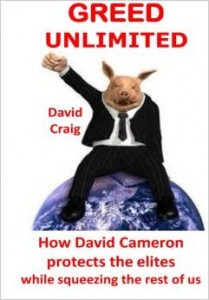
David Craig is the author of GREED UNLIMITED How Cameron and Clegg protect the elites while squeezing the rest of us (Original Book Company £8.99)
By David Craig, on November 11th, 2012 The BBC has been under a lot of criticism for wasting the license fee on rubbish such as pretty much everything broadcast by the pointless and expensive BBC3. But over the last few weeks the shenanigans at Newsnight have kept the country thoroughly entertained. First the BBC is shown to have covered up the antics of its favourite paedophile and rapist. Then Newsnight tries to regain its credibility by falsely accusing a Tory peer of paedophile abuse. Since the Savile scandal broke all we’ve had from the BBC has been blundering, stupidity, bureaucratic incompetence, managerial inertia and lies and lies and lies. You almost couldn’t make it up.
It’s time to cut the BBC’s budget (and the license fee) by 5% a year for the next five years, to scrap BBC3, leave making utter dross to the increasing number of commercial channels, cut BBC management by at least 50% and return the BBC to its original charter as a public service broadcaster.
It is not the BBC’s job to waste our money trying to convince the stupidest people in Britain to watch Strictly rather than Simon Cowell’s fixed karaoke supposed “competitions”. The sooner the overpaid, overpensioned idiots running the BBC realise that, the better
By David Craig, on November 10th, 2012 I’m now in an Internet cafe surrounded by beautiful Thai girls and a couple of Thai boys all chatting online with their foreign “men-friends”. Most girls (and boys) will have several men-friends all sending them money because “you no send money, me hab work bar”. One girl has a book, which sells quite well here, giving useful phrases to use when emailing and chatting to foreign (farang) men-friends. I keep hearing “me lub you” and “me miss you” and “you come Thailand soon” and “mama sick, you send money for doctor”.
Anyway, let’s get back to the financial services rip-off merchants: here are four simple ways to avoid being suckered.
1. Look at the difference between risk-free return and what’s being touted – the most common mistake made by savers is to be seduced into handing over their money by suggestions they can get returns of 4% or 5% or 6% a year – enticingly more than they would get from a bank. But what most savers fail to do is to factor in how much risk they are taking for relatively little extra return. You can get about 3.5% completely risk-free fron a 2-year fixed-interest bond. So if you’re attracted by say a potential 5% from a unit trust, you’re actually taking quite a lot of risk (and paying a lot in charges), not for 5%, but just for the 1.5% difference between the hoped-for 5% and the 3.5% you can get risk-free. In most cases, it’s not worth taking the extra risk and paying the charges for so little extra.
2. Work out the real costs – normally you’ll pay much more for savings products (unit trusts, pensions etc) than you’re led to believe by those selling them. For example, a unit trust may claim their management charge is only 1.5% a year. But you also lose about 5% when you buy in and another 5% when you take your money out. You’ll also pay at least 0.5% a year above the management charge as it doesn’t include costs that are in the TER (Total Expense Ratio). And you’ll pay at least another 0.5% a year in dealing costs which are not included in the TER. So if you keep your unit trust for five years, you lose 5% going in, 5% coming out and 2.5% a year in charges – in total 22.5% of your money.
Had you put your money in a series of 2-year fixed-interest bonds, you’d have about 18% growth (before tax) over 5 years. So, to beat your bond, your unit trust would have to grow by more than 40.5% over the 5 years (the 18% you get risk free plus the 22.5% in unit trust charges). The minimum your unit trust would have to achieve would be over 8% a year to make it worthwhile – that’s not going to happen.
3. Do it yourself – Once you’ve accepted that the people making the real money are financial services insiders manipulating markets and the huge costly chain of advisers, fund managers, lawyers and others siphoning off their cut of your money, then you can invest like a realist and not like a fool. As far as I can see, there’s only one way to make a little money in financial markets. Either with shares or pensions, look at the sales blurb of a few unit trusts, see what are the main shares they hold and then buy a few of those shares yourself either directly or through your SIPP. Ideally, those shares should be regular dividend payers and you should reinvest the dividends to buy more shares in the same companies.
4. Only buy in the dips – This is the most frustrating and difficult aspect of saving. When shares go up, all the financial journalists and advisers and salespeople are shrieking at us to buy, buy, buy! But the opposite is true – when share prices are high, you should never buy. You should only buy when they are low. Stock markets do not go up over the long term. They fluctuate around an average level. If you buy when they’re below the average, you’re likely to make money. If you buy when they’re above the average level, you’ll probably lose. Remember, the FTSE was once at 7000, now it’s around 5800. There are very few people who have the courage to buy when prices are falling or low and the courage to sell when prices are rising or high. If you’re not absolutely convinced that you are one of this tiny group, then shares and unit trusts and SIPPs are not for you.
By David Craig, on November 8th, 2012 On Tuesday I went to a talk by one of Britain’s leading economists John Kay, author of a book about investing – The long and short of it. Kay had recently completed a study for the Government on the working of stock markets. A key conclusion was that originally stock markets were one of the most important sources for companies to raise money. But that now stock markets and companies had little to do with each other any more. When companies need to raise capital, they seldom use stock markets and when there is a share issue nowadays, it’s usually a hugely-hyped scam (like Facebook) where insiders get massively rich at the expense of the suckers.
Stock markets now seem to be gambling dens where share prices are driven more by the trading activities of market insiders than by the value of the companies whose shares are traded. There are probably five main levels of participants
1. High frequency traders – financial institutions which have set up sophisticated computer algorithms which “scalp” – take a cut every time a share is bought or sold
2. Insiders – who can make fortunes from their inside knowledge and from share price manipulation
3. Hedge funds – who take massive bets on prices either rising or falling and then use tricks like pumping-and-dumping, shorting-and-distorting to move share prices to the level they need on the date they need
4. Destroyers of value chain – tens of thousands of fund managers, financial analysts, researchers, salespeople, lawyers, IFAs, trustees, investment consultants, financial journalists and many others who destroy value for savers by encouraging us to put our money in their hands and by all taking their very lucrative cut from our money
5. Ordinary savers – people who put their money into shares, unit trusts and pension funds. But the question for us is – with so much of our money being siphoned off by the above four levels of market participants, can it ever really be worth it for us to put our savings into any financial product like shares, unit trusts, ETFs or pension funds?
Share prices are no longer an image of the health of a company, they just show the results of manipulation and speculation, creating a distorted view of the past and future of companies. Tomorrow, I’ll be on a plane. But on Saturday, I’ll propose ways we can avoid financial services insiders making helpless suckers of us.
In the meantime, I’d be grateful if you could encourage your friends and acquaintances to buy copies of my latest book GREED UNLIMITED, otherwise I’m going to have to burn the remaining copies, which would be a pity.
By David Craig, on November 7th, 2012 Last night I was at a talk in London given by one of Britain’s leading economists – but more of that tomorrow. Before the talk, I had the misfortune to meet and chat with two people who worked for Barclays Wealth. That’s the part of Barclays which “looks after” the money of customers with over £100,000 to invest.
Bob “The Banker” Diamond has left Barclays to spend more time with his hundreds of millions while leaving Barclays’ unfortunate shareholders (mainly us, through the money invested in our unit trusts and pension funds) many billions of pounds poorer. And Barclays’ new boss has made much of his efforts to change the culture at the bank away from greed, market manipulation, rate-rigging, money-laundering, speculation and outright thieving back to “old-fashioned” banking. Don’t believe a word of it.
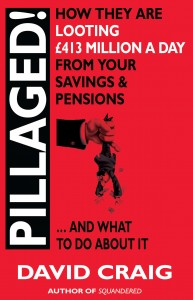
Three years ago, I was in the Bournemouth branch of Barclays to meet the manager about putting money into a 2-year fixed interest bond. While waiting outside the manager’s office, I heard two Barclays financial advisers (salespeople) laughing and joking about what they were going to say to a pensioner who had just lost half his life savings (a six-figure sum) after being advised by Barclays staff to put all his money into the dreadful Aviva Global Balanced Income Fund. That’s what prompted me to investigate the thoroughly corrupt financial services industry and write PILLAGED How they’re looting £413m a day from your savings and pensions.
The two people I met last night were (IMHO) truly awful human beings. They were both upper middle class (one was ex-army) so that they fitted in well with the types of customers they had to convince to put their money with Barclays. They admitted that their customers were unlikely to see their savings grow over the next few years – but that wasn’t their problem, they had sales targets to meet and sod any customers stupid enough to hand over any money to them.
I have also had some bruising exchanges with Barclays, in particular with my former relationship manager at Barclays, Richard Lynton-Jones. However, I probably shouldn’t detail these for legal reasons. Still, I’m sure Richard Lynton-Jones’s opinion of me is as high as my opinion of him.
Incidentally, when my 2-year bond matured, the money “got lost” for weeks and Barclays even claimed I had never invested any money with them in the first place. It took the threat of legal action for the money to be “found”.
Bob The Banker may have gone. But, as far as I can see, nothing at Barclays has changed – many Barclays staff are still (IMHO) a bunch of lying, thieving, corrupt, greedy scum and you should not give them your money.
By David Craig, on November 6th, 2012 Personal finance journalists are all excited by the FSA’s decision to force pension companies to lower the projections they make for pension savers. Up till April 2014, pension companies will be able to use three growth rates for making projections about customers’ pension savings – Low 5%: Medium 7%: High 9%. Like all projections made by anyone in financial services who wants to get hold of our money, these rates were always ludicrously unrealistic.
From April 2014, pension companies will have to lower these rates to – Low 2%: Medium 5%: High 8%. This is supposed to give savers “a harsh dose of reality” as to the final value of their pension savings. Only problem is that these new lower rates are still wildly overoptimistic. The average growth achieved by the pension fund industry over the last 15 years was just 3.4% which is much lower than the new Medium (5%) and High (8%) rates. But we’re now moving into an economic environment where growth is likely to be slower than in the past. And, of course, these growth rates are before the effects of inflation. If we assume inflation will average say 2.5% a year, we’re actually looking at our pension funds achieving real growth of about 1% a year.
A study by the OECD found that “British savers have suffered bigger losses from their workplace pensions in the last decade than virtually every other nation in the developed world”. So why are our pensions such a disaster? High charges and corruption. In Britain we pay about 3 to 5 times the level of annual charges paid by savers in countries like Germany, Australia, Denmark and Holland. Moreover, the British pension industry is thoroughly corrupt with many pension companies “churning” the shares they own – excessive buying and selling – to increase the charges they take from us.
So, don’t believe all the guff from the FSA bureaucrats and personal finance journalists about the new pension growth rates being a “harsh dose of reality” – they’re not even close.
By David Craig, on November 5th, 2012 As the repulsive Edward Balls prepares to take over as Chancellor in 30 months time, I’m happy to offer him two free lessons in basic economics as he doesn’t seem to have the slightest understanding of the subject. Though perhaps it’s not surprising Balls knows so little. The only “proper” job he’s had was as a journalist at the FT. Of course, that’s better than Osborne whose work experience consisted of folding napkins at Selfridges. But the FT spent years telling us that Britain should join the euro. As we’ve now seen, that would have been a disaster, but the FT hasn’t yet apologised for getting it so wrong.
Lesson 1 – In GREED UNLIMITED, I suggested Balls frame something like the following quote and hang it on his office wall, “Annual tax revenues £550bn, annual public spending £540bn – result happiness. Annual tax revenues £550bn, annual public spending £600bn – result misery”. In 2007, at the height of the Brown/Balls boom, tax revenues were £549bn and spending was £583bn, yet Balls still denies Britain had a structural deficit.
Lesson 2 concerns dealing with the results of the Brown/Balls financial incontinence. Government debt was £312bn in 2000 and £525bn by 2007. Then with the crash it shot up to £759bn by the 2010 election and about £1trn today. By the 2015 election it will be about £1.4trn. If the next government completely wiped out the deficit and was able to start repaying our debt at say £10bn a year (something that is virtually impossible), it would take around 90 years to get our debt back down to where it was at the end of the Brown/Balls boom and around 110 years to return debt to its level when Brown and Balls first started their spending spree with our money.
So what is Mr Balls’s solution to this catastrophe? Borrow more money.
One of the best quotes this week came from an American explaining why he would be voting for Romney – “because I don’t want America to end up like Britain.”
By David Craig, on November 4th, 2012 As our lying, incompetent political leaders blunder and bluster, pretending that they are in control of events, it’s maybe necessary to take a step back and view Europe’s and Britain’s totally hopeless situation from a new perspective.
Below is a link to a comedy sketch from Australian TV where the participants wonder how countries that are broke can find money to pay back their debts to other countries which are also broke and are trying to borrow money to pay back their debts to the countries which are borrowing money to pay back their debts to them – or something like that!
Enjoy https://www.youtube.com/watch?v=I5QwKEwo4Bc&feature=relmfu
By David Craig, on November 3rd, 2012 As I’ve been blacklisted from ever working again as a consultant, I have plenty of time for the joys of daytime TV. One programme I watch while on my cross-trainer each morning is the BBC’s Homes Under The Hammer which features people buying homes at auction, usually to do up for the buy-to-let market. With interest rates at record lows, with shares likely to stagnate for the next five or so years and with most pension funds charging huge fees and not giving any growth, it’s understandable that people with a bit of spare cash are turning to property for an income and for their pension. But are these people providing a service by renovating and renting out houses and flats? Or are they just profiteers and parasites, pushing up house prices and then living off those who can’t afford to buy their own homes?
I think there are about 14.5 million homes in England (I don’t have the figures for the UK). Of these 14.5 million, around 3.6 million (a quarter) are buy-to-lets. If we assume that the average buy-to-let is costing £500 to £700 a month, this means that renters are paying £1.8bn £2.5bn a month (£21bn to £30bn a year) for their homes. That’s £21bn to £30bn a year being taken from the less well-off and put directly into the pockets of the better-off. Buy-to-lets add nothing to our national wealth, they just move money from one section of society to another. Moreover, as they account for about a quarter of home purchases, they push prices up beyond the means of many people.
At the moment, buy-to-lets seem to be profitable investments for the lucky few – at least that’s what gushing BBC presenters claim. But when Labour get back into power in 30 months time and the deluded liar Ed Balls goes on a Brownian spending spree, he’s going to need money – lots of it. And there, ripe for the picking is £21bn to £30bn being taken by buy-to-let owners.
Buy-to-let owners beware – it’s not unlikely that, under the banner of “fairness”, the repulsive (IMHO) Balls may be coming after your money. After all, there’s not much else left for our incompetent, wasteful, financially-incontinent governments to tax. Mr Balls may make you rue the day you ever entered the buy-to-let market
|
|