|
|
By  David Craig, on April 9th, 2013 Most people probably know that our MPs are pressuring the inappropriately-named Independent Parliamentary Standards Authority (IPSA) to recommend they get a pay rise from £65,738 to somewhere around £86,500. And most people probably know that almost all our MPs are fiddling their expenses (at the time of the expenses scandal over 95% of MPs voted to keep their expenses secret).
Probably fewer people know that MPs pushed IPSA into increasing the amount they get to pay staff from £115,000 to £137,200 (and £144,000 for London MPs) at least £30,000 to £40,000 of which usually ends up in the pockets of a member of family, partner or friend.
So successful have our MPs been in watering down IPSA’s rules and increasing their own allowances that in the year before the 2010 election they claimed about £130m in expenses, yet last year this had shot up to nearer £150m – about £30,000 per MP more than before the expenses scandal broke.
But MPs have another scam for getting rich at our expense – a truly incredible 90 MPs are supposedly “government ministers”. With 362 MPs in the Coalition, about one in four is a minister, giving Britain over twice as many ministers as Germany, Italy, Spain or France (see chart)

Why so many ministers? Because it gives MPs (and some Lords) real salaries of from £89,435 (33 parliamentary secretaries) to £92,000 (20 whips) to £98,740 (29 ministers of state) to £134,565 (21 cabinet ministers) (see chart)

Top civil servants have been known to complain that they can’t find enough things for all these ministers to do. One parliamentary committee wrote a rapidly-buried report “What do ministers do?” recommending a cut in the number of paid ministers.
Then, of course, MPs have so much time on their hands that many have second, third and even fourth jobs earning them hundreds of thousands of pounds over and above their generous salaries and even more generous expenses.
Given that the EU now makes most of our laws and our MPs have very little to do, we don’t need 650 MPs any more – about 200 would be quite enough. The US Congress, for example, has just 435 members for over 250 million people. All in all, our MPs are doing pretty well getting rich at our expense. So next time you hear them trying to bluff their way to a pay rise, remember that they are largely unnecessary and are already pocketing much more than most of them are worth.
By David Craig, on April 8th, 2013 You probably don’t know what a G-SIFI is. I first saw the acronym about a week ago. But unless our rulers are very careful indeed, soon journalists will be talking and writing about little else.
A G-SIFI is a “Globally active, Systemically Important, Financial Institution” – basically a big bank or insurance company. So, what’s the problem with these G-SIFIs? The problem is that many G-SIFIs have made massive loans to countries that are to all intents and purposes bankrupt. French G-SIFIs are exposed to $489bn of loans to countries like Spain, Italy, Portugal and Greece; German G-SIFIs have at least $572bn of loans to dodgy countries on their books: UK banks are exposed to over $529bn: and so on – you probably get the picture.
But why are these loans unlikely ever to be paid back? Because most of the countries who have borrowed this money are in a downward spiral where austerity measures lead to economic contraction leads to lower tax revenue and higher social spending lead to higher debt leads to higher interest payments lead to more austerity, leads to economic contraction leads to………. Most of these countries have already had one or even two bailouts. Yet their downwards spiral continues. Unless there is economic growth soon, something pretty horrible is going to happen.
Greece was a minnow. So, holders of Greek bonds losing some of their money didn’t cause too many waves amongst the G-SIFIs. But if Spain or Italy get into trouble and bondholders have to take a “haircut”, then one or more G-SIFIs may go bankrupt and that’s when the proverbial really hits the fan.
Our leaders are already preparing for some G-SIFI bailouts. The Bank of England have a plan called “Resolving Globally Active, Systemically Important, Financial Institutions”. According to this plan, in the event of a G-SIFI going down, shareholders and depositors will pay for the bailout. Meanwhile the EU has issued a directive – “The Recovery and Resolution Directive” – which cancels deposit insurance on the first €100,000 (£85,000 in the UK) of savers’ money. So, if we have any money in a G-SIFI that collapses, we risk losing everything. And anyway, who owns the shares in G-SIFIs? Mostly pension funds. So, if a G-SIFI explodes, we can be hit twice – once through losing our savings and secondly through the money our pension fund loses. If a G-SIFI goes down, there’s only one certainty – the big bosses will all walk away from the smoking ruins with tens of millions in their pockets.
The moral of the story is never put more than you can afford to lose in any one major G-SIFI. Moreover, if you do a major transaction, like selling a house, as soon as you get the money, split it between a few banks.
Am I being alarmist? Yes. Will a G-SIFI collapse? Yes. And when a G-SIFI does implode, will all the experts say this was totally unexpected? Yes. And when our leaders steal our savings to bail out the bankrupt G-SIFI, will we be told this is a “one-off” and an “exception” and that there’s no need to withdraw our money from other G-SIFIs? Yes.
(btw – I’m only selling about one copy a week of my latest book GREED UNLIMITED. That’s hardly impressive. So I’d be grateful if some readers of this blog could give some support by buying GREED UNLIMITED)
By David Craig, on April 7th, 2013 One of this week’s big stories is the £10.5m fine the normally supine Ofgem has imposed on energy company SSE for mis-selling. In fact SSE were defrauding customers which is a criminal offence. So are our police doing anything? Ha-ha-ha-ha. We’re as likely to see Sir David Nicholson prosecuted for the manslaughter of 1,200 people as we are to see the police ever act against an energy company committing mass fraud.
But does this fine mean that Ofgem are starting to do what they’re paid so much to do? Ofgem’s mission statement is “Protecting consumers is Ofgem’s first priority. We do this by promoting effective competition”. Really? Here’s a chart showing the trend in retail gas prices (what you and I pay) compared to wholesale gas prices (what the energy companies pay).

Ofgem don’t seem to have noticed that when wholesale prices go up, retail prices go up and when wholesale prices go down, retail prices go up.
As for the £10.5m fine – it looks impressive at first sight. But SSE made profits of £1.3bn last year after raising prices for its 9.6 million customers by a massive 18%. So the fine represents 0.8% of SSE’s profits and can be written off against corporation tax. It will hardly be noticed by SSE’s multimillionaire bosses.
For our energy companies, Ofgem is not an independent watchdog, it’s an impotent, toothless lapdog. Since 2006-7, the useless UK regulator Ofgem’s budget increased from £18.6m to £32.6m and yet due to Ofgem’s pathetic efforts, the UK is one of the most profitable energy markets in the world. Our often foreign-owned energy companies make four to five times as much profit in the UK than they are allowed to make in their properly regulated home markets.
Meanwhile, in this exceptionally long and cold winter, it’s estimated that around 30,000 old people will die prematurely from conditions linked to the cold, because they can no longer afford to heat their homes properly.
Just a small correction. A reader has contacted me to inform me that “this government has certainly contributed to those estimated number of deaths by reducing the heating allowance for 85’s and over by £100 in November, 2011”. So it seems that thanks to the uselessness of Ofgem, government cuts and the excellent efforts of Sir David Nicholson, we’ll get rid of lots of useless, expensive old people and have lots and lots more money to give to the one to two million Romanians and Bulgarians who’ll soon be moving to Britain. Yippee!
By David Craig, on April 6th, 2013 Perhaps nobody embodies the farce of supposed man-made global warming better than John P Holdren. “Who he?” you may ask. Yup, till yesterday, I’d never heard of him either. But he’s a pretty important person. As far as I can see, he’s still President Obama’s chief scientific adviser and he specialises in climate change – in particular supposed man-made global warming.
So what? you might think. Well, in the 1970s, Mr Holdren was already writing and teaching about climate change. Only at that time, he was absolutely convinced that we were going into a mini-ice-age. here’s a typical quote from one of Mr Holdren’s books:
“The effects of a new ice age on agriculture and the supportability of large human populations scarcely need elaboration here. Even more dramatic results are possible, however; for instance, a sudden outward slumping in the Antarctic ice cap, induced by added weight, could generate a tidal wave of proportions unprecedented in recorded history”.
So, there you have it – global cooling would lead to crop failure, mass starvation and flooding. In fact, in one of his books Mr Holdren and his co-authors proposed population control measures such as mass sterilisations for people who were “overproducing children” as a way to help mankind survive the lack of food due to the coming ice age.
Anyway, here we are forty years later and Mr Holdren is, as far as I can make out, a fervent believer in man-made global warming. Yes, this is the same Mr Holdren who was once a fervent believer in global cooling.
Now you could say that president Obama’s scientific adviser is an honest man who changes his opinion as the facts change. Of you could say he’s a fraud who just jumps on the latest bandwagon in order to further his own career. Given that the earth has not warmed for the last thirteen years, I wonder if Mr Holdren will change his highly educated mind yet again?
I’ll end with a couple of quotes from leading global warmists
“Unless we announce disasters, no one will listen” Sir John Houghton First chairman of the IPCC Scientific Working Group
“To capture the public imagination we have to offer up some scary scenarios, make simplified dramatic statements and little mention of any doubts one might have” Dr Steven Schneider
Incidentally, John P Holdren and Dr Steven Schneider were reported to be key figures in attacking Bjorn Lomborg when he published his book The Skeptical Environmentalist
By David Craig, on April 5th, 2013 Here we go again. A bunch of Arabs get all hot and bothered and start smiting each other. This time it’s Syria. Something to do with the Sunnis hating the Shiites, and the Shiites hating the Alawites, and the Alawites hating the Sunnis, and the Sunnis hating the Alawites and the Alawites hating the Shiites, the Muslim fundamentalists hating everybody and so on and so forth. Thus has it always been and thus will it always be.
Of course, this internecine and totally pointless bloodshed leads to loads of refugees and the Disasters and Emergencies Committee (DEC) launches a big TV and press campaign appealing for us Brits to donate money to help the refugees.
The pictures of displaced families and orphaned children living in refugee camp squalor are heartbreaking. But is it really our problem? Should it really be us Brits who have to pay for the results of the Syrian mess, while rich Arab countries don’t seem to give a toss about their own people?
The GDP for Qatar’s 1.9 million people is around $88,314 per capita. For Kuwait’s 3.6 million people it’s $54,283 per capita. For the United Arab Emirates’ 8.2 million people it’s $47,893 per capita. Whereas Britain’s GDP per capita is just $35,657. If these three rich Arab countries donated just a modest $100 for each of their 13.7 million people, there would be a fund of $1.37bn to help refugees in Syrian and throughout the Arab world. That’s quite a lot of money.
I already pointed out on my blog a couple of days ago that tonight Britain’s budget for foreign aid shoots up from £7.9bn last financial year to £10.5bn this financial year. This is a pretty impressive rise of £2.6bn (up 33%) at a time when 40,000 are being sacked from our armed forces and when police numbers are being cut by 32,400. Coincidentally, just this £2.6bn increase in foreign aid is enough to comfortably pay for the 32,400 police and 40,000 military who are losing their jobs.
Yes, the situation in Syria is bad. Yes, we should all feel sorry for the refugees. But should we be the ones paying to help them? Or is it time for oil-rich Arabs to show some concern for their own people?
By David Craig, on April 4th, 2013 A group of shareholders are suing RBS directors (including Fred Goodwin and Sir Tom McKIllop) and the bank for compensation for money they lost when they invested in RBS’s £12bn rights issue in 2008. The investors claim that directors wrongfully told them the bank was financially sound. Just 6 months after the rights issue, RBS became Britain’s largest bankruptcy and was rescued by a £45.5bn taxpayer-funded bail-out.
Fred Goodwin first came to my attention in 2005. Just after I published RIP-OFF The scandalous inside story of the consulting money machine, I was contacted by someone who had worked with Fred Goodwin at Deloittes on the BCCI (Bank of Credit and Commerce International) bankruptcy. This person alleged that the team led by Fred Goodwin had defrauded BCCI creditors of around £50m. The person also gave me details of how Goodwin and Deloittes allegedly carried out the fraud.
I reported this to the SFO and to the Bank of England. I even had a phone conversation with a very senior figure at the BoE during which I suggested that Goodwin was not a fit person to run a bank. But this was at a time when Blair and Brown were sucking up to bankers – they gave honours to 23 bankers several of whom ruined the banks they were running – so no action was taken.
The claim against Goodwin. McKillop and others centres around the prospectus issued in connection with the 2008 £12bn rights issue. I haven’t read the prospectus, but while writing FLEECED How we’ve been betrayed by politicians, bureaucrats and bankers I did look at the statements made by the at that time Sir Fred and Sir Tom in their last financial report just before the bank they were supposed to be running dramatically went tits up.
Fred Goodwin was Forbes Magazine Businessman of the Year in 2002. In early 2008, Fred was able to announce record results for 2007: ‘For the Royal Bank of Scotland Group, 2007 was defined by another strong operating performance and by the acquisition of ABN Amro’. Fred helpfully explained to the world at large why his bank was so successful: ‘Delivering such a robust financial performance in this environment is the consequence of action in two areas: over a number of years we have diversified the Group’s income streams and last year also saw us benefit from our focus on credit quality and risk management’.
Some of us might be tempted to wonder whether Fred’s claim of ‘focus on credit quality and risk management’ might not constitute a crime for gross misuse and abuse of the English language. It might even be construed as misleading shareholders and therefore worthy of prosecution.
Just before the bank’s ignominious collapse, Fred’s chairman, the £750,000 a year former pharmaceuticals boss Sir Tom McKillop also seemed proud of the bank’s diversification strategy and admirable credit control: ‘We have witnessed the benefits of the Group’s long-standing focus on credit quality and the diversification of our income streams which have allowed us to deliver record profits’.
IMHO the statements made by Goodwin and McKillop, shortly before the bank collapsed, are intended to mislead shareholders and I hope that the bank’s shareholders grind these two (IMHO) “greedy, lying fraudsters” into the dust.
By David Craig, on April 3rd, 2013 In the coming financial year which begins this Friday 5 April, our useless government will increase the budget of the Department for International Development (DfID) from £7.9bn to £10.5bn. This is a pretty impressive rise of £2.6bn (up 33%) at a time when 40,000 are being sacked from our armed forces and when police numbers are being cut by 32,400. Coincidentally, just this £2.6bn increase in foreign aid is enough to comfortably pay for the 72,400 police and military who are losing their jobs.
Our hopeless government claims that foreign aid works and that by 2015, British money will have helped to vaccinate 55 million children against killer diseases and put 9 million through primary school. But repeated studies by the UN have shown that somewhere between 80% and 90% of all money given to foreign aid projects is lost either through incompetence or corruption. For example, about a year ago the South African government set aside over £2m to buy books for schools. Not a single book was bought, but the money disappeared.
One of the countries to benefit from our government’s generosity with our money is that earthly paradise Pakistan – one of the most corrupt countries in the world. Pakistan gets about £450m a year much of which supposedly goes on providing education to the poor. Pakistan’s president is known “affectionately” to his people as “Mr Ten Per Cent”. That might provide a clue as to his honesty.
But does Pakistan really need our money? Over 54% of all the money spent by Pakistan’s government goes on the military and on servicing the country’s debts, while less than 2% goes on education. Moreover, out of Pakistan’s 180 million population, less than one million (860,000) pay any income tax. According to an article in the Telegraph today, 35 out of 55 Pakistani cabinet ministers paid no income tax at all. Similarly 251 out of 341 members of the National Assembly chose not to pay any income tax either.
We’re paying for Pakistan’s schools so its rich don’t have to pay any tax and so that the country can squander the money it does have.
In fact, we can see the same pattern in most other countries we give aid to. Either the aid is stolen or else we pay for things like vaccinations and schools and water supply so that the politicians and bureaucrats can spend what little money their countries do have on their own luxury homes or else send it to their offshore bank accounts – ten times as much money leaves Africa for offshore bank accounts as the whole world gives Africa in aid each year.
This leaves us with a terrible dilemma. If we reduced or even stopped aid, millions would suffer because the rulers of most of the countries to which we give aid are so venal that they would rather steal their countries’ money than use it for the welfare of their people. But if we carry on giving aid, we allow these countries’ leaders to continue with their grand larceny.
By David Craig, on April 2nd, 2013 I’m not a religious person. But I have to admit that it seems that a miracle has happened in Britain – 500,000 of the sick, the lame and the handicapped have suddenly been cured.
About 20 years ago, there were 1.1 million people claiming Disability Living Allowance. By 2012 this had almost trebled to 3.2 million people. This huge increase in the number of “disabled” people meant that Britain was paying about £13bn a year in Disability Living Allowance – about twice as much per head of population as countries like France and Germany.
As the Government has gradually tightened up the checks on whether Britain’s 3.2 million “disabled” are actually disabled, a great miracle has happened. At least 500,000 “disabled” have been miraculously cured and have decided not to claim Disability Living Allowance anymore rather than having to face a medical check to see if they are actually disabled. This is truly amazing. Either it’s a miracle that so many people have been cured or else many of Britain’s “disabled” were actually just lazy, greedy, feckless benefits scroungers.
Of course, with hundreds of thousands being checked, there will be cases when people who really are disabled are declared fit to work by some overzealous bureaucrat or just due to bureaucratic bungling. And these cases, will be eagerly seized upon by the Guardian and the BBC to prove that the government is taking money from the poor to give to millionaires. But bleating from the Guardian and the BBC should not be allowed to cover up the fact that for at least one million healthy people, Disability Living Allowance is just a way for them to scam money off British taxpayers.
(If a few readers of this blog were to buy copies of my latest book GREED UNLIMITED to help me pay the costs of running this website, that would be gratefully appreciated)
By David Craig, on April 1st, 2013 Sorry, but today my post is a bit long. But that’s because the issue I deal with is quite serious.
Yesterday I exposed the horrific exposure of UK banks to the debt of European countries. Some of this money was loaned to countries that are financially stable, but a lot has been loaned to countries that are virtually bankrupt. Some of the “good debt” includes $328bn to Germany and $198bn to Holland. Some of the more dodgy loans include $242bn to socialist France, $137bn to almost bankrupt Ireland, $85bn to bankrupt Spain, $57bn to bankrupt Italy, though fortunately only $8bn to thoroughly bankrupt Greece.
So what happens if just one of these countries gets into trouble and debt-holders are forced to take a “haircut” of say 20% or 30%? Well, that would probably bankrupt a couple of UK banks. But this time, our Government is drowning in debt and so can’t afford to hand out tens of billions of taxpayers’ money to save its banker friends.
Question – where else could the Government find the money to yet again bail out bankrupt UK banks? Answer, by “doing a Cyprus” – by handing over some of the £550bn of our savings to the banks in return for some, probably largely worthless, shares in the bank we are saving from its overpaid over-bonused bosses’ greed and incompetence.
But surely no British government would dare confiscate our savings and hand them over to banksters? After all, aren’t the first £85,000 of our savings guaranteed? Unfortunately, I have bad news for you
A joint paper from the US Federal Deposit Insurance Corporation (FDIC) and the Bank of England (BoE) dated December 10, 2012, shows that these plans have been long in the making; that they originated with the G20 Financial Stability Board in Basel, Switzerland; and that in future major bank bailouts will not be paid for by taxpayers but by shareholders and creditors.
Most people probably think that when they deposit money in a bank, they still own that money. Wrong. When you put money in a bank, you are lending money to that bank in return for, you hope, some interest. This means the money belongs to the bank and you are one of the bank’s creditors.
The 15-page FDIC-BOE document is called “Resolving Globally Active, Systemically Important, Financial Institutions.” It explains that the 2008 banking crisis has made it clear that some other way besides taxpayer bailouts is needed to maintain “financial stability.”
The key points of the report are probably:
1. Future bank bailouts will be funded by shareholders and creditors (including depositors)
2. In the case of a major bank failure, depositors (savers) will be “bailed in” and will either lose part (or all) of their money or else part (or all) of their money will be converted to banks shares in the failed bank
3. A EU directive – the EU Recovery and Resolution Directive – allows insured deposits to be bailed in. In layman’s terms, this means that deposits up to £85,000 in the UK and up to €100,000 in the Eurozone can be used to cover the failed bank’s losses
You have been warned. This is NOT an April fool’s joke. Repeat, this is NOT an April fool’s joke.
(Incidentally, the Australian government recently passed a law reducing from 7 years to 3 years the time that a bank account there could be dormant before the contents of that supposedly “dormant” account could be moved from the bank to the Australian government. All around the world, governments are realising that there are rich pickings to be had in bank deposits. This is NOT an April fool’s joke)
By David Craig, on March 31st, 2013 The chart below shows the exposure of banks in a few key European countries to the debts of other countries (in $bn).
You should read the chart like one of those old-fashioned tables of distances between towns that we used to use before we all got satnavs. Here you should work vertically, then horizontally. So, for example, Germany’s banks are exposed to $460bn of UK debt, while British banks are exposed to $328bn of German debt.
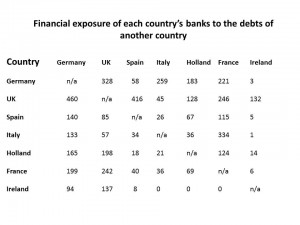 Similarly, French banks are exposed to $115bn of Spanish debt, while Spanish banks are exposed to $40bn of French debt. And UK banks are exposed to $198bn of Dutch debt while Holland’s banks are exposed to $128bn of UK debt. And, ludicrously, bankrupt Spain’s banks are exposed to $34bn of bankrupt Italy’s debts, while bankrupt Italy’s banks are exposed to $26bn of bankrupt Spain’s debt. Similarly, French banks are exposed to $115bn of Spanish debt, while Spanish banks are exposed to $40bn of French debt. And UK banks are exposed to $198bn of Dutch debt while Holland’s banks are exposed to $128bn of UK debt. And, ludicrously, bankrupt Spain’s banks are exposed to $34bn of bankrupt Italy’s debts, while bankrupt Italy’s banks are exposed to $26bn of bankrupt Spain’s debt.
So what does this all mean? It means that the slightest wobble in any major European country will bring the whole of Europe’s banking system tumbling down with such a mighty crash that it will be heard from outer space. This is why the EU cannot allow any country to default or any major bank to implode. This interconnectedness of debt between many mostly bankrupt countries could lead one to describe the whole European economy as a “house of cards in the face of a hurricane”. But, a house of cards in the face of a hurricane actually appears quite solid compared to the European countries’ dependence on each other not defaulting.
This is the first time these figures have ever been revealed in such a horrifyingly simple format – aaaaaarrrrrrgggggghhhhhhhhhh!
Still, at least the Aussies can laugh at Europe’s debt house of cards: “How can broke economies lend money to other broke economies who haven’t got any money because they can’t pay back the money the broke economy lent to the other broke economy and shouldn’t have lent to them in the first place because the broke economy can’t pay it back?” Enjoy https://www.youtube.com/watch?v=I5QwKEwo4Bc&feature=relmfu
(Btw I’d be grateful for your support for this website if you would buy some copies of my latest book GREED UNLIMITED)
|
|