|
|
By  David Craig, on April 28th, 2013 A couple of days ago, I published a list suggesting which companies were run by Britain’s most overpaid bosses. And I promised to list Britain’s “best value” bosses:
As with the list of Britain’s most overpaid bosses, these figures need to be handled with care. In some instances, CEOs may own large holdings of the companies they run and so seemingly modest remuneration has to be offset by the fact that one day they may cash in their holdings and get tens of millions. Also, further down this list are a few that don’t look logical to me.

(left click on table to see it more clearly)
However, the list does ask the question: How can some “best value” bosses survive on a modest million pounds a year or less while running large successful companies while other (overpaid bosses) need two, three, four million or even more a year while in charge of companies which aren’t doing so well?
By David Craig, on April 27th, 2013 (I’ve just come across something so unbelievable, that I’m delaying releasing the list of Britain’s “best value” bosses till tomorrow)
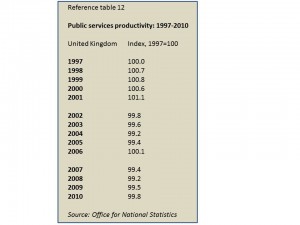
As the arguments rage on about the need for austerity versus cutting too far and too fast, there is a wonderful report from the Office for National Statistics which no politicians dare mention. This report reveals that productivity in the public sector has “increased” by a staggering 0.0% a year since 1997. In fact, it’s actually gone down by 0.02% in the 13 years from 1997 to 2010.
This is so incredible, that I have to quote the absolutely priceless conclusion of the ONS report:
“Productivity for public services has remained broadly constant between 1997 and 2010, with an annual average growth rate of 0.0%. Both public service output (activities performed and services delivered) and public service inputs (labour, goods and services and capital), grew by 3.0% per year on average”.
This is truly astonishing, truly amazing. Any organisation can improve productivity. A serious productivity improvement programme would target something like 20% in 12 to 18 months. A more relaxed approach would be 10%. A totally easy productivity programme might aim at 5% a year. An utterly pathetic attempt to improve productivity could be 2% to 3% a year. So, what has the British public sector achieved? Yes, it’s 0.0%! Nothing. Nada. Niente. Zero. Niechevo. Nul points.
Here are the ghastly figures: (click on diagrams to see them more clearly)
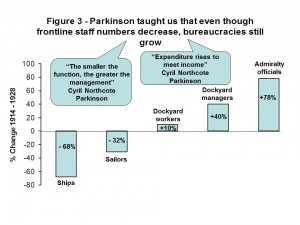
In the period 1997-2010, the number of managers in most areas of the public sector has doubled. (The NHS, for example, has gone from over 8 beds per manager in 1997 to around 3.7 beds per manager today) In the period 1997-2010, the average salary of public-sector managers has doubled and the average salary of public-sector-executives has shot up by around a factor of around four from about £70,000 to well over £250,000. And what have all these increasingly highly paid managers and executives achieved? OK, you guessed it – nothing.
So, what does this show? It shows that we should be slashing the number of managers in the public sector by at least 30% (getting rid of the worst) and that we should be demanding that the remaining managers and executives pull their finger out and else they get fired. No, not early retirement with £500,000+ pay-offs, but fired with nothing.
But sadly, what is actually happening in the public sector, is that most executives and managers are keeping their jobs and still getting salary increases, while reducing the number of useful frontline workers. This precisely reflects what management expert Cecil Northcote Parkinson (of Parkinson’s Law) observed when the navy downsized after the first world war – bureaucracies always grow by 5% to 7% a year, even when the number of frontline staff decreases;
(Source of public-sector productivity data https://www.ons.gov.uk/ons/rel/psa/public-sector-productivity-estimates–total-public-sector/2010/index.html )
By David Craig, on April 26th, 2013 A reader of this blog contacted me yesterday and suggested that I back up my claims about British bosses being overpaid by revealing some names and numbers. It’s quite difficult to find comparative figures. But there’s a company called Obermatt which produces a report looking at executive pay. In particular they compare financial performance with levels of executive remuneration (including bonuses and share options) and come up with what they call “deserved remuneration” and “excess remuneration”.
I’ve been through their figures and produced a list of the 20 UK FTSE100 companies giving their CEOs the most “excess pay” (see chart). The 1st column is the ranking by amount of excess pay: 2nd column their ranking by financial performance of the company: 3rd column the total amount received by the CEO for the 3 years 2008-2010 (inclusive): 4th column the pay level Obermatt judges appropriate: 5th column the amount of excess pay: (click on picture to see more clearly)
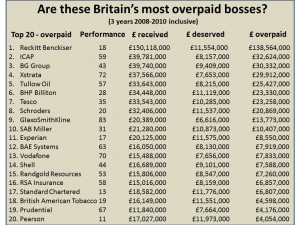
So you can see, for example, that the BG Group came third in amount of excess pay, while the company was only 43rd out of 100 in financial performance.
Care needs to be taken when looking at these rankings and figures. For example, if an executive had a long-term performance incentive plan which was paid during these three years (as I believe happened for Reckitt Benckiser), then this would skew the figures. Nevertheless, the table does suggest the names of a few companies where the CEO pay package may have been rather more generous than necessary.
So what can we use this for? Firstly, we can see that some of the amounts paid seem more than stunning. And secondly, tomorrow I’ll publish a list of the FTSE100’s most underpaid bosses. So we can question why some high-performing CEOs seem content with comparatively modest salary and bonus packages, while some poor-performing bosses are stuffing their pockets with tens of millions.
(source for the information – https://www.obermatt.com/rankings/uk/)
By David Craig, on April 25th, 2013 The economy may be stagnant. Our ever-rising national debt may be pushing us towards bankruptcy. We may be suffering from low wages and high inflation. But Britain’s bosses have never had it so good.
The figures are almost beyond astonishing. In the mid-1980s, executives at the FTSE100 companies were earning about 12 times the average wage. By 2012, this had rocketed up to 185 times the average wage, giving FTSE100 executives over £4.5m a year each. Actually, most are only on a basic salary of a bit over £800,000. But once you add in all the extras – long-term incentive plan, bonuses, share options, pensions and other benefits (see picture) – for most, the final figure rises comfortably above £5m:

Of course, business leaders will justify the massive increases in their rewards (compared to the stagnation of their employees’ pay) by pointing out the huge value they create. But the figures suggest that the value of British companies has declined by over 20% since 2000, while average executive compensation has doubled.

Many executives are not being paid for results – they are just looting the companies they are running. They get away with this larceny because they appoint the people on their remuneration committees. The members of remuneration committees usually come from a small elite circle of business leaders, financiers and free-loading politicians and peers (the new oligarchs I described in yesterday’s blog). And many executives sit on their chums’ remuneration committees. So, they all have an interest in continuously inflating executives’, and their own, rewards.
As economist JK Galbraith wrote over thirty years ago: “The salary of the chief executive of the large corporation is not a market award for achievement. It is frequently in the nature of a warm personal gesture by the individual to himself”.
(Tomorrow – Britain’s 20 most overpaid bosses)
By David Craig, on April 24th, 2013 I only read about it two days ago. But in a commonsense way, it explains the situation of the world and especially Europe and Britain today.
To quote from that great fount of (sometimes questionably accurate) wisdom, Wikipedia ‘The Iron Law of Oligarchy is a political theory, first developed by the German syndicalist, sociologist and fascist, Robert Michels in his 1911 book, Political Parties. It claims that rule by an elite, or “oligarchy” is inevitable as an “iron law” within any democratic organization. Michels stated that the official goal of representative democracy of eliminating elite rule was impossible, that representative democracy is a façade, legitimizing the rule of a particular elite, and that elite rule, that he refers to as oligarchy, is inevitable.’
In fact, Michels’ Iron Law of Oligarchy can be extended to any political system. Whatever the badge – democracy, socialism, Islamic republic or whatever – power and wealth will always be concentrated in the hands of a powerful elite. In the corrupt hell-holes of Africa, South America, India and Pakistan, this is obvious and the elites unashamedly loot their countries while keeping the masses in grinding poverty.
In Western democracies, the rule of the elites in less obvious. In fact, there have been periods in history – particularly the 20th century – where the power of the elites has been reduced and wealth has become more widespread. This has usually happened after major wars. Following the sacrifices made by ordinary people, there is a pressure for more equality. Thus, after the Second World War, we got the 1946 National Insurance Act and the NHS being founded in 1948. But gradually power and wealth will concentrate again in the hands of the few.
This is why it makes little difference which party we vote for.

In the public sector, we see an elite group of bureaucrats move from one highly-paid position to another however incompetent they are – Sir David Nicholson responsible for the Staffordshire hospital disaster now running the NHS, Lin Homer moving from the chaotic UK Border Agency to run HM Revenue and Customs are just two examples. This is why disgraced politicians – self-confessed liar and thief David Laws, the (IMHO) slippery Keith ” Vazeline” Vaz – seem to thrive whatever they get up to. In business, a small group of executives all sit on each others’ remuneration committees and hand out generous pay rises and bonuses, however appalling their performance. In the last 10 years, the value of the FTSE100 companies has decreased by 24% and at the same time executive pay has increased by 75%. In the 1980s top executives were earning about 12 times the average wage. By 2012 this had shot up to 185 times average wage.
This cosy elite club is why no banker has been prosecuted for fraud, although the evidence against some of them is overwhelming..
So it’s time to stop believing in the fairy tale of democracy. Power and wealth will always be concentrated in the hands of the fortunate few. And they will always protect each other in order to protect themselves.
(Somewhat disappointing that not a single person bought a copy of my book GREED UNLIMITED yesterday in spite of me asking for a few people to buy it to help support this website. Hey ho)
By David Craig, on April 23rd, 2013 (This was sent to me by a reader of this blog – I’ve tweaked this a bit, but can’t claim this as my own work. Apologies if you’ve already read this on other websites)
Helga is the proprietor of a bar. She realizes that virtually all of her customers are unemployed alcoholics and, as such, can no longer afford to patronize her bar. To solve this problem, she hires an expensive management consultant who comes up with a new marketing plan that allows customers to drink now, but pay later.
Helga keeps track of the drinks consumed on a ledger (thereby granting loans to the customers).
Word gets around about Helga’s “drink now, pay later” marketing strategy and, as a result, increasing numbers of customers flood into Helga’s bar. Soon she has the largest sales volume for any bar in town.
By providing her customers freedom from immediate payment demands, Helga gets no resistance when, at regular intervals, she substantially increases her prices for wine and beer – the most consumed beverages.
Consequently, Helga’s gross sales volumes and paper profits increase massively. A young and dynamic vice-president at the local bank recognises that these customer debts constitute valuable future assets and increases Helga’s borrowing limit. He sees no reason for any undue concern, since he has the debts of the unemployed alcoholics as collateral. This growth allows Helga to increase her staff from 2 to 11.
The bank vice-president is rewarded with a six-figure bonus.
At the bank’s corporate headquarters, expert traders figure a way to make huge commissions by transforming these customer loans into DRINKBONDS. Docile ratings agencies give these DRINKBONDS the highest rating level. These “securities” are then bundled and aggressively sold on international securities markets. Greedy but ignorant investors (other banks, pension funds etc) don’t really understand that the securities being flogged to them as “AAA Secured Bonds” are really debts of unemployed alcoholics. All the buyers are interested in are the high rates of interest that will be paid on the DRINKBONDS. So, these securities soon become the hottest-selling items for some of the nation’s leading brokerage houses and the DRINKBONDS are packaged and repackaged and re-repackaged so there are ever more DRINKBONDS for the traders to sell.
The traders all receive six-figure bonuses.
The bosses at the ratings agencies also all receive six-figure bonuses.
The people buying the high-interest-paying DRINKBONDS all get six-figure bonuses
One day, even though the number of DRINKBONDS being sold keeps on increasing, a risk manager at the original local bank decides that the time has come to demand payment of some of the interest on the debts incurred by the drinkers at Helga’s bar so that the buyers of the DRINKBONDS can start earning the promised high interest rates on their bonds. He informs Helga. Helga then demands payment from her alcoholic patrons but, being unemployed alcoholics, they cannot pay back even a small part of their drinking debts. Since Helga cannot fulfil her loan obligations she is forced into bankruptcy. The bar closes and Helga’s 11 employees lose their jobs.
Overnight, DRINKBOND prices drop by 90%. The collapsed bond asset value destroys the bank’s liquidity and prevents it from issuing new loans, thus freezing credit and economic activity in the community. The suppliers of Helga’s bar had granted her generous payment extensions and had invested their firms’ pension funds in the Triple A-rated DRINKBOND securities. They find they are now faced with having to write off her bad debt and with losing over 90% of the presumed value of the bonds. Her wine supplier also goes bankrupt, closing the doors on a family business that had thrived for three generations. Her beer supplier is taken over by a competitor, who immediately closes the local plant and lays off 150 workers.
Fortunately though, the bank, the brokerage houses and their respective executives are saved by being bailed out by a multibillion-dollar no-strings attached cash infusion from the government desperate to prop up the banking system and save it from collapse.
All these executhieves receive seven-figure bonuses.
Unfortunately, the government is already deeply in debt after years of spending much more than it takes in tax revenue. So the government has to massively increase its borrowings to raise the money to save the banking system. This increased debt pushes up the annual interest payments the government must make to service its ever-rising debts. The funds required to meet the government’s higher interest payments are obtained by punitive new taxes levied on employed, middle-class, non-drinkers and workers struggling to get by on the minimum wage – none of whom have ever been in Helga’s bar – and by cutting spending on things like healthcare, education, policing and defence. As the new taxes and spending cuts are just enough to cover the higher interest payments, it will be left to future generations to pay off the government’s increased borrowing. The rich naturally have smart accountants and so avoid these new taxes. The politicians who saved the banks all go on to take up extremely lucrative jobs at the banks they have saved with borrowed money that can probably never be paid back.
The politicians all become multi-millionaires.
Now do you understand?
(You’re welcome to forward this link to anyone you think might be interested. Btw, I’d be grateful if a few people would support this website by buying copies of my latest book GREED UNLIMITED)
(click on title to leave a comment)
By David Craig, on April 22nd, 2013 Hopefully you all have well-paid jobs and busy, interesting lives and so don’t have time to keep up with the obscure details of a vicious little spat developing between our hopeless, hapless chancellor and the equally hopeless IMF. So, I’lll summarise briefly:
A few years ago, a couple of US economists, Ken Rogoff and Carmen Reinhart, did a study which, they claimed, showed very high state debts were a cause of low economic growth. This study was used by pointless Osborne to justify his policy of reducing Britain’s deficit. Recently some other economists have allegedly shot a few holes in the Rogoff-Reinhart theory and this has allowed the delusional Ed “borrow-borrow” Balls to claim Osborne needs to ramp up spending by borrowing more. In fact, this whole discussion is meaningless as the way GDP is measured includes government spending. So if a government borrows and wastes a lot of money (Gordon Brown), for a while (until it goes bankrupt) it will look like there is economic growth.
In addition, the IMF, having previously supported Osborne’s plans to reduce the deficit, now says Osborne is wrong and needs to borrow and spend more. This is the same IMF that has imposed such drastic austerity on countries like Spain, Portugal and Greece that unemployment there has gone above 25% and youth unemployment is above 50%. These countries are now in a recessionary downward spiral where shrinking GDP leads to higher unemployment leads to lower tax revenues, leads to higher borrowing, leads to lower spending leads to higher unemployment etc etc
So, over the coming days we can expect lots of heat and fury (but little light) from politicians and journalists and other “experts” about whether we need more austerity or more spending.
But I think they’re missing the point. The real problem with useless Osborne’s plans is that he’s given us the ‘wrong kind of austerity’. Osborne has made major cuts in productive capital spending – building houses, schools, roads and so on – spending that creates jobs and contributes to real growth. At the same time, pointless Osborne has protected wasteful spending – spending that does nothing to stimulate growth. For example, he and Cameron have massively increased spending on the political classes – 117 Cameron cronies have been put into the Lords, expenses rules for MPs have been relaxed so they are now claiming on average £40,000 a year more than they did before the expenses scandal broke and over £80m was wasted on Clegg’s AV referendum. They have increased the cost of bureaucracy – £2m for the worthless Office for Budget Responsibility, another £2m for the equally disastrous Office for Tax Simplification, pay for bureaucrats has kept on rising, thousands of bureaucrats have been given 6-figure pay-offs only to return to their jobs a few days later as highly-paid consultants, many quangos have increased their spending by 30% or more since the 2007/7 crash, this year we’ll spend £70m on the laughable Equality and Human Rights Commission and so it goes on.
The real issue is not more austerity versus less austerity. The problem is that Osborne has protected the bureaucratic and political elites so our money keeps pouring into their pockets and pensions, while cutting the spending that creates useful jobs. What a buffoon, what a fool what a…….but hold on, Ed “borrow-borrow” Balls will be our next chancellor. Compared to him, useless Osborne is an economic genius.
By David Craig, on April 21st, 2013 Here’s a comment a Romanian reader (living in the UK, I think) posted on this blog after reading about Romanian gypsies coming to Benefits Britain:
“I hope that all million or so Romanian nationals like those in the pictures would move permanently to UK. Because those people are exclusively gypsies and hopefully all of them would leave Romania, leaving us, ethnic Romanians (85% of Romania’s population) free of them and the troubles they bring. Seeing their back is worth the humiliations we all, ethnic Romanians, are suffering in UK because of the gypsies. Take them and rejoice for the cultural enrichment they will bring. Oh, I will move back to Romania…”
And here’s a photo of a manhole cover:

Enjoy looking at it as, once a million or more Romanian gypsies move here, manhole covers will be a rare sight – holes in the road will be more common:

And here’s photo of a swan:

Enjoy looking at this too. Because, once our new arrivals find out that barbecued swan is both delicious and free, there won’t be too many swans left in Britain:

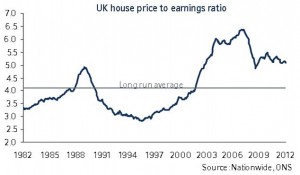
By David Craig, on April 20th, 2013 Yesterday I showed a chart of UK property prices and compared these to the current bubble in gold and silver prices. UK property prices are now around 5.5 times average earnings – down from a high of 6.5 times at the top of the market in 2007, but well above the long-term average of 4.2 times average earnings. So, are UK prices sustainable at their current levels?
Since the 2007/8 financial crisis, home prices have fallen much more in other affected countries. Ireland – prices down 50%: US – down 28%: Spain – down 22%. But in the UK and Italy prices are only down by around 10%.
Factors keeping UK prices up are the growing number of households due to immigration and divorce and a shortage of supply due to planning restrictions – Ireland, Spain and the US all had huge construction booms before the 2007/8 crash which led to an oversupply. There are also the Coalition’s desperate attempts to keep interest rates down and to shore house prices up till the next election in the hope that property price stability will win them votes.
There’s also an effect called “anchoring” which is shoring up prices. When prices of something increase, people get used to the higher price levels and see these as the “new normal”. And anyway, UK property prices seem to be increasing again. So, why worry?
Here are UK prices again:
And here’s a chart of US stock prices before and after the great 1929 crash:
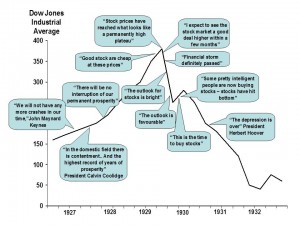
You’ll notice two things. 1. There are always lots of experts “talking up” the market 2. On the way down shares started to rise again. This is what’s called a “Fools’ Rally” – people have become so used to the “new normal” (higher prices) that they assume a 10% to 20% drop provides a wonderful buying opportunity. Invariably they are wrong.
House prices are always much “stickier” than share prices or gold prices so will respond much more slowly whether rising or falling than something like shares or gold which can quickly be bought or sold. And it’s almost certain house prices will continue to rise up till the 2015 election as the Coalition tries to create the illusion of economic stability while our national debt shoots up to unsustainable levels. So, no problem there.
But can property prices continue to defy gravity when Ed “borrow-borrow” Balls becomes chancellor and we have a massive financial crisis when the interest we pay on our national debt shoots up as markets lose confidence in chancellor Balls’s economic management? I don’t think so.
So, if you want to downsize, the next couple of years are the perfect time to do it. If you want to buy a bigger property, I believe you should wait 800 to 900 days to see how the dust settles after the delusional, buffoon Balls takes over.
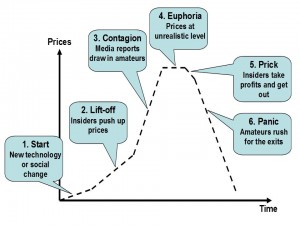
By David Craig, on April 19th, 2013 This is a bubble:

This is the way a bubble inflates and then bursts:
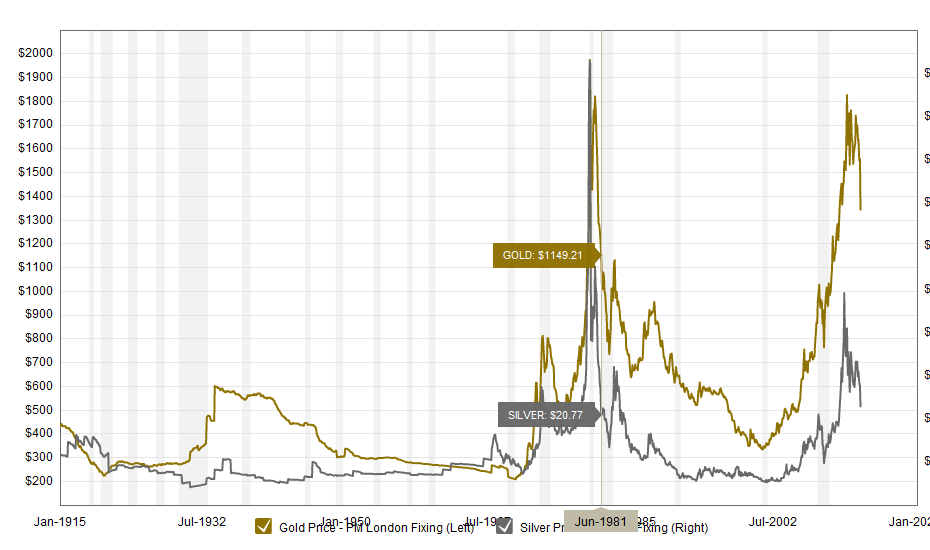
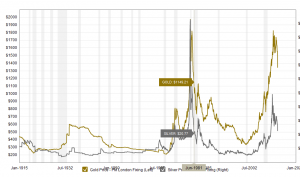
These are the prices of gold and silver – these look like bubbles:
This is the graph of UK house prices compared to average earnings. Are house prices at realistic levels held up by supply not satisfying demand? Or are we in a bubble supported by historically low interest rates?
And this is what might happen to UK house prices when Ed “borrow-borrow” Balls becomes chancellor, our national debt hits £1.7trn by 2017, markets lose confidence in the Miliband government’s financial competence, the interest we pay on our national debt shoots up, the rich move their money abroad, there is a collapse in the value of the pound and Ed “borrow-spend-waste” Balls is forced to push up interest rates and impose punitive taxes on our homes and savings to stave off national bankruptcy:

|
|