|
|
By  David Craig, on May 10th, 2014 Some photos of British soldiers giving the thumbs up over the dead bodies of Taliban fighters killed in a raid on Camp Bastion have appeared

The elites are apparently outraged and Amnesty International are squealing that this is a “war crime”.
But when photos like these appear

Those who claim to represent morality cower away in their luxurious offices (paid for by our taxes or our donations), terrified of offending a certain group in our society.
The cowardice and hypocrisy of our rulers are more than sickening.
By David Craig, on May 9th, 2014 (On a lighter note today, here’s an article I have on the Daily Express website)
If you’re ever with someone who is trying to sell you something – a home, car, insurance, clothes, new phone or whatever – here are 10 common tricks and traps you should look out for.
The Probe On your first contact with any salesperson, they’ll usually ask you a few questions. These have two main goals. Most obviously, they’re trying find out what you’re looking for. But they’re also aimed at finding out how serious you are about buying. For example, a car dealer would want to work out if you’re a tyre-kicker (someone who is just looking around but not intending to buy) or a fish (someone who can be caught and reeled in).
The Psychology Test To be successful in selling to you, a seller must quickly work out what kind of a person you are so they can adjust their sales pitch to appeal to someone like you. If you’re a positive, extrovert, glass-half-full person, then they’ll probably try to sell the dream – stress how what they’re selling will improve your life. But if you’re more of a glass-half-empty worrier, then the seller will sell security – focus more on the features and performance of what’s being sold.
The Make-a-Friend Sellers will have many tricks to make us like them as the more we like someone, the more likely we are to buy from them. One of the most frequently used techniques is called active listening. With active listening the seller will use all kinds of non-verbal gestures such as leaning forward, inclining their head slightly to one side, widening their eyes, pursing their lips thoughtfully and stroking their chin to show their interest in us. Some sellers even sit in front of the mirror at home practising their active listening skills.
The Trust Me Many salespeople are trained to portray themselves as trusted advisers helping us make the right buying decision rather than being seen as commission-hungry vultures slavering to get hold of our money. One of many ways of achieving this is the same side of the table. Rather than standing or sitting opposite the customer creating a situation where the seller and buyer are like adversaries facing each other, the seller changes their position so they’re standing or sitting almost beside the customer as if they’re working together with the customer to solve the customer’s problem – which house, car, TV, phone or insurance to buy.
The Persuaders Having managed to get us interested in buying something, the seller then needs to get us to make the decision to move ahead. To put pressure on us, they might try the closing door – suggest there’s only a limited time to get the deal they’re offering; or the phantom buyer – tell us there are other people interested in buying what we want even if this isn’t true; auction fever – use other real or phantom buyers to make us feel we have to offer a higher price if we’re to get what we want; or even the deliberate mistake – when adding up the price of something, they deliberately ‘forget’ some small part so that the buyer, thinking they’re smarter than the seller, rushes to complete the deal.
The One-Step Negotiation In the West, we’re used to most things we buy having fixed prices and so often feel uncomfortable haggling over price. Sellers understand this and will often quote an inflated price then allow us to negotiate a small reduction. Relieved at having supposedly achieved a price cut, most of us will then buy. Very few buyers will do two- three- and even four-step negotiations.
The Absent Authority If we do try to do more than a one-step negotiation, then a seller might use the absent authority trick. They could say something like, ‘I’d love to offer this at the price you want, but I’m not allowed to. If you want, I can ask my manager to see what they say’. Then off they’ll go to apparently fight for you against their tough sales manager. After a few minutes, they’ll come back with a small concession claiming this is the best they can do. But as the manager is an absent authority, you can’t negotiate any further.
The Feel-Felt-Found If a buyer is worrying about the price or features or reliability of what’s being sold, the seller might try the feel-felt-found. They may say, ‘I know how you feel. Many of our best customers felt like that, but when they bought this they found they were delighted at having gone ahead’.
The Close Most sellers will have the ABC (Always Be Closing) drummed into them by sales trainers and their sales managers. This means that at all stages of the sales process, sellers must be absolutely focused on the end result – closing the sale and getting their commission. Any seller who can charm customers, get them interested but doesn’t get the close will either have extremely skinny children or else no job at all.
SSI Once a seller has closed the sale, then it’s time for SSI (Sell Second Item). If we’re taking a car, SSI might be all kinds of extras, additional warranties and GAP and payment protection insurances. If we’re buying a suit, SSI might include a couple of shirts, ties and a belt. With TVs or phones, SSI would be a care plan – paying a lot of money for an extended guarantee. And with a home, an estate agent might pressure us to take out a mortgage with the mortgage broker used by their agency.
David Craig is the author of DON’T BUY IT Tricks and Traps Salespeople Use and How to Beat Them (Thistle Publishing. Available only from Amazon)
By David Craig, on May 8th, 2014 As the BBC bleats and moans about the brave, freedom-loving, peace-loving Syrian rebels being forced out of Homs and being betrayed by the world, I thought it might be worth producing an infographic guide to the Syrian conflict.
On the one side we have President Bashar “Basher” Al-Assad (click to see more clearly)

And on the other, we have the courageous warriors of the Syrian opposition (click to see more clearly)

Conclusions:
1. As usual it seems that our useless leaders may have backed the wrong side
2. I suspect most people in Britain feel we should leave the Syrians to their mutual slaughter and hope that both sides lose.
By David Craig, on May 7th, 2014 For many years our banks have wanted to make us pay them to run our current accounts for us. But they realised this would cause howls of protest at ‘greedy bankers’. But about 15 years ago, our banks had a collective brainwave – convince us that it would be a good idea for us to willingly pay for our current accounts.

So our banks introduced what they call ‘packaged accounts’ – current accounts with a few bells and whistles attached. These could be things like a bit of car breakdown cover, some travel insurance, maybe mobile phone insurance and being given the opportunity to put money in special savings accounts that are only available to customers who pay for their current accounts.

And our banks managed to persuade an astonishing eleven million of us to pay for these accounts.
These ‘packaged accounts’ will be good value for some of us. But eleven million of us? I doubt it. For example, some people will be too old to use the travel insurance, others may already be paying for car breakdown cover from being members of the AA (15 million members) or RAC (7 million members) or a similar organisation and the terms and conditions on the mobile phone insurance are often so restrictive that it’s next to useless.
These problems have been spotted by the claims companies who made fortunes from PPI mis-selling compensation and now some of them are heading for what they hope is another bonanza from ‘packaged accounts’ mis-selling

So, if you or anyone you know are generously giving your bank somewhere between £150 and £300 a year to run your current account for you, is it really worth it?
And, if you decide to stop paying your bank for your current account, then why not use just a little of the money you save to buy copies of my two most recent books – GREED UNLIMITED and DON’T BUY IT!
By David Craig, on May 6th, 2014 Anyone watching the news recently might have been reminded of the Who’s 1978 song “Won’t get fooled again” www.youtube.com/watch?v=g_SWP3qI7Rg Following the abduction of about 250 schoolgirls by Boko Haram Muslim militants, Nigeria’s current president, the possibly aptly named Goodluck Jonathan, has appeared on our screens belatedly explaining why the massive Nigerian military have done absolutely nothing to try to recover the girls.
Here’s a list of the most corrupt political leaders of the last 50 years (click to see more clearly)

(You’ll note that Argentina’s delectable Christina ‘Botox’ Kirchner is not on the list. I suspect she should be. But given that she is still in power and is still looting hundreds of millions every year while her country heads towards bankruptcy, I imagine she’ll soon join these other wonderful people)
Anyway, coming in at a very respectable fourth place is Nigeria’s former president, Sani Abacha. In the five years he was in power, before he died at the age of 54 while having sex with a group of Indian prostitutes, he was estimated to have stolen about $5bn – $1bn for every year in power, equivalent to $4m every single working day.
A recent United Nations report estimated that Nigeria loses around $10bn a year – $40m each working day – through corruption.
Here are Nigeria’s former president Abacha and the country’s current leader Goodluck Jonathan

They both look like nice people, don’t they?
Goodluck Jonathan, like pretty much every leader Nigeria has ever had, has promised to stamp out corruption. But not every Nigerian seems convinced (click to see more clearly)

Meanwhile the population of this potentially rich, but actually poverty-stricken, violent hell-hole has shot up from 45 million in 1960 to 168 million today and is projected to reach 440 million by 2050.
And what does Britain do about this utter catastrophe? Oh, of course, we give Nigeria lots of money to be stolen by the country’s kleptocratic rulers – £1,140,000,000 during the five years of the Coalition – about £38 from every British taxpayer.
The Who sang “won’t get fooled again”. But we and the Nigerian population have been fooled again and again and again and again…….
By David Craig, on May 4th, 2014 The great and the good bien pensants are forever preaching to us about how we should live our lives. Time and time again they lecture us from their moral high ground demanding that we hard-pressed, over-taxed workers should be handing over ever more of our money to help the Third World poor while our masters keep on hungrily pocketing ever larger amounts of our money for themselves.
But one thing our self-serving, arrogant, greedy betters never seem to mention is population. Or rather the possible link between overpopulation and poverty. But are poverty and population growth linked?
Here’s a list of the twenty poorest countries in the world (click to see more clearly)

(Oh look. Eighteen of them are in Africa)
And here’s a list of the twenty countries with the fastest growing populations

(Oh look. Fifteen of them are in Africa)
And here are the two lists put side by side

Oh, look. Twelve countries (the ones marked in red) are in both lists.
Good heavens, most of the countries that are poorest are in Africa. Most of the countries with the fastest rising populations are in Africa. And twelve of the countries with the fastest growing populations are also in the twenty poorest countries in the world.
What could this be telling us? That there’s a link between poverty and overpopulation? What a surprise! Who would have thunk it? I need to sit down to get over my total astonishment.
Why don’t the great and the good ever mention these (possibly inconvenient) facts when extracting money from us to supposedly ‘help the poor’? Because it would be ‘raaacccciiiisssstttt’ to dare to suggest that people in poorer African countries could better their own conditions by having slightly fewer children?
And so David Cameron is proud to have increased the amount of money we borrow to give to these basket-case hell-holes in foreign aid from about £7.9bn a year to over £11bn a year – an increase of over £3.1bn a year – enough to pay the salaries of the 40,000 troops and 34,000 police who are being fired here in Britain to save money.
‘Tis surely an odd (politically-correct) world we live in.
(Oh and while we’re on the subject of poverty – why not help stamp out poverty here in Britain by buying a copy of my latest book DON’T BUY IT!)
By David Craig, on May 3rd, 2014 Most readers will know that BA (formerly but no longer the ‘World’s Favourite Airline’) runs a loyalty scheme whereby the more you fly, you more points you collect theoretically to be exchanged for free flights or upgrades. I think the BA scheme used to use ‘Airmiles’ but now BA calls them ‘Avios Points’.
Anyway, a couple of years ago, my better half and I did a 6-month round-the-world trip with BA/Quantas and clocked up a surprisingly modest number of BA’s Avios points considering the distance we travelled. This week, I decided to use my depressingly few Avios points but was confounded by what looks like a massive scam being run by useless BA.
I had two problems:
1. The ‘you can’t upgrade’ scam First I rang Trailfinders to book a BA long-haul flight and tried to use my BA Avios points to upgrade us from monkey class to premium monkey class. No luck. I was told I would have to book my flight direct with BA to use my points for an upgrade. So I rang BA.
After 16 minutes expensively listening to the BA theme tune, I finally managed to speak to a human being. I tried to make the booking and do the upgrade with my points. But I was told that to upgrade from economy to premium economy, I would have to book the most expensive economy ticket – over £300 per person more than the ticket with BA that I could get from Trailfinders. I agreed anyway.
Then I hit the next obstacle. The BA agent claimed that all the possible upgrades with Avios points were already sold out, so I couldn’t use my points to upgrade anyway. Please note that I was looking to upgrade on a long-haul flight on any day in March 2015 – almost a year away! Yet, apparently the upgrades on all the 31 flights I could have taken were ‘sold out’!!!!
So, no luck with my upgrade. Back to Trailfinders where I managed to book premium economy seats with a rival airline for less than the price of economy class seats with BA.

2. The ‘free flights’ scam Being rather stupid, I had another brilliant idea – use my pathetically few Avios points to book my better half and I on a week’s holiday to Nice. On the phone again. This time only 15 minutes listening to the BA theme tune before contact with a BA booking agent. I found the flights from Gatwick to Nice, made the booking and was feeling pretty satisfied till the booking agent said I’d have to pay £170 in ‘taxes’. Now, I realise that taxes on flights are quite high. But before ringing BA, I’d looked at the EasyJet website and found that I could fly the same Gatwick-Nice route with EasyJet for £150 for two of us including flights and taxes.
So, I asked the BA booking agent how the ‘taxes’ on a supposedly ‘free’ BA flight could be higher than the full cost of a flight including taxes on a rival airline. First she claimed that EasyJet didn’t fly from Gatwick. Lie. Then she claimed that EasyJet had lower taxes because EasyJet was a ‘charter airline’. Lie. Then she said that if I wanted to discuss the matter further she’d put me through to ‘Customer Services’ and cut me off.
Conclusion – Having flown every week for over 20 years when I was working and having reasonable experience from more than 1,500 flights on various airlines, I’d say that the BA Avios points scheme is a massive scam.
You have been warned.
By David Craig, on May 2nd, 2014 (Here’s a piece I wrote for the London Evening Standard yesterday)
With Nigel Farage deciding not to fight in the Newark by-election, this has given the three establishment parties yet another stick with which to beat UKIP. And the insults are flying thick and fast.
The main parties are hoping to portray Farage’s decision as cowardice. But for UKIP the Newark by-election was a bear trap. It would have created a massive media circus distracting from UKIP surging into the lead for the May 2014 EU elections. Plus, if Farage had contested the seat and not managed to overturn the huge Conservative majority, the main parties would have been given yet another weapon with which to attack the new upstart contender threatening their grip on power and privilege.
But behind all the heat and bluster about Newark, there seems to be real fear now amongst the main parties that UKIP could actually cause a political earthquake by winning seats at Westminster in the 2015 General Election.
Of course, the British ‘First Past the Post’ system makes it extremely difficult for a new party to break through. But there may be some parliamentary seats where the barrier of ‘First Past the Post’ can be overcome.
Clearly, Tories or Labour or even LibDems are going to be almost invulnerable in any seat where they’re currently getting 50% or more of the vote.
But in any seat where two of the main parties are close, the maths can suddenly turn dramatically in UKIP’s favour. For example, if we take a close marginal like Romsey and Southampton North where the LibDems won almost 44% of the vote, the Conservatives 43% and remaining parties 17%. In such a seat, if UKIP could just take about a quarter of the votes from each of the other parties and encourage a few people, who have given up voting because ‘they’re all the same’, to vote, then they would win the seat with just 30% of the votes. And there are at least sixty five such ‘golden opportunity’ marginal seats spread all around the country.
UKIP’s polling figures keep rising and are now up around 38%. But UKIP could win most of these ‘golden opportunity’ seats with around 30% of the votes in the 2015 General Election. Even if UKIP’s support fell back in 2015 to around 25%, the party could still win about thirty seats at Westminster.
The main parties keep claiming that the EU elections are a distraction and that UKIP voters will abandon UKIP come the 2015 General Election. But the maths suggest that UKIP may be here to stay.
So, can UKIP win Westminster seats in 2015? Yes they can.
And here’s a (possibly over-optimistic) chart produced by some psephologists predicting how many Westminster seats UKIP could win in the 2015 General Election at different levels of the vote (click to see more clearly)

If this is anywhere near accurate, it’s no wonder that corrupt, expenses-thieving, arrogant, self-serving LibLabCon are desperately afraid of UKIP and are doing everything possible to smear their new rival.
By David Craig, on May 1st, 2014 As we all love a wedding, I’d thought I’d use today’s blog to cheer up our lives by bringing some heart-warming photos of weddings in today’s wonderful world.
Here are six joyous, smiling brides and delighted grooms, obviously very much in love (click to see more clearly)

Though, being somewhat old-fashioned, I’ve had difficulty working out which six are the brides and which six are the grooms.
And here are some more delightful wedding photos (click to see more clearly)

Don’t the pictures of the blissful, radiant brides fill your little hearts with joy? At least, I assume the brides are blissful and radiant. It’s just a bit difficult to see.
By David Craig, on April 30th, 2014 If you ever read the Money section of your weekend newspaper, you’ll see article after article about our savings in which the journalist writes something like “assuming growth of six per cent a year” or “assuming growth of seven per cent a year”.
Or if you’re saving for a pension, you’ll get three projections of how much money you’ll have by retirement – usually there will be a ‘low’ growth rate of 5%, a ‘medium’ one of 7% and a ‘high’ rate of 9%. Though, from this month pension companies will be forced to reduce these rates to: low – 2.5%, medium – 5% and high – 8%.
There’s only one problem – apart from the new low rate of 2.5% for pensions, all the other projected growth rates used by sloppy journalists and pension fund managers are pure fantasy. Well, not total fantasy – they did happen once (yes just once) in the last 300 years.
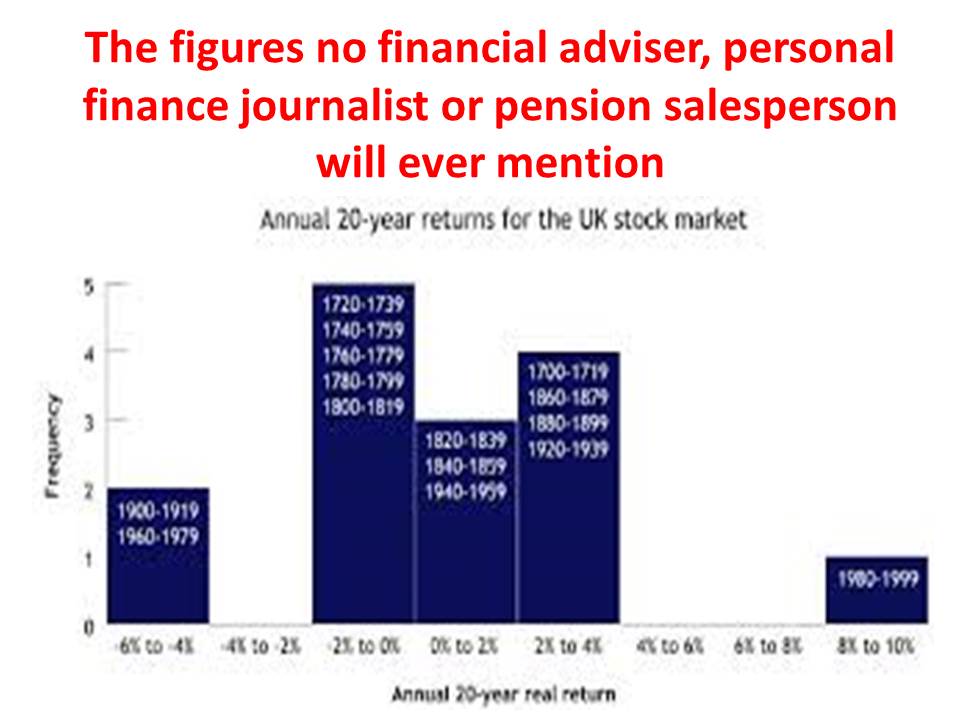
This may be the most important chart any saver, unit trust holder or person putting money in a pension will ever see. And it’s a chart no financial adviser, no newspaper financial journalist and no pension company will ever show you.
What this chart does is split the last 300 years into 20-year segments and show how often different levels of real (adjusted for inflation) growth have been achieved (click to see more clearly)
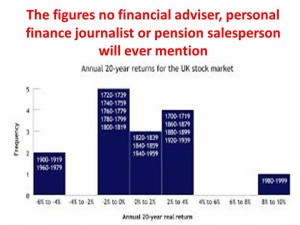
So, for example, growth of 2% to 4% was achieved four times; 0% to 2% three times; -2% to 0% five times and -6% to -4% twice. Growth above 4% a year was only achieved once – in the 1980s and 1990s.
(These figures don’t include dividends, so you can add on say 2% to 2.5% per year for these. But even so, the growth rates of 5% to 6% and even 7% a year commonly used by journalists and financial services insiders are pure fantasy. Moreover, if you have savings in unit trusts or pensions, you’ll probably be paying total fees of 2% to 3% a year. So, that will eat up most if not all your dividends.)
Why were the 1980s and 1990s so exceptional? The main reason is probably the baby-boomers. The 1980s and 1990s were the time when the baby-boomers were at their maximum earning and savings potential and were putting their savings into things like shares, unit trusts and pensions.
But as the baby-boomers retire and start to withdraw their savings to live off, it’s hard to see where new demand for shares will come from. After all, the next generation (Generation Debt) will be so burdened by paying off large mortgages on over-inflated house prices and repaying student loans that they won’t have much left to save. So it’s more than unlikely we’ll ever see ever see returns like the 1980s and 1990s again in our lifetimes.
What does this mean for us? Two things:
1. Next time some self-interested journalist writes about “assuming growth of six per cent” or your pension company sends you projections of 5% or 8% or whatever, please remember this chart. Such figures are pure fantasy.
2. If you are paying more than say 1% in management charges for your investments or pension, then the only person getting rich is your unit trust or pension fund manager.
If it’s of interest to any reader, I do a talk called HOW TO SAVE A FORTUNE. More details here https://www.howtoacademy.com/money/save-a-fortune-a-financial-masterclass-in-savings-pensions-and-other-financial-products-2309?fromcat=36 I’m looking for speaking opportunities. Ideally it should be to the management teams of companies or to clubs and similar organisations. I believe that anyone attending such a talk will be able to save themselves and their families anywhere from £5,000 to £50,000 from getting a better understanding of how financial services sell their products to us. If this could be of interest, please get in touch.
|
|