|
|
By  David Craig, on June 13th, 2014 I’ve written before about how our Government always talks about CPI inflation and hopes we forget about RPI – because CPI (which doesn’t include some things like housing, council tax, road tax and TV licence) is almost always lower than RPI. So, when telling us how high inflation is, the government uses the lower CPI to make it look like they are in control of the economy.
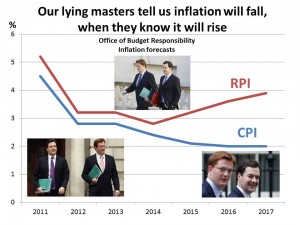
The Government uses the lower CPI for the indexation of most tax rates, allowances and thresholds, in order to take more money from us. However, even though the Government claims RPI is no longer relevant, it uses the much higher RPI for things like student loan repayments and for index-linking pensions of Bank of England staff, senior civil servants and politicians so as to take more money from us for our rulers
But the Government has also devised some extremely clever ways of fiddling the CPI figures so even these don’t tell us anything like the truth about the real level of inflation. The three main tricks are ‘Hedonic Quality Modelling’, ‘Substitution’ and ‘Geometric Means’ (please stay with me as this is quite important)
Hedonic Quality Modelling This allows statisticians to claim the prices of some things have fallen if those things are improved. For example, if broadband speeds increase while we pay the same each month, statisticians will conclude that the price has actually fallen even though we may get no advantage from faster speeds as most of the increased speed is used up bombarding us with ever more useless all-singing all-dancing ads. Or if the memory size of the average computer increases while prices remain stable, statisticians will decide that the price has actually fallen even though we get no increased ‘utility’ as programmes and apps become increasingly complex and memory-intensive.
Substitution Statisticians replace things that are rising rapidly in the CPI figures with things that have not risen. For example, if steak or salmon go up in price, statisticians will reduce their weighting in the CPI index or even take them out of the index altogether and replace them with something cheaper like chicken. The reasoning is that this is the way consumers behave in the real world. So, instead of measuring a constant standard of living, CPI is actually measuring a declining standard of living where rising prices are forcing consumers into making second, third and even fourth choices because they can no longer afford to buy the things they really want and which they used to buy.
Geometric means I don’t understand this, but apparently by using a ‘geometric mean’ rather than an ‘arithmetic mean’ this knocks at least another 1% off the supposed CPI inflation level.
I suspect that CPI inflation is really running at around 5% and RPI is in the region of 7%. (Pete Comley, author of the free ebook on Amazon about investing – MONKEY WITH A PIN – will have calculated the real inflation levels by the autumn).
Why is this important? The Government has 4 main ways of taking our money – direct taxes, indirect taxes, stealth taxes (not raising tax thresholds) and inflation. The one that nobody really notices is inflation. If my figures are anywhere near correct, then your savings, investments and pensions will look like they keep going up in value making you feel pretty good, but will actually have lost at least 20% of their buying power in the next 5 years and close to 40% within 10 years. This is happening and almost nobody in Britain realises it.
(And talking about prices, remember my latest book DON’T BUY IT! is available from Amazon as an ebook at only £0.99p for a very limited period. Now is the time to get a copy before the promotion ends https://www.amazon.co.uk/Dont-Buy-It-tricks-salespeople-ebook/dp/B00J0Y59GC/ref=tmm_kin_title_0 )
By David Craig, on June 12th, 2014 The Lawn Tennis Association’s (LTA’s) serial no-hopers Dan Evans and James Ward have both lost in just the second round of the Queens Club tennis competition. Of course, both are reasonable players and much better than most of us will ever be. But when you look at the hundreds of millions of pounds that have been spent (squandered?) on supposedly bringing up the next generation of British ‘champions’, their performance is less than impressive.
The LTA has an annual budget of about £60m. Around £35m of this comes from Wimbledon, about £10m comes from us stupid, gullible taxpayers and the rest comes from other sources. But where does this £60m go? It certainly hasn’t gone into helping any of Britain’s last 3 tennis champions. Remember Greg Rusedski, Tim Henman and Andy Murray all developed outside the LTA coaching system.
A few years ago, the Government increased the amount of taxpayers’ money going to the LTA. In return, the LTA set some goals such as the average ranking of the top five British men being 101 – the LTA only achieved 204. The year 2010 marked a low point for British tennis when a British team (funding £60m a year) lost to Lithuania – population 3.2 million and total annual tennis spend £100,000 a year. In fact, the dire state of British tennis was so bad, that in 2012, Sports England withheld around £10m in funding for the next 5-year period.
In 2007 the LTA’s National Tennis Centre in Roehampton opened at a cost of £40m to support the supposed elite end of the game. But many argue the centre is barely used and it certainly hasn’t given us many decent players.
Apart from Andy Murray there is not another British man in the top 100 and no sign of a budding Nadal or Federer. The situation for British women is slightly different, with two women in the top 100 but no-one anywhere near the top 20.
An awful lot of the LTA’s money seems to go into providing a very comfortable living for its bureaucrats. The previous boss of the LTA was paid an almost unbelievable £640,000 a year plus reportedly had massive expenses junketing around the world to attend all the best tournaments while staying in the best hotels and eating at the best restaurants. The new boss ‘only’ gets a modest £497,000 plus, of course, probably eye-wateringly generous expenses.
The LTA has long been criticised for having too many committees with too many people creaming off substantial amounts of money from being on these committees:

It is believed that many of these committee members also enjoy a jet-setting life thanks in part to the generosity of British taxpayers.
The LTA gets an awful lot of money and spends an awful lot of money – much of it apparently on the comfort of its own panjandrums. But the LTA seems to have done little to nothing for tennis in Britain. As one commentator wrote: “The LTA has mismanaged its huge budget, failed to grow the game and at times seems intent on managing decline hidden by the annual splendour of the Wimbledon Championships”.
By David Craig, on June 10th, 2014 Everyone knows the cliché ‘the operation was a success, but the patient died’. Perhaps this could be applied to Britain’s supposed ‘recovery’ from the 2008 financial crisis?
Almost every day we hear about Britain growing faster than any other developed country: how both manufacturing and services are growing: how our deficit is coming down and how stock markets are at record highs. Even Labour, who should be lambasting the Coalition’s economic performance, agrees that Britain is recovering but complains that with the ‘cost of living crisis’ only a few people benefit from the ‘recovery’.
There’s just one thing none of our opinion leaders and other ‘experts’ seems interested in mentioning – the massive rise in our national debt. This will have gone up from £350bn in 1997 to £700bn by the 2010 election to over £1.4trn by the 2015 election – an astonishing £46,000 for every taxpayer in Britain. To use another cliché, our debt is the ‘elephant in the room’.

Our interest payments on this Alpine mountain of debt are shooting up from £26bn a year in 2000 to £30.5bn a year in 2010 to £52bn a year by 2015 to £68bn a year by 2018.
To put this into context, we’re already paying more in debt interest each year than we pay on defence (£42.9bn).
We can expect relative calm till after the next election. But by around 2016/7 we can expect the proverbial to really hit the fan as our debts become so huge that the government can only borrow more at extortionate rates of interest.
There are only three ways a government can reduce debt:
1. Increase taxes Despite all the bleating by Guardianistas and the BBC about ‘brutal cuts’, public spending has actually increased every year the Coalition has been in power. As our leaders seem unable to reduce spending, they will be forced to tax us more. VAT has gone up, tax deductions on pensions savings have been whittled away and taxes have also been increased by not raising thresholds in line with inflation. Expect an awful lot more of this whoever wins the next election.
2. Renege on promises The Government has made a series of promises to us – these include paying various benefits and pensions. If the Tories win in 2015, we can expect necessary further reductions in our overly-generous benefits system (amid much bleating and handwringing from Guardianistas and the BBC) and for the government to step carefully away from its obligations to pay pensions by reducing amounts paid and eligibility. If Labour win in 2015, Miliband and Balls will probably increase benefits for the idle, feckless and parasitic while taking away the state pension away from anyone who was responsible enough to save in a company or private pension.
3. Default A government can directly default – refuse to pay it’s debts. Britain won’t do this. Instead the government will ‘default by stealth’ by allowing inflation to rise sharply thus devaluing the currency and reducing its own debts in real terms. We can already see this in the way the government only uses CPI as a measure of inflation rather than RPI which includes rapidly rising housing costs
From now till 2016 is the calm before the debt storm hits us. But around 2016 or 2017, things should get quite ‘interesting’.

By David Craig, on June 9th, 2014 At the risk of boring readers, I’m going to use today’s blog to bang on again about the farce of foreign aid.
Here’s a list of the countries which received the most foreign aid from the developed countries between 2009-2013. For each country receiving aid, I’ve laid out the total aid handed over, the GDP per capita and the country’s position on the Transparency International Corruption Perceptions Index (where 1 is ‘not corrupt’ and 174 is the ‘most corrupt’) (click to see more clearly)

So, what does this tell us?
1. Vietnam Why has this relatively highly developed country with reasonable GDP/Capita received more aid than any other country?
2. Ethiopia A corrupt, worthless basket-case country whose population is one of the fastest-growing in the world and has shot up from 22m in 1960 to 35m by 1980 to 66m by 2000 to about 90m today. Looks like Ethiopia’s problems are of its own making and that a little birth control would go a long way to solving this country’s self-inflicted poverty.
3. Turkey Hold on a minute. A wealthy (GDP/Capita of an amazing $15,353) country that is turning into yet another increasingly corrupt Islamic dictatorship is number 3 in the amount of aid received. What on earth is happening?
4. Democratic Republic of Congo Totally hopeless, poverty-stricken, deeply corrupt cesspit of human misery. I wonder how much of the $2.859bn went into building palaces for the rich and into buying them fleets of Mercedes?
5. Tanzania Not as corrupt as most African countries and therefore wealthier than many of them. So why does Tanzania get $2.831bn? Still, Tanzania’s rulers look extremely well-fed and are probably good customers at their local Mercedes dealership.
6. Kenya A bit more corrupt than Tanzania, but with a reasonable (for Africa) GDP/Capita. Maybe there are more deserving causes for the West’s money? Still, Kenya’s rulers look extremely well-fed and are probably good customers at their local Mercedes dealership.
7. Ivory Coast I wonder who got hold of this country’s $2.626bn – the poor or their rulers?
8. Bangladesh Utterly corrupt, but the workshop of the clothing world with a GDP/Capita of $2,080. Time to cut off the flow of our cash and let the country stand on its own?
9. Mozambique Probably a deserving recipient, though one might wonder who – the poor or the rich – actually got hold of the $2.096bn. After all, if the money has been well-spent, then surely Mozambique won’t need too much aid any more?
10. Pakistan Utterly corrupt hell-hole of backwardness and religious bigotry. Pakistan is our enemy – the Pakistan government deliberately hid Bin Laden near a large army base in the belief that he would be safe there. Pakistan has nuclear weapons and none of its multimillionaire politicians pay any tax. All aid should be stopped immediately!
11. Nigeria Utterly corrupt. With its vast oil reserves, Nigeria should be one of Africa’s wealthiest countries. But the ruling elites have stolen (and keep on stealing) the country’s wealth leaving over 90% of the population living in poverty. The UN should take over this cesspit, try the rulers and their cronies for corruption and start to reinvest the country’s wealth into roads, schools, hospitals, universities etc
12. India What? India – a nuclear power with more billionaires than almost any other country gets $1.667bn in aid! Time to stop this farce by stopping all aid to India.
13. Brazil Brazil! You mean the Brazil that is spending billions on the World Cup – much of the money being lost to corruption – while leaving tens of millions of its own citizens in poverty? Yet Brazil gets $1,288bn in aid. What a joke! Time to stop all aid to Brazil. If the country can afford the Sepp Blatter’s venal World Cup scam, it doesn’t need any of our money in aid.
Conclusion Hopefully this brief listing has shown what a farce most foreign aid is and that most of our money never goes anywhere near those who really need help.
By David Craig, on June 8th, 2014 Britain’s aid budget will be around £11.5bn this year. With about 30 million people working in Britain, this means that about £383 is being taken from every worker in direct and indirect taxes to be given to some of the world’s worst-governed, most corrupt and most hopeless basket-case countries.
Here are just five of Africa’s worst kleptocrats, almost all of whom receive hundreds of millions of aid each year from the West:
Omar Al-Bashir, President of Sudan – $1,128m/year in aid
Sudan’s President seized power in 1989 and then dispersed all political parties in the country, disbanded the country’s parliament and shut down all privately-owned media outlets. His reign has been characterized by a civil war in which over one million have been killed, while several millions have been displaced. Al-Bashir is still wanted by the International Criminal Court for instigating crimes against humanity, particularly in directing and funding acts of violence against the Southern Sudan. Famously corrupt, a diplomatic wikileaks cable revealed that Al-Bashir likely siphoned some $9bn of his country’s funds into his private bank accounts in the UK.
Robert Mugabe, President of Zimbabwe – $715m/year in aid
The 87 year-old megalomaniac has vowed not to step down despite having ruled the Southern African state for over 27 years. He has almost single-handedly wrecked the country’s economy, transforming the ‘breadbasket of Africa’ into an impoverished hell-hole while slaughtering hundreds of thousands of his own people. The average life expectancy for those not killed by Mugabe’s stooges is around 50 years.
José Eduardo dos Santos, President of Angola – $200m/year aid
José Eduardo dos Santos is Africa’s second longest serving president – 35 years. He has always run his government like it’s his personal, privately-owned investment holding company. His cousin serves as the Angola’s vice president, and his daughter, Isabel Dos Santos is arguably the wealthiest woman in the country. Angola is extremely resource-rich. But the vast majority of Angolans still live in the most horrid socio-economic conditions. 68% of the country’s total population lives below the poverty line of $1.7 a day, while 28% live on less than 30 cents. According to the U.N. Children’s Fund, 30% of the country’s children are malnourished. The average life expectancy is about 41 years while child and maternal deaths are extremely high.
King Mswati III, King of Swaziland – $125m/year in aid
Sub-Saharan Africa’s last absolute monarch presides over a country which has one of the world’s highest HIV prevalence rates – over 35% of adults. Its average life expectancy is the lowest in the world at 33 years; nearly 70% of the country’s citizens live on less than $1 a day and 40% are unemployed. But for all the suffering of the Swazi people, King Mswati has barely shown concern or interest. He lives lavishly enjoying luxury German cars, first-class leisure trips around the world and women. He once famously spent £450,000 on a fleet of top-range BMWs for his eleven wives while many of his people were starving. But his gross mismanagement of his country’s finances is now having dire economic consequences. Swaziland is going through a severe fiscal crisis. The kingdom’s economy is collapsing and pensions have been stopped.
Teodoro Obiang Nguema Mbasogo, President of Equatorial Guinea – $24m/year aid
Teodoro Obiang Nguema Mbasogo is Africa’s longest serving ruler. He has ruled Equatorial Guinea, a tiny, oil-rich West African country, since August 1979 when he overthrew his uncle, Francisco Macías Nguema, in a bloody coup d’état. Equatorial Guinea is one of the continent’s largest producers of oil and has one of the highest per capita incomes in the world, but the vast majority of Equatorial Guineans hardly have access to clean drinking water. The country also has one of the world’s highest under-5 mortality rates: about 20% of its children die before the age of five. Many of the remaining 80% of the children don’t have access to quality educational and healthcare facilities. Meanwhile, the first son of the president, Teodorin Obiang (who is in line to succeed his father), spends millions of dollars of state funds financing his lavish lifestyle which includes luxurious property in Malibu, a Gulfstream jet, Michael Jackson memorabilia and a car collection that could easily make billionaires go green with envy.
Conclusion We can all rejoice knowing that the £11.5bn our Government spends on foreign aid goes to a good cause – keeping Africa’s brutal kleptocrats in the luxury to which they’ve become accustomed.
By David Craig, on June 7th, 2014 Apparently there is some kind of ‘charity’ football match this Sunday called “Soccer Aid”. I suppose a bunch of preening, self-regarding multimillionaire celebs will be taking part while ‘doing a Bono’ – telling us to give our hard-earned, heavily-taxed money to their wonderful charity, while they keep their own fortunes safely hidden away from the British tax authorities.
So, where will the “Soccer Aid” money go? It will be given to UNICEF (United Nations Children’s Fund) an organisation that already receives around $4.2bn a year, mostly from Western governments (ordinary taxpayers). UNICEF’s boss, Anthony Lake only gets paid about $201,000 a year. But there are 36 UNICEF National Committees and that’s where the real money seems to be. For example, Caryl M Stern CEO of the US UNICEF National Committee, gets about $484,855 a year (tax-free, I think, as UNICEF is a United Nations organisation). This is her, smiling with delight:

So would you, if you were pocketing that amount of cash each year.
I’ve tried to get hold of UNICEF’s accounts to see where our money goes. But without success. All I’ve managed to establish is that UNICEF admits it spends around $636m on administration each year, though I suspect that, as with all the other ‘charities’ I’ve investigated, the real figure is at least three times higher.
And what will UNICEF do with the $3.588bn it does supposedly use for charity work each year? Around $2.492bn (70%) of UNICEF’s (our?) money goes to help the poor in Africa. Well, that’s good isn’t it? After all, Africa’s poor need our help, don’t they?
In fact, the bleeding heart liberals and the Guardianistas of this world often claim that Africa needs a Marshall Plan to escape from its backwardness and poverty.
But hold on a minute – the Marshall Plan gave Europe $15bn (the equivalent of $148bn in today’s money) over four years to rebuild after World War II. Africa currently receives about $50bn a year in Western aid. So, Africa receives the equivalent of a four-year Marshall Plan every three years and has done so for the last 60 years. That means that about twenty Marshall Plans have poured into Africa. Yet around 90% of Africa’s people still live in abject poverty. I wonder why.
Could Africa’s plight have anything to do with the stupidity, incompetence, greed and brutality of the kleptocratic buffoons who always seem to get power?

So, if on Sunday’s “Soccer Aid” some multimillionaire celeb tells you to give give give to a wonderful cause. Don’t bother. Repeated studies by foreign aid experts have shown that over 80% of all the money given to Africa is lost due to corruption and incompetence.
Oh, and to cheer us all up, here’s a Bird and Fortune sketch in which an African dictator, George Mparrbe, is being interviewed about what he’s doing with all the Chinese money flowing into his country https://www.youtube.com/watch?v=uwQWi4bahas Enjoy
By David Craig, on June 6th, 2014 Today our great leader, David “Winston” Cameron, lines up with other colossi of international diplomacy – Obama, Hollande, Kerry, Van Rompuy, Barroso etc – to celebrate the Normandy landings which led eventually to freeing Europe from German domination.
And while we’re thinking about the liberation of Europe from fascism, maybe the gritty British fighter for freedom, Baroness Ashton, will even take part? After all, she is one of the most important and most highly-paid diplomats in the world today and almost single-handedly liberated the Ukraine from its Russia-controlled puppet dictator

But as Cameron makes the usual pompous speech praising the courage of those involved in liberating Europe 70 years ago, while bowing and scraping to the likes of Van Rompuy, Barroso and of course Merkel, I wonder if he can see any irony in the fact that he will be the British leader who hands back control of Europe to the Germans – especially after most European policy areas will move from ‘unanimous’ voting to ‘qualified majority’ voting on 21 November this year.
And, while we’re on the subject of great British leaders, why not take part in our “Spot the Quisling” competition?

By David Craig, on June 5th, 2014 I’m seriously thinking about writing a new book. Though hopefully this madness will pass and I’ll not waste my time on such a futile exercise.
Anyway, while doing research for the book that will never be written, I came across a sentence in a somewhat obscure economics study which seemed to sum up why most Western democracies are failing and why we are drowning in an ocean of debt that can never be repaid:
“The government was reduced to a constant pandering to base motives of greedy citizens, a constant pursuit of faddist causes trumped up by noisy cliques and a constant bartering of self-interest amongst strong private factions to the exclusion of the broader interests of the nation”.
This was written about the US government in the early 1970s. But it seems to perfectly sum up our government today:
Pandering, not leading – Thatcher was probably the last real leader Britain had. She had a set of core beliefs (which you may or may not have agreed with) and she never deviated from doing what she thought was best for the country. Almost all politicians since then have only been interested in getting and holding on to power and reaping all the financial and other rewards that power gives them. And with around 55% of the population getting more in services and benefits than they pay in taxes, this pandering means ever more borrowing and spending until we are driven into national bankruptcy
Faddist causes – Whether it be gay marriage, fighting the myth of man-made climate change, increasing foreign aid to the world’s most corrupt countries or giving in to the demands of the increasingly strident followers of the Religion of Peace and Tolerance, our supposed leaders never miss an opportunity to grovel to whatever pressure group shouts the loudest in the hope that this will win them the approbation of the metropolitan mainstream media and votes from Britain’s dim-witted electorate
Self-interest of strong private factions – As I hopefully demonstrated in my book “GREED UNLIMITED How Cameron and Clegg Protect the Elites While Squeezing the Rest of Us” the powerful vested-interest groups in Britain – politicians, bureaucrats, business bosses and bankers – have all had a wonderful recession. In fact, during the financial crisis, all these groups prospered and got wealthier as the rest of us saw our lives blighted by unemployment, wage repression, rising prices and open-door immigration.
Looking to the future, one could be excused for feeling a sense of despair at the inadequacy of those who somehow believe they have the qualities to lead our country:

(Please note that as part of a promotion, the Kindle version of my latest book DON’T BUY IT! has been reduced to only £0.99. So now is the time to grab a copy before the promotion ends.
Even if you don’t have a Kindle reader, you can download a totally free app from Amazon for your computer, tablet or smartphone, which allows you to read my book on whatever device you use, here https://www.amazon.co.uk/gp/feature.html/ref=dp_kinw_strp_1?ie=UTF8&docId=1000425503 )
By David Craig, on June 4th, 2014 I don’t whether my readers (or many people in Britain) are aware that within the EU’s 28 countries there’s a group of countries that have got together and call themselves the ‘Friends of Cohesion’ (FoCs).
So, who are these FoCs? And does it matter?
The FoCs are Bulgaria, the Czech Republic, Croatia, Estonia, Greece, Hungary, Latvia, Lithuania, Malta, Poland, Portugal, Romania, Slovakia, Slovenia and Spain.
Why have these countries banded together to get what they want from the EU?
Well, here’s a clue (click to see more clearly)

The countries in the top part of this table from a German publication are those which are net contributors (Zahler) to the EU and those in the lower part of the table are countries which are net recipients (Empfanger) of EU funds.
Oh, look! All the countries (apart from Ireland) which are net recipients of EU funds are FoCs (I’ve indicated these with a red ‘FoC’), while none of the countries which are net contributors are FoCs.
So, we have a group of countries which can always block any EU legislation. And what do the FoCs want? More money, more money, more money.
Prior to the latest negotiations on the EU budget, the FoCs got together and produced a statement declaring:
- The European Union is facing an unprecedented crisis and needs to mobilize all available instruments to stabilize the economy, while restoring the conditions for sustainable growth and jobs. The European budget, and Cohesion policy in particular, should play a strong role in this regard.
- Further decrease of Cohesion policy funding – on top of the current Commission proposal – would not match the ambitions repeated in successive European Council conclusions nor the Treaty and the Europe 2020 Strategy objectives.
- The overall level of resources allocated to Cohesion policy should be in line with the Commission proposal in order to achieve our common European goals. There is no room for further reduction following the Commission proposal.
- Cohesion funding should remain concentrated on less developed regions and Member States, while recognising the need to help regions exiting convergence and phasing out regions to reach a higher level of development.
- The current level of co-financing rates should be maintained or even increased
Given that there are more countries which get more from the EU than they put in and given that they have banded together to block any reductions in the EU budget and even want the EU budget increased, I’d conclude that Britain’s attempts to control EU spending are doomed and Britain is totally FoCked unless we can get out of the EU.
(Please note that as part of a promotion, the Kindle version of my latest book DON’T BUY IT! has been reduced to only £0.99. So now is the time to grab a copy.
Even if you don’t have a Kindle reader, you can download a totally free app from Amazon for your computer, tablet or smartphone, which allows you to read my book on whatever device you use, here https://www.amazon.co.uk/gp/feature.html/ref=dp_kinw_strp_1?ie=UTF8&docId=1000425503 )
By David Craig, on June 3rd, 2014 Yesterday I wrote about how on 21 November 2014, a huge number of areas controlled by the EU move from requiring a unanimous vote in the Council of Ministers to something called ‘qualified majority voting’ (QMV). Probably most readers fell asleep with tedium while reading the post. But that’s one of the great ‘strengths’ of the EU – almost nobody in Britain (or Europe) has the slightest clue how it works and when the EU makes a power-grab, this is usually so clouded in bureaucracy and legalistic gobbledigook, that nobody has the slightest understanding of what has just happened.
So, at the risk of sending readers into a permanent coma, here are just a few lines explaining why the move to QMV is actually important.
The EU Commission – The ‘Government’ of the EU is the unelected and largely corrupt EU Commission stuffed with sycophantic yes-men (and yes-women), failed politicians (Andrew Lansley?) and politicians so tainted by scandal that they can no longer work in their own countries (Peter Mandelson?).
The EU Commission is the only body that can put forward legislation. Then, just like we have the House of Conmen and the House of Liars, the EU also has two legislative assemblies – the European Parliament and the Council of Ministers. Just like the House of Conmen and the House of Liars, these two bodies – the European Parliament and the Council of Ministers – can propose changes to legislation put forward by the Commission, but they cannot legislate themselves (click to see more clearly)

The European Parliament – In spite of the supposed ‘political earthquake’ caused by the rise in Eurosceptic parties, the European Parliament is still dominated (two thirds) by politicians who are committed to establishing a EU superstate and removing individual countries’ sovereignty. So, the ‘political earthquake’ changes nothing. In fact, it will probably accelerate the rush to form a superstate and make this irreversible before the 2019 EU elections in case there is a further rise in the Eurosceptic vote.
The Council of Ministers – So, we have a Commission obsessed with creating a single EUSSR superstate and a European Parliament obsessed with creating a single EUSSR superstate in which they will be our well-rewarded and unaccountable rulers. That just leaves the Council of Ministers as the last barrier to the United States of Europe (EUSSR). Until 21 November 2014, Britain had a veto in the Council of Ministers. But from 21 November 2014, as most voting moves to ‘qualified majority’ Britain becomes less than powerless to stop any legislation it believes is against our national interest.
Qualified Majority Voting (QMV) – Under QMV an act proposed by the EU Commission must have the support of at least 55 % of the EU Member States (i.e. 15 Member States in a Union of 28) and at least 65 % of the population of the EU.
Why is this important? – Of the EU’s 28 countries, 11 are net contributors and 17 get more out than they put in (click to see more clearly)

So there are more countries sponging off the EU than paying for it. Under QMV, the 17 spongers will always vote for ‘more Europe’ as ‘more Europe’ means more money for them. Moreover, the spongers represent more than 65% of the EU population.
Conclusion – It’s a stitch-up. Britain is becoming an impotent, but wealthy sub-region of an EU superstate. The EU will use Britain as a dumping ground for its unemployed (who lost their jobs due to failing EU policies largely to save the euro) and as a cash cow to siphon off billions to pour into the pockets of politicians and their corrupt business cronies in joke countries (or criminal enterprises) like impoverished Romania, mafia Bulgaria, mafia Italy, venal Greece, corrupt Spain, paedophile paradise Portugal and many others of a similar ilk.
So, the 21 November move to QMV is quite important – it’s the end of Britain as a sovereign country.
But don’t expect the mainstream media to mention this. After all, if people understood what was really happening, they might support UKIP.
(Please note that as part of a promotion, the Kindle price of my latest book DON’T BUY IT! appears to have just been slashed to just £0.99. Now is the time to get a copy).
|
|