
 David Craig, on March 31st, 2026
Tuesday-Wednesday blog
Arrest the victims!
First I just wanted to bring you a comment written by one viewer of a YouTube video about the Derby car ramming.
“All the 7 people injured will be arrested for getting in the way of the terrorist trying to wipe out the British people”
You can’t beat British anti-establishment humour. I guess that’s why our UK-hating government is trying to criminalise it and ban it.
Now on to today’s blog.
PPE- Piss Poor Economics?
Here are some recent prime ministers who studied PPE (Politics, Philosophy and Economics) at Oxford University: Harold Wilson, Edward Heath, David Cameron, Liz Truss and Rishi Sunak. Lots of other British politicians also did PPE at Oxford:
- Labour: Ed Balls, Yvette Cooper, Peter Mandelson, David Miliband, Ed Miliband, Ruth Kelly, James Purnell, Tony Benn, Barbara Castle, Alan Beith, Rushanara Ali.
- Conservative: Jeremy Hunt, Philip Hammond, William Hague, Damian Green, Nicky Boles, Alan Duncan, Chris Huhne, Michael Heseltine, Nigel Lawson.
- Liberal Democrat: Ed Davey, Danny Alexander.
And, of course, Britain’s most successful female Chancellor, Rachel Reeves, also studied at Oxford. Though she did the serious course – Pure Economics.
So what?
Theoretical nonsense?
One of the basic principles of economics is the ‘Supply and Demand Curve’. Here’s just one example:
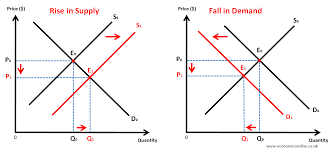
Professor Wikipedia tells us:
“Supply and demand is an economic model of price determination in a market. It postulates that, holding all else equal, the unit price for a particular good or other traded item in a perfectly competitive market, will vary until it settles at the market-clearing price, where the quantity demanded equals the quantity supplied such that an economic equilibrium is achieved for price and quantity transacted. The concept of supply and demand forms the theoretical basis of modern economics.”
I think this means if demand for an item increases, then the price asked will often increase. Conversely, if demand falls, then the price may also reduce in order to stimulate demand.
Professor Google helpfully adds:
“Adam Smith (1723–1790) popularised the concepts of supply and demand in The Wealth of Nations (1776), describing them as the “invisible hand” that guides free markets toward equilibrium. He theorized that market prices, driven by competition, naturally balance the quantity producers supply with the demand from consumers”.
Meanwhile back in the real world
Let’s imagine a multi-national company with manufacturing plants in say Britain, Poland, Hungary and the Czech Republic. Let’s just assume for simplicity that the factories make chocolate bars. Now let’s imagine a business-hating Labour government gets elected in Britain as people revolt after 14 years of Tory lies, incompetence, bungling, corruption and treachery. Now let’s imagine that the business-hating Labour government massively increases taxes on business and on anybody who can be bothered to get up in the morning and go to work. At the same time this business-hating Labour government hugely increases the benefits paid to the 9+ million scroungers and parasites who’d much rather stay at home watching Netflix or suchlike on their widescreen TVs than go to work.
The continuing increases in taxes and the financial burden of the ever-increasing number of idlers and layabouts send the economy into recession. The demand for chocolate bars in Britain falls. According to the wondrous ‘Supply and Demand Curve’ this will lead to a fall in the price of those chocolate bars. But that’s not what actually happens.
Faced with falling UK demand, the multinational realises that with increasing taxation and the world’s highest energy prices due to the monumental stupidity of Ed ‘two-kitchens’ Miliband’s insane Net Zero economic suicide, that they would be losing money on their British factory were they to reduce the price of their chocolate bars.
So, instead of cutting the price of the chocolate bars as the ‘Supply and Demand Curve’ predicts, the multinational instead shuts its UK factory and starts supplyig the UK market from its factories in Poland, Hungary and the Czech Republic. More than 150 UK jobs suddenly disappear. This also has a knock-on effect on the town where these 150 workers live as they can no longer afford to buy many of the things they did in the past.
Models like the ‘Supply and Demand Curve’ may have worked in Adam Smith’s era when manufacturing tended to be done within a country. But when most of the things we buy are now provided by multinationals with factories in several countries, a fall in demand in one country doesn’t necessarily lead to a price reduction. Instead it can lead to closing that operation. And once it is closed, it doesn’t re-open even if demand picks up again.
Professor Google tells us: “Based on analysis of ONS data released in early 2026, the UK manufacturing sector experienced a reduction in its workforce of over 36,000 people in 2025“
If I remember correctly, around 185,000 manufacturing jobs were lost in Europe’s manufacturing powerhouse – Germany – in 2025. The loss of these often well-paid jobs will be a catastrophe for those thrown out of work and their families. It will also have been disastrous for the towns where these 185,000 people live, leading to the closure of shops, restaurants, bars and other local facilities.
So, while Rachel ‘1+1=3’ Reeves, Torsten ‘tax-tax-tax’ Bell and Darren ‘they’re mostly women and children’ Jones play around with their outdated economic models, in the real world they are doing irreparable damage to the economy and people’s lives. The clever theoretical models predict that when demand rises again, the 36,000 Brits and 185,000 Germans who lost their manufacturing jobs in 2025 will mysteriously be employed again. Of course, in the real world that doesn’t happen because when businesses close – ‘once it’s gone, it’s gone’.

 Category:














Leave a Reply