|
|
By  David Craig, on February 16th, 2013 Here we go again. As the government’s Funding for Lending gives the banks cheap money, they don’t need our savings and so have cut interest rates on savings accounts to below the rate of inflation. So anyone with savings is being virtually forced to put them into stock-market “investments” like shares and unit trusts just to try and preserve the value of their money. Consequence – shares prices rise and all the usual journalists start gushing about the supposed “stock market boom” and advising us to get on the bandwagon. Helpfully, many journalists even suggest a few unit trusts where we could put our money.
So here are a few words of warning. Firstly, one financial journalist admitted that for financial journalists life was just a series of junkets as investment managers and unit trust managers and pension fund managers wined and dined them, took them to exclusive sporting events and even paid for their holidays to get their companies’ products mentioned in newpaper and magazine articles. After all, there are over 3,000 unit trusts – so how come just a handful repeatedly get their names into junketing journalists’ articles?
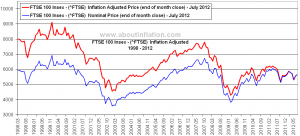
Secondly, share prices may be going up in nominal terms (blue line on the chart). But if you adjust for inflation (red line) then the picture isn’t quite as rosy as the well-junketed journos like to suggest. In fact, if you look at the inflation-adjusted (red) line, the FTSE100 would have to go above 8000 to reach its level of 12 years ago. It’s only just over 6300 at the moment, so it’s around 30% down in real terms.
Thirdly, quite a few FTSE100 companies earn much of their money abroad. So their rising profitability may have more to do with the collapse in the value of sterling than being based on business activities.
I feel shares are a bit too high at the moment given the economic situation. Personally, I bought a bunch of shares when the FTSE was at 5500 as I reckoned it would soon go above 6000 and anyway companies were paying more in dividends that the banks were in interest. But at current levels, I’m not confident. Of course, the dividends are very attractive compared to bank interest rates, but I suspect the FTSE will go below 6000 some time in 2013 and that’s when I’ll top up on more shares.
But why do I know? Maybe the junketing journalists are right and we should all be buying more shares?
(click on title to leave a comment)
By David Craig, on February 16th, 2013 According to some figures a reader sent me, there are about 1.2 billion Muslims making up about 20% of the world’s population. Muslims have won in total 7 Nobel prizes – so that’s about one Nobel prize for every 171 million Muslims.
In contrast, thanks to the efforts of the Germans and Austrians (enthusiastically supported by the French and Italians) there are only around 14 million Jews (just 0.02% of the world’s population). Yet Jews have won 129 Nobel prizes – one for every 108,000 Jews alive today. How can we explain the incredible disparity in achievement and contribution to mankind between 1,200,000,000 Muslims and just 14,000,000 Jews?
Of course, the usual bigots would probably suggest that the problem lies with the Islamic religion – its oppression of women, its discouragement of new thinking, its overly-literal interpretation of its holy book and its obsession with the past which means that the two main sects (Sunnis and Shiites) still love killing each other hundreds of years after the two main sects of Christianity (Catholics and Protestants) gave up internecine mass murder as a waste of time and energy and preferred to live in peace with each other. Then there’s also the unfortunate fact that one of the few Muslims to receive a Nobel Peace Prize was almost immediately murdered by other Muslims who disagreed with his desire for peace.
But I’m not a bigot. So I must conclude that the abject failure of Muslims to win Nobel prizes lies with the committees that award the Nobel prizes. Clearly they are heavily and shamefully biased in favour of Jews and against Muslims. Many Muslims have made huge contributions to mankind in medicine, science, literature and peace over the last century or so – although none springs to mind at the moment. Surely we should expose the scandal of anti-Islamic racism at the heart of the whole Nobel prizes set-up?
(click on headline to leave a comment)
By David Craig, on February 15th, 2013 One of the readers of this blog sent me this picture:

It’s a booklet produced by the Department of Work and Pensions explaining to new arrivals in Britain how they can start claiming benefits from the minute they arrive. No wonder the family in the photo look so happy. For people from a Third World country arriving in Britain is like winning the lottery.
This picture shows the English version of the booklet. But you can be sure that we taxpayers will have paid for it to be translated into at least 20 languages so anyone coming here will be able to get the maximum benefits as soon as they arrive whether they speak a word of English or not.
And with at least a million Romanian and Bulgarian families headed to Britain along with trash from all corners of the globe, we can expect to pay at least £30bn a year for the housing, schooling, healthcare and benefits for the next batch of new arrivals.
If you’ve ever wondered why the government can’t afford to give you a decent pension after all the money you’ve paid in National Insurance, hopefully this wonderful picture will explain why.
(please click on headline to leave a comment)
By David Craig, on February 14th, 2013 The media has been full of speculation about whether Britain will go into a double-dip recession or triple-dip recession. And it seems most politicians, journalists and economists all have an opinion that they’re overly keen to share with us in order to score points against their opponents (politicians), to earn their 80p a word (journalists) or to show how smart they are (economists). All these supposed “experts” use the level of GDP (Gross Domestic Product) to judge whether or not we are in recession. But hold on a minute. Why would you use GDP? It’s completely the wrong measure.
I admit I know about as much about economics as my hamster. Though that is an awful lot more than the (IMHO) worthless, lying, bullying waste of skin that is Ed Balls. But as far as I understand, GDP includes things like retail sales, government spending and private-sector activity such as construction, manufacturing and oil production. So let’s imagine a couple of situations
1. We all rush out tomorrow and buy some super fashionable clothes (actually cheap tat mostly made in China) at GAP or H&M. There will be asurge in retail sales and this will push up GDP. But what we’ve done is actually damaging Britain’s economy. It would have been better if we had used our money to pay down credit card and mortgage debts instead of buying Gap’s crap from China. So while GDP will show the economy is improving, we will in fact have weakened the economy.
2. Second scenario. The government decides to spend 3 billion of our taxes buying a worthless computer system from say Liam Byrne’s former employers – the thieving, tax-avoiding, multimillionares from Accenture. GDP would record this spending as a rise in activity. But in fact the government will just have wasted a few billion that could have been used to reduce the deficit rather than further enriching Accenture’s tax-avoiding partners.
Throughout the Brown Boom of 1997-2007 GDP went up and up and up and we ended up bankrupt. GDP went up because economic incompetents Brown, Balls and Miliband borrowed 400 billion, spent another 320 billion on PFI projects and wasted virtually all of this money. Yet GDP figures showed we were all rich and happy.
If the government cuts spending, that is good. Yet GDP figures would record this as a drop. If we save more and spend less on crap from China, that is good. Yet GDP would ecord this as a drop in economic activity. There is probably a good figure available which genuinely shows if we are in recession or not. But it is not GDP!
The fact that politicians, journalists and economists continually use GDP suggests they don’t understand it and haven’t a fr****ng clue what they are talking about.
By David Craig, on February 13th, 2013 Apologies for 2 days’ silence, but I was travelling then jetlagged. Anyway, maybe it’s me that is mad, but as far as I can see, Britain hasn’t yet had its real economic crisis. I know virtually every journalist (especially the supposed “economic experts”) are all singing from the same hymn sheet – the 2007/8 banking crash was the worst since 1929: the recession that followed was due to the banking crash: it’s taking much longer for Britain (and other countries) to recover from the recession, eventually growth will return. But I don’t buy this story.
As far as I can see, there are two separate disasters that just happened to coincide. One was the realisation that the whole banking industry was virtually bankrupt because banks had been selling financial garbage to each other and to pension funds after having the rating agencies’ help to dress up the garbage to make it look like gold. Many bankers became multimillionaires and even billionaires. When all this blew up, credit was frozen, banks couldn’t get access to funding and some were rescued at taxpayers’ expense while a couple were allowed to fail.
But there was a separate disaster – for decades most Western governments have been spending around $120bn for every $100bn they took in taxes. Dickens’ Mr Micawber warned us where this policy would lead. Even without the corrupt bank crisis, the crisis due to government overspending would have crashed most economies at some point. The banking crash just accelerated the government overspending crisis. Greece is already paying the price – 25% unemployment (50% amongst the young), waves of bankruptcies, homelessness, family breakdowns, rising suicide rate, riots, drastic cuts in public-sector salaries, cuts in pensions and so on.
But with the British government desperately inventing money to buy its own debt, we haven’t yet had to face the result of our ever-increasing debt – rising interest rates, an ever larger proportion of taxes going to pay off interest on our debt, a loss in confidence, the collapse in sterling and the choice of either defaulting or else of horrendous spending cuts and tax increases. That will probably happen in 2015 when our debt hits 1.5 trillion pounds.
The only comfort we can take from the situation is that it will be the new chancellor’s, Ed Balls’, job to clean up the mess for which he along with economic incompetents Brown and Miliband are responsible.
By David Craig, on February 10th, 2013 It really annoys me that so many people around the world fail to show sufficient tolerance to our peace-loving, broadminded Muslim brothers and sisters.
In Burma and Thailand, Muslims are forced to fight Buddhists. In India/Pakistan Muslims are forced to fight Hindus. In Indonesia and Nigeria, Muslims are forced to fight Christians. In the Middle East 700 million Muslims are being horribly oppressed (so they say) by a couple of million Jews. Also in the Middle East, when they’re not being oppressed by the Jews, then Muslims are forced to fight each other, because clearly it’s terribly important whether you’re a Shiite or Sunni (although most people couldn’t tell the difference). And throughout the world Muslims are having to defend themselves against the Great Satan – the United States – and its puppets like Britain.
Moreover, Muslims are forced to fight against homosexuality, atheists, agnostics, women not dressing with sufficient modesty, girls wanting education, doctors and nurses trying to eradicate polio, evil cartoonists, people who drink alcohol, people who don’t like forced marriage and so many other groups who deliberately set out to offend Muslim sensibilities.
Israel’s Benjamin Netanyahu once said: “If the Arabs put down their weapons today, there would be no more violence. If the Jews put down their weapons today, there would be no more Israel .” What a stupid thing to say.
I say, “If Buddhists, Christians, Hindus, Jews, atheists, agnostics, homosexuals, women who don’t want to wear veils, girls wanting an education, Westerners, doctors and nurses trying to eradicate polio, cartoonists, people who drink alcohol, people who don’t like forced marriage and many many others would only show more tolerance to our peace-loving, broadminded Muslim brothers and sisters and show them the respect they deserve, then the world would be a much happier place.” You know it makes sense.
By David Craig, on February 9th, 2013 Britain’s largest banking failure was the RBS, named Global Bank of the Year by The Banker magazine, a year or so before the bank’s implosion. Here Britain’s number one failed banker was former Deloittes accountant Fred Goodwin, Forbes Magazine Businessman of the Year in 2002. In early 2008, Fred was able to announce record results for 2007: ‘For the Royal Bank of Scotland Group, 2007 was defined by another strong operating performance and by the acquisition of ABN Amro’. Fred helpfully explained to the world at large why his bank was so successful: ‘Delivering such a robust financial performance in this environment is the consequence of action in two areas: over a number of years we have diversified the Group’s income streams and last year also saw us benefit from our focus on credit quality and risk management’.
As tens of billions of pounds of our money poured into the black hole that was and unfortunately still is the RBS, some of us might be tempted to wonder whether Fred’s claim of ‘focus on credit quality and risk management’ might not constitute a crime for gross misuse and abuse of the English language. It might even be construed as misleading shareholders and therefore worthy of prosecution.
Just before the bank’s ignominious collapse, Fred’s chairman, the £750,000 a year former pharmaceuticals boss Sir Tom McKillop also seemed proud of the bank’s diversification strategy and admirable credit control: ‘We have witnessed the benefits of the Group’s long-standing focus on credit quality and the diversification of our income streams which have allowed us to deliver record profits’.
At no time do RBS’s accountants, Fred’s former employer Deloittes, seem to have questioned the glowing self-congratulations of the bank’s bosses nor any of the dodgy numbers Fred and Sir Tom used to demonstrate the bank’s supposedly admirable profitability and financial strength.
IMHO the statements made by Goodwin and McKillop, shortly before the bank collapsed, are intended to mislead shareholders. So these two (IMHO) lying scumbags should be prosecuted. But, of course, they were mates of Tony and Gordon and are part of the elite of politicians, bureaucrats and bankers who have free rein to fleece the rest of us without ever suffering any consequences for their negligence, incompetence and dishonesty.
By David Craig, on February 8th, 2013 I’d be grateful if you could print out the letter below, stick in your address and send it to the Staffordshire Chief Constable asking for investigations and prosecutions for Corporate Manslaughter of three people. They are Martin Yeates (former chief executive of the Mid-Staffordshire hospital where around 1,200 patients died due to poor care), Cynthia Bower (head of the strategic health authority at the time of the disaster) and Sir David Nicholson (overall responsibility for the hospital).
Of course, I realise that some of the Stafford police bosses and hospital supremos are probably members of the same masonic lodge. And I realise that the government has probably told the police to stay well away from the healthcare scandal as incompetent, negligent, public-sector chiefs are never punished and are usually promoted out of trouble and given massive pay-offs to keep them quiet. But I have a feeling that if several members of the public report a suspected crime, then the police are obliged to at least give the impression they are investigating.
Thanks for your help
Mike Cunningham
Chief Constable
Staffordshire Police Headquarters
PO Box 3167
Stafford
ST16 9JZ
Dear Mr Cunningham
Following the appalling series of unnecessary deaths at the Mid-Staffordshire NHS Trust, I am writing to request that the police proceed with investigations and prosecutions of Martin Yeates, Cynthia Bower and Sir David Nicholson for Corporate Manslaughter.
I look forward to your confirmation that you are taking action and the case number you are giving your investigations and subsequent prosecutions.
Yours
By David Craig, on February 7th, 2013 When writing my blog, I try to include new information (often in the form of a graph or other illustration) that people may not already know. This is because I want my blog to be informative rather than just being a wild uncontrolled rant. But sometimes something happens which is so awful that all one can do is hurl frustrated abuse at the person (or people) responsible.
Last night I saw a (IMHO) truly repulsive human being being interviewed. This was Sir David Nicholson – head of the NHS. Sir David was chief executive of Shropshire and Staffordshire Strategic Health Authority, with oversight of Mid Staffordshire hospital, for a nine-month period in 2005-06 when the first instances of mistreatment and neglect are believed to have taken place. https://www.itv.com/news/update/2013-02-06/nhs-chief-did-not-see-abuse-on-visits-to-stafford-hospital/
Around 1,200 people died unnecessarily at the Mid Staffordshire hospital for which Sir David was responsible. But nobody has been punished. In fact, several of those responsible, like Sir David, were promoted. And now a new investigation is expected to reveal that at least 5,000 patients died unnecessarily at four or five other poorly-performing hospitals. In his interview Sir David denied any responsibility for anything and only seemed to be interested in preserving his own lousy job and his own generous pension – sod all the people dying in his hospitals.
Actually, the situation in the NHS is much worse than most people imagine. There was an internal NHS report written in 2006 or 2007 – I have a copy of part of this report. This report found that every year around 34,000 people die unnecessarily in NHS hospitals and another 25,000 are unnecessarily permanently disabled. This report is no lonnger available, for obvious reasons.
My book WHO CARES? describes just one of these tragedies and the lengths the hospital involved went to in order to cover up what really happened.
So NHS bosses have known for years (and covered up) that there have been widespread failures in basic care across the NHS. But they did nothing. They were too busy enjoying their hugely-inflated salaries and all the privileges of power to worry about thousand upon thousand of patients dying unnecessarily or being unnecessarily disabled.
Sir David – you are (IMHO) a lying, self-serving, bullying, greedy, worthless slug. You should be fired. You should be stripped of your knighthood. You should lose your generous pension and you should be prosecuted for corporate manslaughter. But of course in the Age of Incompetence you’ll keep your lousy job, your huge salary, your undeserved knighthood and your massive pension. I feel sick. But I’m not so sick that I would go to one of Sir David’s filthy Third World hospitals.
By David Craig, on February 6th, 2013 The establishment’s response to the catastrophic scandal at the Mid-Staffordshire NHS trust has been depressingly predictable. The chief executive, Martin Yeates, was allowed to retire with a £400,000 pay-off and didn’t even turn up at the public enquiry as he claimed to be too ill. The head of the trust, Cynthia Bower, was promoted to run the Care Quality Commission (responsible for care throughout the NHS) and the overall bureaucrat at the time, David Nicholson, was promoted to run the NHS.
And now that the official report has been published, the main recommendation seems to be – hire more useless, self-serving, overpaid, overpensioned bureaucrats. But let’s remember the massive increase in NHS bureaucrats which happened under Blair’s and Brown’s New Labour around the time Mr Yeates was killing off about 1,200 patients:
In 2001 the National Patients Safety Agency (NPSA) was established to: ‘improve patient safety in the NHS’ and by 2009 it had amassed 292 staff and an annual budget of almost £30 million. Unfortunately, after spending well over £100m of our money on paperwork and their own comfort, they still had no real idea of the number of unnecessary deaths in hospitals each year. One independent study even suggested that the NPSA was only picking up about 5% of incidents where avoidable harm was done to patients. The situation was so bad that in 2006 the Public Accounts Committee denounced the NPSA as being ‘dysfunctional’ and ‘not value for money’.
In 2002, the Nursing and Midwifery Council (NMC) was set up in order ‘to protect the public by ensuring that nurses and midwives provide high standards of care’. Its motto is also inspiring: ‘protecting the public through professional standards’. The NMC increased its budget from about £14.9m to £34m in the first seven years of its existence and now employs about 220 staff. Perhaps a little worrying for people in hospital is the fact that the NMC, which is responsible for ensuring we receive quality nursing, takes no disciplinary action against nurses in around 90% of the complaints it receives – most are rejected as ‘trivial’.
In 2002 we were also fortunate to be given the NHS Confederation. It calls itself ‘The voice of NHS Leadership’ and its aim is to ‘help members improve health and patient care’. Its budget rose by a factor of five from a tiny £5.3m in its first year to a much more impressive £29m. It too seems to be in the business of destroying innumerable forests to produce mountains of reports. Some could be useful such as Managing Excellence in the NHS and Bringing Leaders into the NHS. Some like Why We Need Fewer Hospital Beds might seem a little worrying to those of us who know that hospital over-crowding is one of the major causes of hospital-acquired infections.
In 2003 we got the Health Protection Agency (HPA) to look after our well-being. Its aim was ‘to provide an integrated approach to protecting UK public health’. The HPA has certainly been effective at spending taxpayers’ money. Its total costs increased by fifty per cent from £180m in 2004 to £270m and the number of staff went up from 2,518 to 3,160. The HPA produces a vast amount of presumably valuable literature about almost any medical topic you could think of including lots of guidance about reducing hospital-acquired infections such as MRSA and C Diff. In the meantime, these infections have claimed over 20,000 British lives. The death toll would have been less than 400 had these victims been living in countries like Holland, Denmark orSweden. In the same year, we also were given the Medicines and Healthcare Products Regulatory authority. It has eighty staff and an £80m budget, yet EU regulations should mean that medicines tested and approved in one member state should be available throughout the whole EU without any need for further approvals.
The following year, 2004, was a bit of a bumper year for new healthcare regulators with no fewer than three being established. In January 2004, we were blessed by the appearance of Monitor. Its mission is: ‘To operate a transparent and effective regulatory framework that incentivises NHS foundation trusts to be professionally managed and financially strong and capable of delivering innovative services that respond to patients and commissioners’. Its chairman earned over £215,000 in 2008-09 (almost £20,000 more than the Prime Minister) and it spends about £12.5m of our money a year supposedly regulating NHS foundation trusts so they provide better healthcare to us. Yet events at the Mid-Staffordshire NHS Trust which was granted trust status in spite of the unnecessary deaths of more than a thousand patients might make people wonder what Monitor is up to. At the time of the Mid-Staffordshire scandal, the head of health at Unison commented: ‘It seems unbelievable now that despite a history of clinical and staffing problems and failures at Mid Staffordshire, the trust was awarded foundation status in February last year. It is time Monitor the regulator was held to account’.
2004 also gave us the Healthcare Commission (HC). The HC’s motto is ‘Inspecting, improving, informing’ and it has an inspiring mission statement for its more than 500 staff: ‘The Healthcare Commission is committed to driving improvement in the quality of both the NHS and independent healthcare services and to making sure that patients are at the centre of everything we do’. The HC cost us about £70m a year. Then in the same year, perhaps to score a hat-trick, the government dreamt up the Commission for Social Care Inspection which by 2008 grew to 2,335 staff and a budget of £164m. This new organisation only lasted about four years as it was rolled into the Care Quality Commission (CQC) in 2009.
The CQC combined several existing regulators such as the Healthcare Commission, the Mental Health Act Commission and the Commission for Social Care Inspection. Its aim is: ‘To make sure better care is provided for everyone, whether that’s in hospital, in care homes, in people’s own homes, or elsewhere’. Had any of the other bureaucracies done their job properly, this new regulator would not have been necessary. Moreover there is only one certainty with today’s new generation of expensive, self-serving, regulatory-captured regulators – this new body will be as ludicrously expensive and as laughably ineffectual as all the others.
In its 1997 election manifesto New Labour promised to reduce administrative costs in the NHS, ‘The key is to root out unnecessary administrative cost and to spend money on the right things – frontline care’. Yet we now pay over £450m a year more for regulators than we did 15 years ago.
|
|