|
|
By  David Craig, on July 27th, 2013 By an extraordinary coincidence, there have been no less than three reports published in the last month claiming either that immigration is good for Britain or that old people are a burden for Britain or both at the same time.
First was a report by the OECD which laughably tried to prove that immigrants contributed more in taxes than they took in public services.
Then, last week the useless, sycophantically-obedient Office for Budget Responsibility produced a report concluding that the more immigration Britain had, the better off our economy would be. No doubt the head of the OBR, Mr Robert Chote, will get a knighthood or CBE for producing what is IMHO misleading government propaganda.
And yesterday, the OECD was at it again with yet another report – this time highlighting the supposed burden of the elderly. As one newspaper wrote – “Ageing population pushes welfare bill to crisis point. Britain’s rapidly ageing population threatens to push the NHS and state pension system to the brink of collapse, according to an international study that found almost a quarter of the UK economy is consumed by social welfare”.
Here’s a nice picture of immigrants camping out in the centre of London:

I wonder how the OECD and the OBR consider these people are contributing to Britain’s economy.
How come we get three similar reports at the same time? Coincidence? Or is it because our leaders and masters know that we are fed up of uncontrolled immigration: we are fed up of our hospitals looking like Third World butchers shops: we are fed up of our schools being unable to teach anything because too many children don’t speak English: we are fed up of our parks and streets looking like refugee camps and people are rightly fearful of what is going to happen from January 2014 when millions of Romanians and Bulgarians will be able to come to Britain and earn five to ten times as much on benefits here as they can get from working in their own countries?
Our leaders have handed over control of our borders to the corrupt, wasteful bureaucrats in Brussels who hate the idea of independent countries as they try to construct their European superstate. There seems to be a concerted campaign by the elites to justify opening up Britain as a dumping ground for almost anyone from anywhere in the world. Then when we’re swamped by 100,000 new migrants a year, our leaders will point to the three reports and try to claim immigration is necessary to support Britain’s ageing population.
Eventually, when our masters find out that immigration is actually costing us tens of billions a year, destroying our society and wrecking our economy, will this be their next great idea?

By David Craig, on July 26th, 2013 A couple of days ago, I blogged about the extraordinary number of supposed “charities” in Britain and suggested that the 874,829 employees and 945,278 trustees at Britain’s 180,281 charities probably did a lot better from our £58.65bn in donations than anyone actually needing charitable help https://www.snouts-in-the-trough.com/archives/5980
Since then, I’ve been looking at the average employee costs of a few of the better-known charities. Most charities seemed to come in at around the same level – the average cost of an employee (full time equivalent) including salary, NI and pension contributions is around £26,000. Save The Children seems to be lower than the average. Oxfam is a fair bit higher. But there’s one charity that really seems to be throwing donors’ money at its staff, rather than at the people it is supposed to be helping – the BBC Children In Need – where the average cost per person is an impressive £43,368 (click on chart to see more clearly)

I wonder why the BBC Children In Need staff are paid almost twice as much as staff in most other charities. Could it be because everyone working on anything connected with our bloated public broadcaster is overpaid and over-pensioned thanks to the enforced generosity of license-fee payers?
I have repeatedly argued that the BBC’s budget should be cut by 5% a year for the next 5 years and our clinically obese national broadcaster should be forced to stick to its charter – public service broadcasting – instead of making garbage in a pointless effort to compete with the increasing number of commercial channels.
Perhaps the inflated salaries and pensions of BBC Children In Need staff will further reinforce many people’s view of the BBC as a massive, self-serving, greed-ridden monstrosity that needs to be cut down to size. And if you want to give money to charity, I’d avoid giving it to the wasteful overpaid, bureaucratic parasites at the BBC Children In Need
By David Craig, on July 25th, 2013 I’ve been trying to make sense of Oxfam’s accounts to see how much/little of our money actually goes to charity. Here are some first thoughts.
Oxfam’s total income last year was £385.5m. But only £286.5m was actually used for what Oxfam and the Charity Commission call “charitable expenditure” – a reasonable, but not impressive 74.3%. Why so little?
Oxfam seems to have 3 main sources of funds – shops, public donations and government grants.
Its shops raise £89.9m, but cost £67.6m, leaving just £22.3m for charity. Not great, considering the people working in the shops are mostly volunteers.
It raises about £295.6m in donations with a cost for raising this money of £23m (7.8%). That looks pretty good. But £159.8m of these donations come from government, large institutions and public authorities. So, actually only £135.8m is raised at a cost of £23m (17%). Not great, but not disastrous either.
So we now know that of the £385.5m raised by Oxfam, £90.6m (shops – £67.6m plus fundraising – £23m) of this is spent getting the money in. That leaves about £294.9m to be spent.
Then we have to knock off about £31.9m for support and governance costs, leaving £263m – 68% of the £385.5m raised – available for charity work.
Now comes a bit of guessing. Oxfam’s staff costs are £59.5m in the UK and £42.3m overseas – total £101.8m. If we assume that say a third of these staff are in administrative and managerial functions and that two thirds are doing real charitable work, then the administration and managerial staff costs would be £33.9m. This would leave around £229.1m for charitable work (59.4% of the £385.5m raised).
Of the £229.1m available for charitable work, £90.6m is handed out in grants to other charities. As they will certainly have managerial and administrative costs of 20% or more, that’s another £18.1m not available for real charity. That leaves us with £211m – 54.7% of the £385.5m raised by Oxfam (click on chart to see more clearly)

Then there are a few other costs I haven’t included like the £48,000 expenses claimed by Oxfam’s top boss.
By my reckoning, only about 50% or less of the money given to Oxfam is actually used for real charitable work. That’s pathetic.
Then there’s one other not so small problem – how much of the money actually used for charity is lost to Third World corruption and incompetence? I’ll do a separate blog on that in the next couple of days.
All in all, you’re probably wasting your money if you give it to Oxfam and you’re probably wasting your time if you’re one of the 22,000 volunteers who help out at Oxfam.
(Tomorrow, I’ll have a brief look at the BBC Children In Need charity to see whether it might be more generous to its own employees than it is to the children it is meant to be helping)
By David Craig, on July 24th, 2013 There are many good reasons why the royal baby should be called Mohammed:
1. Looking on Mumsnet for the 100 most popular boys name in Britain, I found that Mohammed came in at number 19, Muhammed was 22nd and Mohammad was 63rd. This probably means that a boy’s name based on the name of the Prophet is already among the most popular boy’s names in Britain today
2. The Islamophiliacs who run our national broadcaster Al-BBC, would surely approve of the baby being named Mohammed as this would reflect the kind of open, tolerant, multicultural society so loved by the panjandrums at Al-BBC
3. Here’s a lovely picture of King Mohammed of Morocco. Our future King Mohammed could be just as “cool”

4. The boy’s grandfather has spent much of his life grovelling to Muslims, while showing little liking for Christians. So, surely he’d approve of the boy being named Mohammed
5. If we speculate that the royal baby will be king in about 60 years, we have to look at the religious make-up of Britain, not today, but in 60 years time. In the last decade, the number of Christians in Britain has dropped by 11% from 37.3m to 33.2m. At the same time, the number of Muslims has gone up by 80% from 1.5m to 2.7m. Even if these trends slow down a little, by 2073 we’ll have about 10 million Christians in the UK and closer to 15 million Muslims. So, a King Mohammed would better reflect the dominant religious group than a Harry or George or Edward or Charles or something like that
6. By the time King Mohammed gets the top job, Britain will no longer exist as an independent country. It will just be the Northwestern Province of the EU superstate. So we won’t need a king any more. Then King Mohammed can just become Sheikh Mohammed of the Northwestern Province
So come on Will and Kate. Show your open-mindedness: think of your child’s future as titular head of the EU’s Northwestern Province: understand that Muslims will be in a majority when your son becomes boss: seize this great opportunity – name your son Mohammed!
(Tomorrow, I’ll take a look at what Oxfam does with our £385.5m of donations and suggest why we shouldn’t give them any of our money)
By David Craig, on July 23rd, 2013 Charities in England and Wales raise and spend about £58.65bn a year. Of this, around £51.94bn (88%) is used for what the Charity Commission (the regulator for charities in England and Wales) classes as “charitable expenditure”. Looks good, doesn’t it? But let’s pry a little deeper into some more figures about the charitable sector.
There are an almost unbelievable 180,000 registered charities in England and Wales. Yes, 180,000. The population of England and Wales is around 56,600,000 – that’s a truly incredible charity for every 314 people!!!

These charities employ – wait for it – 874,829 people. Let’s assume the average cost of these people (including salaries, NI contributions, pension payments, office costs, computers, phones and so on) is a modest £25,000 a year (The average employee cost – just salaries and benefits – at the BBC’s Children in Need charity, for example is an attractive £43,368). This would mean that £22bn of the £58.65bn we give to charities is spent on staff costs. Some these staff may be doing charitable things like caring for children, answering helplines or conducting cancer research. But many of them will just be administrators, managers on high 5-figure salaries and executives on comfortable 6-figure salaries.
Incredibly, the Charity Commission allows charities to include staff costs under “charitable expenditure”. Perhaps it’s because doing this makes it look like most of our donations are being used for charity.
There are also 945,278 charity trustees. In theory, these trustees should not be paid. But some are and all can claim for their time and expenses. If we assume they claim on average just £500 per year each, that’s another £472,000,000 of our donations to charities going into someone’s pockets.
Each year, every charity has to provide a set of accounts and a report to the Charity Commission. If we assume this just costs £1,000 per charity – wow, there’s another £180,000,000 blown on administration. And we mustn’t forget the generous expense accounts enjoyed by many charity executives and managers. If each charity spent only £1,000 a year on such expenses – I’m sure many spend much more than this (the director of Oxfam, for example, runs up an annual expenses bill of around £48,000 – about £1,000 every working week) – there’s £180,000,000 more of our money gone up in smoke.
So, let’s look again at some figures. £58.65bn a year is collected by charities. Of this, about £6.71bn (11.4%) goes on governance and fundraising and a further estimated £22.5bn (38.4%) goes on staff costs. In all, about 49.8% of all the money we give to British-registered charities is spent by them on themselves, leaving just 50.2% for real charitable expenditure.
This is a very different picture to that painted by the Charity Commission which boasts that more than 88% of all donated money goes on “charitable expenditure”.
I don’t know what readers will conclude from this. But my conclusions are:
1. The number of charities should be slashed by over 90% from 180,000 to somewhere around 10,000 to 15,000
2. The number of staff working for these charities should be cut by at least 70% from the extraordinary 874,829 to perhaps 260,000
3. The number of trustees should be cut from 945,278 to maybe 50,000 at most
3. Making these obviously necessary cuts would release at least £15bn a year for real charitable expenditure
As far as I can see, it’s time to slash into Britain’s bloated, self-serving charities – cut the number of charities, cut the number of staff, cut all the chief executives and financial directors and marketing directors and trustees.
(Talking of charity – it would be nice if 4 or 5 of you could buy a copy of my latest book GREED UNLIMITED. It’s not because I want your money – I’m going to lose over £1,000 from doing the book – it’s just that it seems pointless for the books to be lying in piles around my home when people could be reading them)
By David Craig, on July 22nd, 2013 As the Coalition makes a few feeble efforts to slow the rise in benefits spending, we’re getting all the predictable howls of protest from the professional handwringers at the BBC, the Guardian and the Independent. So, who is right? Are all benefits claimants good, honest, highly-educated people who would like nothing other than a job? Or are there at least a million lazy, pig-ignorant, idle skivers amongst the benefits-supported masses?
Almost a quarter of all government spending goes on benefits – £166bn a year. Of this around £74bn is for paying the state pension. The rest – £92bn – goes on various benefits to the unemployed and the low paid. But how can we tell whether these benefits are going to people who deserve them?
Well, here’s a first clue. In the years from 1997 (New Labour being elected) till the 2007/8 financial crash, benefits spending went up at the same time as GDP. This meant that during the Brown Boom, ever more people were claiming ever more in benefits (click on chart to see more clearly)

Of course, the opposite should have happened. As the economy grew, benefits spending should have fallen. But the problem was that of the 2 million or so new jobs created during the Brown Boom, at least 1.77 million went to foreigners, because 1.77 million Brits couldn’t be bothered to work or couldn’t be bothered to get the education that would make them fit for work.
But there’s a conundrum here. During the Brown Boom, according to official statistics unemployment fell. So the benefits bill should have also fallen. Why didn’t it? Well, here’s clue as to how our leaders manipulate the figures to lie to us. At the same time as unemployment seemed (according to our lying leaders) to be falling, the numbers claiming incapacity benefits shot up (click on chart to see more clearly)

Yup. To hide rising levels of unemployment, both Conservative and New Labour governments pushed about 1,500,000 people, many of whom were capable of work, onto incapacity benefits so they would not show up on the unemployment figures. When Brown claimed there were more people in work than ever before, he wasn’t exactly lying, but he wasn’t telling the truth either. Too many new jobs went to foreigners, while the real levels of unemployment amongst British people were hidden by allowing so many to sign on as being unable to work.
While we should feel every sympathy for those who have lost their jobs since the 2007/8 crash, these two charts suggest that we might be justified in thinking that many of those who didn’t find jobs during the Brown Boom were just ignorant or lazy scroungers.
(click on title to leave a comment or see comments)
By David Craig, on July 21st, 2013 Hopefully most people realise that most/all politicians lie most/all of the time. But it can be difficult to prove they’re lying. For a start, by putting pressure on obsequious, career-focused civil servants, politicians can control the information we are given. And even when the information is available, it often requires a fair bit of forensic analysis to expose the lies.
Here’s just one example of New Labour lies I found while writing SQUANDERED. In 1997, applications for asylum were running at about 30,000 a year. By 1999, they had more than doubled to over 70,000 a year. In 2002, aware of public concern, Britain’s most accomplished liar, Tony Blair, pledged to halve the number of asylum seekers and, sure enough by 2006 the number dropped to around 23,000 (click on chart to see Blair’s lies more clearly)

What Blair’s government didn’t mention was a massive increase in citizenships granted to foreigners (see chart). In order to make it look like they were reducing the number of asylum seekers, Blair’s government started throwing British passports around like confetti. When immigrants were being given passports so freely, they didn’t need to claim asylum – hence the almost miraculous drop in asylum seekers.
So, what lies are we being given by Coalition politicians? Last week we got the whopper about the £9bn 2012 Olympics having generated £10bn for Britain. Total garbage of course. We’re also getting plenty of lies about supposed Man-Made Global Warming. Having signed up to the new Global Warming religion, our leaders find themselves trapped by their own stupidity and forced to continue with energy policies that are destroying British jobs and wrecking our economy.
There are plenty of lies about the EU. No politician and no grovelingly-sycophantic journalist has felt it necessary to admit that unpopular policies like legalising single-sex marriage and privatising the Royal Mail (at a cost to us taxpayers of around £9bn), have been forced on us by the EU.
Then there’s immigration. Our leaders claim they can’t predict how many Romanians and Bulgarians will come to Britain after restrictions are lifted in January 2014. Yet more lies. Spain and Italy have fewer restrictions and there are about 920,000 Romanians and 170,000 Bulgarians in Spain. In Italy there are about 997,000 Romanians and over 70,000 Bulgarians. Britain has much more generous benefits and more jobs than Spain or Italy, So the absolute minimum number that will be moving here will be well over one million. Probably it will be closer to two million.
Knowing that a tsunami of immigration is going to hit us next year, our leaders are once again producing reports claiming immigration is good for Britain as we supposedly need more young immigrants to support our ageing population. Let’s test that – unemployment amongst Romanians and Bulgarians in Spain is 36.4% – that’s about 396,760 immigrants who are unemployed. So we can expect somewhere in the region of 400,000 Romanians and Bulgarians to be claiming benefits for housing, council tax and unemployment here in Britain. That will probably cost us about £200m a week – £10bn a year. (There are already more than 140,000 here, many of them claiming benefits, in spite of supposed restrictions) It’s a pity our leaders haven’t bothered to give us these figures either.
So, what can we expect from our masters from now to the next election and far beyond? Lies, more lies and even more lies.
(click on title to leave a comment)
By David Craig, on July 20th, 2013 Just as our greedy, lying, lazy, expenses-fiddling MPs head off for their well-paid 8-weeks summer holidays, the Government has issued a report claiming that the 2012 Olympics came in on budget at around £9bn and (conveniently for our leaders) produced £10bn in benefits for Britain. The worry is that some people might be stupid enough to believe them.
Here are the figures for the original Olympics bid – the bid that was accepted by the International Olympics Committee (IOC) when the Games were awarded to London.

According to this, the Games should “only” have cost around £4bn and we taxpayers would “only” have to pay about £1.8bn of this. A bargain?
But once London was awarded the Games, the “budget” was quickly changed:

The total cost had suddenly more than doubled to over £9bn and the taxpayers’ share more than tripled to over £7bn. A cynic might have concluded that the original figures were just a bunch of lies cobbled together to win the Games and that those behind the figures knew all along that they were lies.
As for the supposed £10bn in benefits for Britain. Well, I seem to remember that during the Olympics, London hotels were slashing their prices in a desperate attempt to attract visitors and restaurants were unusually empty – knowing the Olympics were on, hundreds of thousands of tourists stayed away. And while Cameron and Coe and Boris Johnson were gabbing on yesterday about the tremendous benefits from their Olympics, sad old Vince Cable admitted that the whole report was a “marketing exercise” aka a load of bollocks.
Oh, and here’s a picture of the very rich Mr Coe. Having spent £9bn of our money on the London Olympics, he may well become the next head of the IOC. A cynic might conclude that the London Olympics really were a very expensive (for us) job application for him:

By David Craig, on July 19th, 2013 The OBR (Office for Budget Responsibility) has just come out with a report claiming that Britain needs about 140,000 immigrants a year. The OBR is a supposedly “independent” body, costing us more than £2m a year, which conveniently always predicts the economy is growing just as Chancellor Osborne produces his fanciful budgets. And every single OBR forecast has been laughably and predictably over-optimistic.
Well, now as Britain faces a tidal wave (or even tsunami) of immigration from Romania and Bulgaria, the OBR has (conveniently for our leaders) produced a report full of supposed “facts” and “figures” supposedly “proving” we need more, not less immigration.
One chart in the OBR propaganda/report (delete as appropriate) pretends to show that old people cost us lots of money (click on chart to see more clearly)

Another “useful” chart laughably claims that the higher immigration is, the lower our future national debt will be (click on chart to see more clearly)

The OBR report implausibly claims: “Our sensitivity analysis shows that overall migration has a positive impact on the sustainability of the public finances over our 50 year horizon. Under our central assumption of 140,000 annual net inward migration from 2016 the public sector net debt to GDP ratio reaches 99% by 2062-63, while assuming zero gross migration increases the net debt to GDP ratio to over 174%”.
Well, that’s alright then. Open up the borders and let them all in.
But could it be that the OBR report is just a little biased? Or even a bunch of lies?
Here are just a few counter arguments:
– Old people work for longer and are healthier for longer. So the OBR projections of the cost of an ageing population are plain wrong
– Immigration has led to an increase in criminality – a third of all crime suspects arrested in London last year were foreign nationals, according to new police figures. Just over 72,500 foreigners were held by the Metropolitan Police and questioned about crimes ranging from fraud to murder.
– We’re going to need an awful lot of new houses, schools, hospitals and prisons to cope with a new wave of immigration. Where are we going to find the money to build and staff them?
– Unemployment is much higher amongst certain immigrant groups than it is amongst the ethnic British population and the desire to work is much lower (click on chart to see more clearly)

No doubt the head of the useless, politically-correct, sycophantically-obedient OBR, Mr Robert Chote, will get a nice big bonus this year for grovelingly doing his masters’ bidding. But as for the OBR’s forecasts and reports – you can either use them for lighting the barbecue during the “wash-out summer” forecast by the equally useless Met Office or else just chuck them in the garbage.
(A wonderful day yesterday – am amazing two people bought copies of my latest book GREED UNLIMITED – I’m £5 less poor – yippee!)
By David Craig, on July 18th, 2013 This was Paul Steane before he went into a NHS hospital for a minor operation:

Unfortunately for Paul Steane his local hospital was the George Eliot Hospital (GEH). The GEH is one of the hospitals a recent report classed as one of the worst in England for excess death rates.
Shortly after being discharged, Paul suffered Acute Renal Failure (from dehydration – not being given enough water to drink) and had to be readmitted. He was probably discharged too early because the hospital was “hot-bedding” – getting patients out as fast as possible to free up beds to meet government targets on A&E waiting times.
Then followed a series of further blunders. To save his life, surgeons had to cut open his throat and insert a tracheotomy (a tube put into his throat so he could breathe):

Because he wasn’t looked after properly, he developed a blood clot and his feet became rotten from lack of blood flow:

So he had to have a leg amputated.
Finally, in constant pain and unable to walk, talk or breathe properly, Paul Steane took his own life to free his family from the burden of having to look after him.
The GEH denied any responsibility for Paul’s suffering. But a nurse, outraged at how the family were being lied to, sent Paul’s wife, Amanda, a copy of a blood test done just before Paul was first discharged, The blood test showed clearly that Paul was about to suffer Acute Renal Failure and should never have been discharged.
The GEH first claimed that no blood test had been done on Paul on the day of his discharge, so there were no indications that anything might go wrong. When Amanda showed this incriminating blood test result to the GEH, it claimed the results had been lost and fought for years to deny the catastrophic series of blunders which led to Paul Steane’s death. When the GEH finally admitted liability, all those involved were promoted out of trouble and one key figure in the scandal may soon end up in a very senior NHS position.
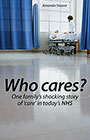
This whole horrific story of negligence, lies and cover-ups is described in horrific detail in a book I published WHO CARES? by Amanda Steane. At the time (2007) a Sunday Times journalist was interested in covering the story. But apparently their editor said it wasn’t important – pity really, many thousands of lives could have been saved if that editor had realised the scale of the disaster in the NHS.
Since Paul killed himself, tens of thousands of patients have died unnecessarily in our filthy slaughterhouse hospitals and not a single person has been fired and not a single person has been prosecuted.
If anything like this had happened in a private hospital, our politicians would be screaming for those responsible to be punished. But when it’s the NHS, incompetence, dishonesty and blundering are always rewarded with promotion.
|
|