|
|
By  David Craig, on March 31st, 2014 A few days ago, most of the mainstream media went into paroxysms of delight as they announced that the £79m a year Ofgem had asked another regulator – the Competition and Markets Authority (CMA) – to investigate the energy market. On this blog, I tried to point out that this was merely a delaying tactic by the useless £79m a year Ofgem as the CMA study would take about 2 to 3 years and that in reality it was the £79m a year Ofgem’s job to regulate the market.
Finally, one newspaper seems to have realised the truth. Under the title “Pull the plug on Ofgem – nobody will notice” one Sunday Times journalist wrote “The is as abject a capitulation by a regulator as can be imagined”. The article then went on “Ofgem’s job is to police energy companies and look after the public interest”.
On my blog yesterday, I laid out (hopefully clearly) how the Big Six energy companies have repeatedly lied to us and fleeced us for years. Today, I’ll provide a little bit more information to reinforce my argument that the energy companies, ably assisted by the supposed regulator Ofgem, are having a laugh at our expense.
As I explained yesterday, the energy companies claim they have low profit margins of 4% to 5%. But this is just on supplying gas and electricity to households. The companies deliberately keep these profit margins low so they don’t appear to be fleecing us. Where they make the big money is on generating power or extracting gas which they then sell to themselves at vastly inflated prices. Here are just a few 2012 profit margins I managed to find:

And we could also look at the dividends the energy companies paid their owners – often foreign companies. It’s difficult to find good figures as many of the energy companies lend themselves hundreds of millions at artificial rates of interest to hide their profits and reduce their tax liabilities. But here are the significant increases in dividends from 2009 to 2012 for three companies where I could get reasonably reliable figures:

The energy companies are taking us to the cleaners and there’s nothing either our politicians or our regulators are doing about it as they’re in the pockets of the Big Six energy companies.
By the way, my latest book “DON’T BUY IT!” is now available on Amazon in either paperback or Kindle – it would be great if a few people could show some support for this website by buying a few copies for themselves, friends and family.
By David Craig, on March 30th, 2014 A couple of days ago, I explained why I believe Ofgem is ducking its responsibility to regulate the energy market by asking another useless regulator to investigate the market – an investigation that will take 2 to 3 years. Today I’d like to try to explain briefly the tricks and lies the energy companies use to fleece us. Here are the key points:
1. The ‘Big Six’ control the market With 98% of households using the ‘Big Six’, they have complete control over the market
2. Energy company profits are shooting up Profit per household from supplying power has rocketed from about £8 in 2009 to £65 last year (click to see pictures more clearly)

3. The ‘Big Six’ claim they have to put prices up because wholesale prices are rising As this chart shows, this is a lie. Wholesale prices up 3.2% in 4 years, the price we pay up 24%

4. Energy companies ‘hide’ their real profits With a claimed profit level of around 5% for supplying electricity and gas to our homes, energy companies insist their profits are low compared to many other businesses. But the clever trick here is their selective use of data. There are two parts to the energy business – power generation and power supply to households. It’s true that profit margins are modest on the ‘downstream’ (power supply) part of the business (4% to 5%). But all the ‘Big Six’ also generate power which they sell to themselves at much healthier profit margins – 25% or more (click to see more clearly)

So, by only mentioning their downstream profit margins (4% to 5%) when defending themselves against criticism for predatory behaviour, the energy companies try to fool us into believing that their profits are not excessive.
5. ‘It’s a competitive market’ Energy companies’ claims that they are in a ‘competitive market’ are rubbish. It’s almost impossible for a competitor to enter the power generation market as the initial investment costs are so huge. The only place competitors can enter is in power supply. So, the energy companies keep high profit margins on power generation (where there’s no competition) and deliberately keep profit margins low on energy supply to discourage many companies from entering the market.
6. ‘We need the money for investment’ The other claim energy companies make is that they need to generate large profits to pay for investment in new power generation and supply infrastructure. But their profits, even after they’ve paid for investment, rocketed up by over 74% in the last few years

7. Angela is back You remember the fragrant Angela Knight? She used to be head of the British Bankers Association and vigorously defended the banks as they plundered our savings and drove the country towards bankruptcy. Well, now she’s the big boss at Energy UK and is defending the ‘Big Six’ energy companies

Well, (IMHO) experience should tell us that anything that Angela defends is likely to be rotten to the core and right royally ripping us off.
Oh, and my new book “DON’T BUY IT!” is now available on Amazon in paperback and Kindle. Please show your support for this website by buying some copies for yourselves, friends and family so I can afford to pay my ever-rising energy bills and Angela Knight’s extremely generous salary.
By David Craig, on March 29th, 2014 They seem to be having collective multiple orgasms on BBC news programmes at the moment over the fact that same-sex marriage (SSM) will be legalised this weekend. But the one thing none of our rulers dare mention is the reason why Cameron pushed so hard last year to get SSM (not to be confused with BDSM) legalised – pressure from the European Court of Human Rights (ECHR). They don’t mention this because they know there would be a massive surge in support for UKIP if people knew that a European institution was the driving force behind a measure which many find distasteful and/or unnecessary.
In May 2013, you might have noticed an almost unseemly rush in both the British and French parliaments to legalise SSM. What a coincidence that two major EU countries were doing this at almost exactly the same time! So, here’s the real explanation why both countries are hurrying to legalise SSM:
One of the human rights guaranteed by the European Convention on Human Rights is Article 8 – “The right to respect for private and family life”. Just so you know “Private Life “ includes “relationships between homosexuals and their partners with or without children”. Thankfully, for the moment, the Convention makes clear that: “Private life does not extend to the relationship between an owner and his pet”. Though, that could (and probably will) change in the future.
The ECHR had already announced that SSM would be a “human right”, as soon as a few countries had legalised it. By 2013 SSMs were already legal in Belgium, Denmark, Netherlands, Portugal, Spain and Sweden. So the ECHR decided that “the recognition in national law of same-sex relationships had, by our present day, reached a degree that justified a broader understanding of family life as that term is used in Article 8 of the Convention”.
The British Government along with several other governments were committed to “full implementation” of this policy no later than June 2013. That’s why SSM laws were rushed through in several EU countries including Britain and France (click to see more clearly)

If the Government had not passed SSM legislation, then gays could have gone to other EU countries that allowed SSMs and then come back to the UK and demand that their marriage be recognised here. The ensuing legal challenges against the British Government and the resentment against EU interference in our laws that would inevitably follow would have hugely embarrassed our europhiliac politicians – Cameron, Clegg and Miliband.
So, they all supported SSM, but didn’t and still don’t dare mention the real reason why – that this is being forced on them by their EU bosses. And when our leaders claim they’re legalising SSMs because “it’s the right thing to do”, they’re lying.
In France, they were being fed the same lies. President Francois Hollande said “I have taken [the decision]; now it is time to respect the law of the Republic”. But was it “the law of the Republic”? Or was it the law dictated by the wasteful, corrupt, self-serving bureaucrats in Brussels, Strasbourg and Luxembourg?
By David Craig, on March 28th, 2014 Firstly, my latest book DON’T BUY IT! is now available on Amazon in either paperback or for Kindle – I’d be grateful if people could show support for this site by buying copies for themselves, friends and family
https://www.amazon.co.uk/Dont-Buy-David-Craig/dp/1909869937/ref=sr_1_14?s=books&ie=UTF8&qid=1395984912&sr=1-14&keywords=don%27t+buy+it
By learning about salespeople’s many tricks and traps revealed in the book, readers will save themselves an awful lot more than the modest cost of the book.
Now Ofgem. I imagine everyone is aware that after massive public and political pressure, the dolts at the energy regulator Ofgem have finally decided to act. Well, sort of act. Ofgem has asked another regulator – the newly created Competition and Markets Authority (CMA) – to investigate the energy market and in particular the stranglehold on the market by the ‘Big Six’ energy companies. This announcement was greeted with great excitement by journalists in the mainstream media. But, as usual with big stories, my cynical website snouts-in-the-trough is not quite so ecstatic over this news. Here are the three reasons why I am not bowled over by Ofgem’s announcement:
1. Ofgem is the regulator Ofgem is meant to regulate the energy market. But after years of complete passivity, Ofgem hands the problem over to yet another regulator in the full knowledge that this will delay the need for Ofgem to take any meaningful action for at least another two years. This would be laughable if it wasn’t so serious
2. Market abuse has been obvious for a long time Here’s a simple chart that shows the Big Six have been abusing their market control for years to extract massive profits. When wholesale energy prices go up, the price we pay goes up. When wholesale prices go down, the price we pay doesn’t go down (click to see more clearly)

(The blue line is the wholesale price, the red line is the retail price we pay)
Ofgem has had this information for years and done absolutely nothing to protect consumers. And, of course, by referring the whole issue to another regulator, Ofgem continues to do nothing.
3. Ofgem keeps taking ever more of our money for itself While doing nothing to protect us from the predatory activities of the Big Six energy companies, the bureaucrats at Ofgem have been very active in feathering their own nests with our money. The cost of Ofgem’s staff has more than doubled from £18.6m in 2006/7 (just before the recession) to an incredible £43.3m by 2012/3. What about the Government’s “we’re all in this together” austerity? At the same time the overall cost of Ofgem to us has rocketed up from £33m just before the recession to over £73m now.

Moreover, the average employee cost (salary, social security and pension) at Ofgem is an eye-watering £59,396. Crikey, that’s more than the good people at the BBC’s supposed “charity” Sport Relief get paid. And most of the big bosses at Ofgem are on salaries of around £200,000 or more a year.
This is a farce! This is worse than a farce! Ofgem is in the pockets of the Big Six energy companies. And we should treat Ofgem’s great announcement of yet another enquiry with a monumental amount of cynicism.
Are we being scammed? Yes we are!
By David Craig, on March 27th, 2014 Sadly, despite my many days’ appeals, none of my readers have been able to find the few pounds necessary to show their support for this website by buying a copy of my recent book GREED UNLIMITED. Perhaps it’s because this website has the poorest readers in Britain? Or perhaps it’s because my readers have generously donated their spare cash to the recent BBC Sport Relief appeal? If you have been handing your hard-earned cash to the BBC’s Sport Relief, I’ve got some baddish news for you.
From what I can see, the two major BBC charity campaigns – Sport Relief and Red Nose Day – are run with a private company registered as Charity Projects (company number 1806414). The supposed aim of this company (which is also a registered charity) is “to seek to spend its money as effectively and professionally as possible. It also aims to raise awareness of its operations both to grant applicants and the public in support of its vision of ‘a just world free from poverty’ and the mission of ‘positive change through the power of entertainment'”.
Charity Projects (better known as Comic Relief) runs Sport Relief and Red Nose Day on alternate years. Sport Relief raises about £45m to £53m in the years when it runs and Red Nose Day pulls in a much more impressive £70m to £90m in the years when it runs. So, lots of money flowing into this company/charity. But where does this money go? To real charitable works? Or into the bulging pockets of those lucky enough to be living (extremely well) off the British public’s generosity?
Let’s start with how much of the British public’s money is grabbed by those working in Charity Projects. The ‘cost of generating funds’ rose from £9.278m in 2009 to £13.014m in 2010, fell slightly to £12.927m in 2011 before rocketing up to £17.720m in 2012 (I only have the figures up to 2012 as the company’s 2013 accounts have not yet been published by the Charity Commission). So the company has increased the amount of our money it takes for itself by 91% between 2009 to 2012. Yippeee, it’s party time! (click to see more clearly)

And how many “charitable” people work for this great company. This flew up from 180 to 288 between 2009 and 2012

And what about the average employee cost? Again up, up, up!

Remember (see yesterday’s post) the average employee cost at most other major charities is around £25,000 a year. So, employees at Charity Projects get an awful lot of our money compared to employees at other charities.
And what about the salary of the company’s boss Kevin Cahill CBE? Yabba-dabba-doo – up, up up! Up 32% from £99,290 to £130,823 in just 4 years

The BBC’s Comic Relief campaigns (Sport Relief and Red Nose Day) are certainly charitable. But perhaps they’re rather too charitable to the company Charity Projects, its boss and its employees? Are we being scammed? (IMHO) YES WE ARE!!
By David Craig, on March 26th, 2014 You probably know that the huge, cash-guzzling monstrosity that is the BBC is just finishing one of its major charity appeals – Sports Relief. Apparently over £53m has already been raised from the great British public. But where does this money actually go? I’m trying to find out and hope to have some information in a few days. In the meantime, why don’t we have a quick look at the other major BBC charity appeal – Children in Need?
Summing up the charity’s 2013 performance, the big boss wrote: “The incredible generosity of the public saw us raise our second highest total ever of £43.3 million and every penny of that will be used to support projects helping to change the lives and prospects of children and young people across the UK”. Yippeee! What a promise – “every penny of that will be used to support projects helping to change the lives and prospects of children and young people across the UK”. What a great guy!
But, it’s not quite true is it, Mr Big BBC boss?
In 2012, Children in Need employed just 73 people. In 2013, this had shot up by 22% to 89 people.
OK, so they hired a few more people, no big deal you might think. But we are living in a time when public-sector bodies are supposed to be cutting their costs, not increasing them. And let’s look at the salaries and pensions of these lucky “charity” workers. In 2012 these cost us £2,419,000. In 2013, this had rocketed up by an astonishing 52% to £3,673,000. This meant that the average remuneration (salary, social security and pension) paid to Children in Need employees glided effortlessly up from £33,137 in 2012 to a delicious (for them) £41,270 for 2013 – a rise of 25%.
Oh, and in case you were wondering how the remuneration at the BBC’s Children in Need compared to that at other charities, here’s the answer

Hoorray! It’s party time! Not for the children in need, but for the fortunate few who somehow landed wonderful well-paid, well-pensioned jobs for life at the BBC’s Children in Need charity.
Oh, and while we’re on the subject of charity, could someone out there please buy a copy of my recent book GREED UNLIMITED? Please, please. I do quite a lot of work for some of the blogs I write, so it would be good to know some of them are appreciated.
(I’ve found the numbers for the BBC’s Sport Relief. What a total shambles! What an expensive shambles! All will be revealed tomorrow)
By David Craig, on March 25th, 2014 I’ll keep it short today as I’ve already explained in great detail why I believe Putin’s actions over the Crimea were justified, decisive and skilful: why I believe the West’s response is dishonest, hypocritical and dangerous and why I’m amazed that our useless leaders are trying to fight the last (Cold) war rather than allying with Russia against our common enemy – radical Islam (though some readers might be tempted to take out the word ‘radical’).
Anyway, as Putin looks at the West’s military capabilities, how afraid is he? Here’s a picture of four neat-looking ladies (click to see more clearly)

But do you know who they are? Former models? No. Successful business-women? No. Hyper-shopping wives of political leaders? No. In fact, they’re all defence ministers from key European countries. From left to right there’s Norway, Sweden, Netherlands and Germany. Whooaar! as the Sun might say, nice totty!
I don’t mean to be sexist and I’m sure these ladies have many talents – nudge, nudge, wink, wink. But how many of them are battle-hardened warriors with a deep understanding of military matters? How many of them have any experience of warfare, apart from fighting their way through the crowds at the January sales? And how many of them got their jobs due to political correctness rather than relevant experience?
Perhaps it’s surprising that they’re not all Muslim women? After all, that really would tick all the political correctness boxes. Though maybe in a few years they will be?
In contrast, here are a few photos of Sergei Shoigu. He’s the Russian defence minister.

I doubt Sergei has heard of political correctness. But I bet he knows how to handle himself on a battlefield. And that’s probably an important and relevant qualification for a defence minister.
So, how afraid is Putin of Europe’s handbag-wielding totty? Probably not quaking in his boots.
But if you’ve 2 to 3 minutes spare, here’s some gun-totting totty we should all really be afraid of. This is a tape-recording of the “democratic” (actually utterly corrupt, embezzling, as rotten as Yanukovich) darling of the West, former Ukrainian PM Yulia Tymoshenko, discussing how she wants to kill as many ‘f**k*ng Russians’ as she can and also nuke Russia https://www.youtube.com/watch?v=6RxSzSWbcxo Lucky she doesn’t have any nuclear weapons left in the Ukraine or else we’d all be hiding under the kitchen table.
(I’m selling about one copy of GREED UNLIMITED a week. Can anybody please show their support for this website by upping that figure just a little?)
By David Craig, on March 24th, 2014 This weekend, the British media really went into anti-Putin overdrive. Various “experts” claimed that Russia was about to invade the Ukraine or Moldova or the whole of Eastern Europe. I don’t buy it and I’m astonished at the propagandist and inflammatory language being used:
1. Annexing the Crimea Russia did not “annexe” the Crimea. There was a vote – a little rushed – but it was overwhelmingly in favour of Crimea rejoining Russia after 60 years (1954 to 2014) of being part of the Ukraine
2. Russia attacking Ukrainian military bases Once Crimea became part of Russia, Russian troops understandably moved to disarm any Ukrainian troops on Russian territory. In fact, I’m impressed at how swiftly, professionally and bloodlessly the whole operation was carried out
3. The Putin “Regime” Western media constantly refer to Russia’s leadership as “the Putin regime”. Why? Putin is an elected leader. Yes, he’s a tough guy and rules with a hard hand. But as the West’s ghastly (400,000+ people dead) misadventures in the Middle East show, different countries have differing cultural and political histories and our form of Western democracy is simply not suitable for every country in the world. In fact, if there’s an unelected “regime”, then perhaps the Barosso regime is worse than the Putin regime because at least Putin was elected unlike Barroso and the other corrupt, unelected, greedy, self-serving kommissars who rule us
4. The coming Russian invasion I don’t believe Russia is planning to invade anyone. But if the new Ukrainian government behaves like a bunch of narrow-minded, nationalist idiots and starts oppressing the Russian population in Eastern Ukraine by, for example removing Russian as an official language, excluding Russians from jobs and so on, then yes, Putin will send in the troops
5. Putin the new Hitler Some commentators have even been comparing Putin to Hitler. This is completely unacceptable. Putin is a tough leader who defends the interests of his country and won’t be pushed around – absolutely. It’s a pity our rulers don’t defend our interests in the same way. Here are some photos of Putin and Obama meeting other world leaders (click to see more clearly)

While Obama bows and scrapes, Putin looks them straight in the eye as if to make clear he won’t accept any b*llsh*t from them.
And here’s a close-up of Obama grovelling to the Saudi king and three pictures of Putin not grovelling to Obama

Oh for a British PM with the same clear-headed, direct focus on our national interests. Oh for a British PM with cojones and a backbone.
By David Craig, on March 23rd, 2014 Let’s imagine a friend or financial adviser called you up and suggested you invest your life savings in a promising company called Great Britain Plc (GB).
The first thing you asked might be, “could you tell me a bit about the top management of GB?”
“Well”, your contact replies, “the CEO used to work in the PR department and has never run a major organisation or even department before. But he seems nice enough, though a bit vacuous. The Financial Director is one of the CEO’s closest chums, but has no financial qualifications – in fact he’s a history graduate with no real work experience apart from folding towels in a department store”.
“What about the rest of the management team? Surely they know what they’re doing?” could be your next question.
“Umm,” your contact hesitates for a moment, “actually most of them have been caught fiddling their expenses and using company money to pay partners, friends and children as supposedly working for them. One is a convicted criminal and another a fraudster. And they’ve been pushing for more generous expenses and a massive pay rise even though GB’s results get worse every year and its share price has fallen by about 30% in the last 5 years”.
By now, you’re not feeling too excited about the prospect of investing your cash in GB. But, just in case there’s something you’ve overlooked, you ask, “what’s GB’s financial situation like?”
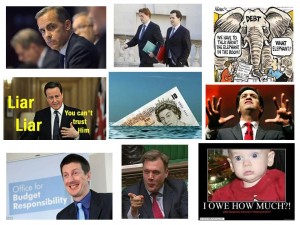
There’s a long silence, then finally your contact admits, “unfortunately GB spends £750m for every £650m it earns, its debt is rising by £100m a year and markets will soon lose confidence in GB’s management. In just five years from 2010 to 2015, GB’s debt will have doubled from £700m to £1.4bn and soon the company will only be able to borrow money at almost extortionate rates of interest. Unless GB’s management do something pretty drastic and do it quickly, GB may go bankrupt” (click to see picture more clearly)
Hearing this, you politely suggest that there’s no way you’d consider putting your hard-earned money into a seemingly obvious disaster like GB.
“Ah,” your contact quickly replies, “it’s not as bad as it looks. There’s a very strong rumour that a new management team will be taking over GB in May 2015”.
By this time, you’re pretty doubtful this will improve the situation. But out of politeness you ask, “what’s the new management team like? Have they a better record than the current team?”
“The person likely to be the next CEO is quite young and was most people’s second choice for the job. Everybody preferred his brother, whom he stabbed in the back to get his job. He was very close to the former Financial Director, who got booted out 4 years ago when GB got into severe financial difficulties. He has little to no experience and isn’t really that impressive. In fact, most people think he’s a bit of a nerd,” your contact hesitatingly reveals.
“And” your contact continues, “the likely next Financial Director is a loud-mouthed bully who was very closely involved in the last management team but one. During a time when business was booming, they unfortunately more than doubled spending while revenue only increased by about 60% and they pushed GB’s debt from £350m to over £700m even though sales had never been so good. This meant that when business conditions worsened, as they always do after a period of unusually strong growth, GB got into real financial trouble and the whole of the previous management team was replaced”.
“So,” you ask your contact, “you’re telling me that key members of the team responsible for wrecking GB’s finances will soon be back in charge?”
“Yes” you contact replies, “but although they won’t admit to making any major mistakes last time they were running GB, they’ve promised to be a little more careful if they take over in 2015. So, it’s a great investment with a great future”.
Being a rather cynical person, you’re not convinced and decide to put your money elsewhere – Australia Plc, for example, or even Russia Plc as both seem to have quite tough CEOs.
Now, I don’t know whether comparing a country with a company is valid. But what this little parable tells me is that Britain’s future looks a little worrying as neither of the two management teams likely to run the country have a track record of success. And neither has either the ideas or the courage to solve Great Britain’s financial problems.
Oh dear, that’s ruined my weekend. I wish I’d never written this.
By David Craig, on March 22nd, 2014 I found this clear and decisive message from a speech Vladimir Putin made last year. I think it tells us all we need to know about the moral, cultural and economic suicide the West is committing. This certainly stands in sharp contrast to the self-important witterings of our pointless, self-serving, politically-correct, morally-bankrupt, quisling masters. Enjoy (click on picture to see more clearly)

“In Russia live Russians. Any minority, from anywhere, if it wants to live in Russia, to work and eat in Russia, should speak Russian and should respect Russian laws. If they prefer Sharia Law, then we advise them to go to those places where that’s the state law. Russia does not need minorities. Minorities need Russia and we will not grant them special privileges, or try to change our laws to fit their desires, no matter how loud they yell ‘discrimination’. We better learn from the suicides of America, England, Holland and France if we are to survive as a nation. The Russian customs and traditions are not compatible with the lack of culture or the primitive ways of most minorities”
(BTW, why not use some of the money our great chancellor has given you in raising the tax threshold to £10,500 to show your support for this website by buying a copy of my recent book GREED UNLIMITED? You know it makes sense)
|
|