|
|
By  David Craig, on May 16th, 2014 Following on from yesterday’s blog, we have a conundrum. The Government and its cheerleaders in the Torygraph, Times and Daily Mail claim earnings are rising faster than inflation and that the ‘cost of living crisis’ is over. But are they telling the truth?
This is what the ruling elites want us to believe (click to see more clearly)

This chart suggests earnings have been lagging behind inflation, but are now moving above inflation.
But this may be what is really happening (click to see more clearly)

A continuing fall in real wages
So, why the difference? I think it’s because the figures our rulers prefer to use include bonuses, whereas the figures our rulers prefer to ignore don’t include bonuses. And who gets bonuses? Ordinary workers? Or bankers, big company bosses, local government bigwigs and senior bureaucrats?
I’ll leave it to two readers of this blog to explain what is really happening:
“As predicted by many, incomes would drop and housing costs rise due to a huge influx of cheap labour from Eastern Europe and the third world. Wasn’t really that difficult to figure out. Let’s also factor in a rise in crime, squalor, and a strain upon public services and we can see exactly what our “elites” are doing to us. They are systematically taking a wrecking ball to the country.”
“Fact is there is no recovery. The recent housing boom has injected more money into the economy via the taxpayer backed mortgage scheme that the government has provided by increasing borrowing; but there has been no impact upon the number of paid working hours available nationwide, which are needed for families to pay their household bills. All we are seeing here is how zero-hour contracts and manipulation of benefit claimant figures have served to further corrupt the statistics in the coalition’s favour.”
Meanwhile, here’s a message from our rulers “We’re all in it together”

And here’s a comment an educationally-challenged reader just posted on my website: “UKIP are faschists. They need to be exposed! I’ve UKIP leafeters to the Police. In a dedent socisty they would all be in prion or the gulag undergoing re-education to become decent citizens.
Only a weird minority follw UKIP anywise! They are gpong nowhere.”
By David Craig, on May 15th, 2014 You’ll all have seen the headlines: Britain recovering: Britain will have fastest growing economy: Feelgood factor lifts Britain etc etc etc. And the headlines (coming conveniently just before the EU elections) about UK employment reaching record highs.
I’ve no doubt that the British economy is growing. Though I’m struggling to understand how the Government borrowing and spending £110bn a year is only giving £37bn (2.5%) economic growth.
But behind the triumphant headlines and feelgood stories, there is a worrying trend the papers don’t seem so keen to mention – average wages continue to fall (while prices continue to shoot ever upwards)
Here’s a possibly interesting chart (click to see more clearly)

What does the chart show? The red line, measured against the right hand axis, shows real average weekly regular pay (excluding bonuses) for the whole of the UK in pounds, adjusted for inflation (in March 2014 prices). The blue line, measured against the left hand axis, shows the unemployment rate (in percent) for everyone aged over 16 in the previous three months. Someone is defined as unemployed if they are without a job but are currently looking for one (so does not include those out of the labour market for any reason). The green line (also measured against the left hand axis) shows the underemployment rate – that is, the number of people in temporary or part-time work because they can’t find a full-time job, as a percentage of the total number of people in employment.
Why is the chart interesting? The continuing decline in unemployment has dominated the headlines recently, and the fall since the middle of last year has been dramatic. The latest figures from the ONS suggest an unemployment rate in the three months to March of just 6.8% – the last time unemployment was that low was in February 2009. However, although the underemployment rate is falling slightly, it is not falling nearly as fast, and in fact, it may soon overtake the unemployment rate. Meanwhile, real average regular earnings have continued on their downwards trajectory, despite reports to the contrary (which usually include bonus payments or compare different time periods), and are now £5 per week less than they were 10 years ago.
So, while the Tories trumpet their “great economic recovery” story, many people, seeing their living standards continue to fall, might be more receptive to Red Ed “Nationalise Everything” Miliband’s “only Labour will solve the cost of living crisis” story.
(to be continued tomorrow……..)
By David Craig, on May 14th, 2014 No blog today as I’m busy swotting up on what I wrote in my book THE GREAT EUROPEAN RIP-OFF five years ago as I’m being interviewed by Russian TV this morning. However, here’s an email I received from a reader in repsonse to a blog I did mentioning Argentina’s president Christina “Botox” Kirchener. Maybe Argentina is really a paradise on earth (unlike Britain) and not a soon-to-be-bankrupt dump being unnecessarily run into the ground by a bunch of corrupt, kleptocratic buffoons (a bit like Britain). Who knows?
Dear Mr Craig
I generally agree with most of what you write in your website. Your insight, analysis and revelations of the UK and EU politicians are informative and authoritative.
However, I surprisingly find myself in a position where I disagree with you, and it is regarding Argentina and its President.
You have stated that Argentina is bankrupt and President Kirchner is one of the most corrupt and thieving leaders in the world. You are incorrect on both counts.
Let’s look first at the supposed bankruptcy of Argentina. You are a man of facts and figures so here are some of them.
Between 2003 and 2013 Argentina DOUBLED its GDP, this is equivalent to an annualised GDP growth of over 7% every year. Even better, this great GDP growth is based on the trade (both internal and external) of real and tangible agricultural and industrial products; rather than being based on financial fantasies, speculation and casino banking.

Whilst doubling its GDP, it has reduced its public debt by a great margin, in fact it is one of top countries (if not the very top) in the world for public debt reduction.
Despite this debt reduction, huge investments were done by the federal government in social welfare, health, education and infrastructure. Just to give you an idea – thousands of new schools, new universities (which are free, unlike England) and hospitals, thousands of kilometres in new and/or renewed gas, water, sewage, electricity, roads and railway infrastructure. All these thigns had laid forgotten by previous federal (neoliberal) governments.
Also, the country was able to substantially reduce its gini coefficient (its inequality). And all this whilst actually reducing public debt !
And no, it is not true that Argentina is not paying its debts. It is paying them but on its own terms. Some nasty vulture funds are the ones that complain.
Whilst the UK (and much of the so called “first world”) suffered through the worst economic downturn in decades, Argentina was enjoying both fiscal and trade surpluses.
UK’s REAL public debt = 150% of GDP (approx) Argentina’s public debt = 47% of GDP (approx) most of which is NOT foreign
UK’s REAL overal debt = 600% of GDP (approx) Argentina’s overall debt = less than 70% of GDP (approx)
Argentina has trade surplus and fiscal surplus. UK has years long trade and fiscal deficits.
So how can a country that has less than 100% in overall debt (and most of it internal), has doubled its GDP its GDP in 10 years (by selling real things) and has both fiscal and trade surpluses be considered bankrupt ?
If Argentina is bankrupt then may the full pantheon of the gods help the UK, with its 600% overall debt (400% of it foreign owned), laughable growth (and mostly based on financial speculation and credit bubbles) and both fiscal and trade deficits.
Argentina is not a paradise of course, but to say it’s bankrupt is incorrect. Compared to most of the supposed rich “first world” nations and taking debt into account, it is actually a wealthy, stable and prosperous country.
Here is a suggestion for a future article on your website – the GDP per capita (in purchasing power parity) of various countries AFTER debt has been discounted from GDP.
Regarding President Kirchner, you are probably not aware of this but her wealth and finances (and her late husband’s) have undergone independent auditing and not a single peso was found to have been earned illegally or dishonestly. Is there a possibility that she has been “wheeling and dealing” despite this auditing ? Yes. But nothing that can be proven in a court of law (yet). Besides, whatever she and/or her late husband (also a President) may have stolen, they have at least done a great deal of good for their country and most of its people. She is no more corrupt than any and every senior politican from the UK, EU, North America or Oceania (who at present are not doing a lot of good for their countries).
You have to bear in mind that her government is under constant attack by much of the media (within and outside of Argentina) because she has dared to put some controls and regulations on the neoliberal capitalism which (as you very well know) is responsible for much of the economic problems of the so called “first world”. The Argentina of today is actually a very good example of how things SHOULD BE done.
Those that have gotten rich from the recent global financial collapse do not want the rest of the world to follow Argentina’s example and therefore do anything they can to make Argentina and its President look bad, particularly by using compliant mainstream media (msm). I’m sure that I don’t have to remind you that the msm has an agenda and much of what they report is not correct or accurate. Look at the msm’s treatment of President Putin of Russia – it’s true that Putin is no saint but he’s portrayed as an evil warmongerer.
President Kirchner is also a victim of the msm and the vast majority of the “bad things” said about her, her government and Argentina are at best exaggerations and at worst outright falsehoods.
Believe it or not, she is actually carrying out many of the measures that you, me and the vast majority of sane, normal people that live in the UK, EU, N.America and Oceania have been begging our useless politicians to do for years.
By David Craig, on May 13th, 2014 This a tale of two books. In 2008, my book “SQUANDERED How Gordon Brown is wasting over one trillion pounds of our money” was published. It sold about 15,000 copies and I got an advance from my publisher of about £6,000. So I earned about £0.40 per copy for a book that sold for about £8.99. Not much for all my work.
Not long after, the delectable Cherie Blair (wife of IMHO lying, expenses-thieving war criminal Tony Blair) published her book “SPEAKING FOR MYSELF”. It sold about 33,000 copies and she got an advance of somewhere between £1m and £1.5m. That means the delightful Cherie earned around £30 to £45 per copy even though the book only sold for about £9.99. So the publisher lost around £20 to £35 for every copy of Cherie’s book that was sold. Not a great business deal, perhaps?

So, what could explain the publisher’s extraordinary generosity to the charming Cherie?
There seem to be two possible explanations:
1. Bad business decision Perhaps the publisher mistakenly thought that Cherie was so popular and such a talented scribbler that millions of us would be rushing out to buy her brilliant memoirs and the publisher would make a fortune.
2. Corruption However, for those those who like conspiracy theories, there is a slightly more sinister possible scenario. Gail Rebuck, the boss of the publishing company that was so generous in handing over her shareholders’ money to the saintly Cherie was married to the now deceased Philip Gould. Philip Gould was Tony Blair’s strategy and polling adviser and is widely credited for helping Tony get elected three times. Gould was later ennobled by Blair and became Baron Gould of Brookwood. So, was the massive book advance thrust into the adorable Cherie’s bulging bank account actually a case of ‘you put taxpayers’ money in my pocket and I’ll put shareholders’ money in yours’?
I know not. I leave it up to my dear readers to judge Cherie’s saintliness or otherwise.
By David Craig, on May 12th, 2014 Do you have any money saved up in unit trusts? If so, do you have any idea how much you’re paying each year in charges? Probably not.
Many people think that the Annual Management Charge (AMC) is all they’re paying. AMCs for the 2,000 or so UK-based unit trusts are around 1.1%.
Some people have understood that they pay more than the AMC. They probably think that what they’re paying is the Total Expense Ratio (TER). The TER includes the AMC plus a few other costs and averages about 1.6%. Please note that in the US, where the market is more competitive, the TER averages just 0.98% – an awful lot lower than in the UK.
Now, you might think that something with the word ‘total’ in it means that is all you’ll pay. And in fact, surveys have shown that the majority of savers believe they’re either paying just the AMC or the TER.
But there are a whole lot of costs not included in the TER. The biggest of these is probably the cost of your unit trust manager buying and selling shares. On average this adds another 0.6%. So, that takes your cost up to around 2.2%. Then there are a few other ‘hidden costs’ which mean that a unit trust with a TER of 1.6% can actually be costing you anywhere from 2.75% to 3.2%.
Now you may be thinking: ‘well 2.75% to 3.2% doesn’t sound too bad’. If so, you’d be awfully wrong.
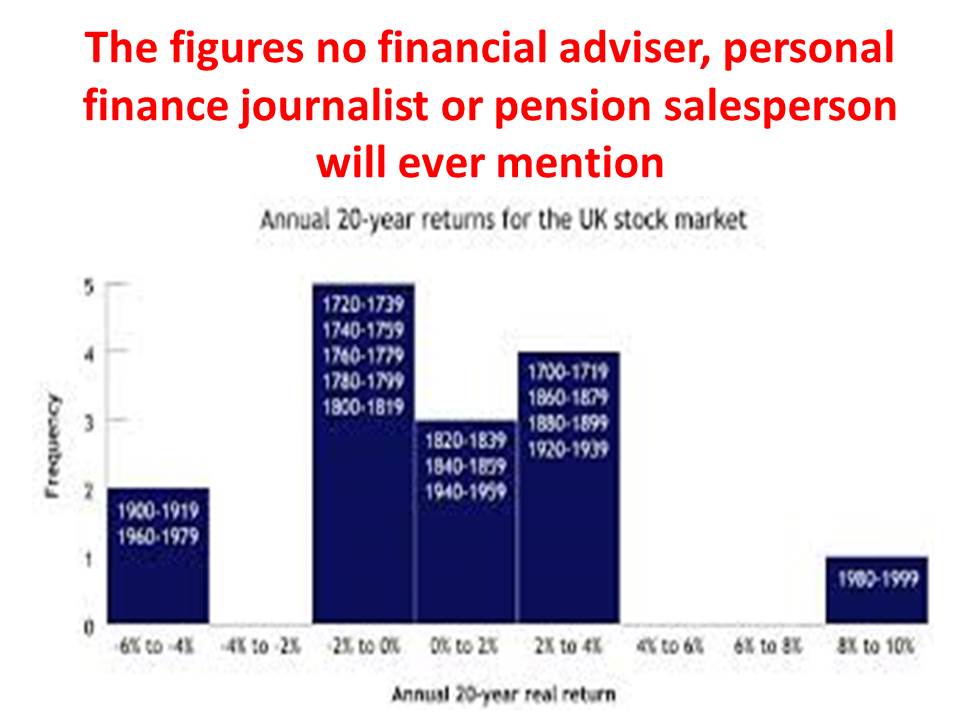
The total annual return on UK stock markets over the last 110 years has been about 5.2%. But this is pushed up by returns of 8% to 10% during the 1980s and 1990s (click to see more clearly)
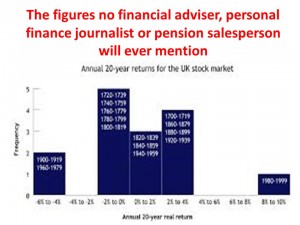
So when you take out those years, factor in that all unit trusts will hold some cash so can never achieve the performance of the overall market and account for the fact that tax is automatically deducted from dividends paid to your unit trust, you can expect returns of about 4% a year at most from an average unit trust.
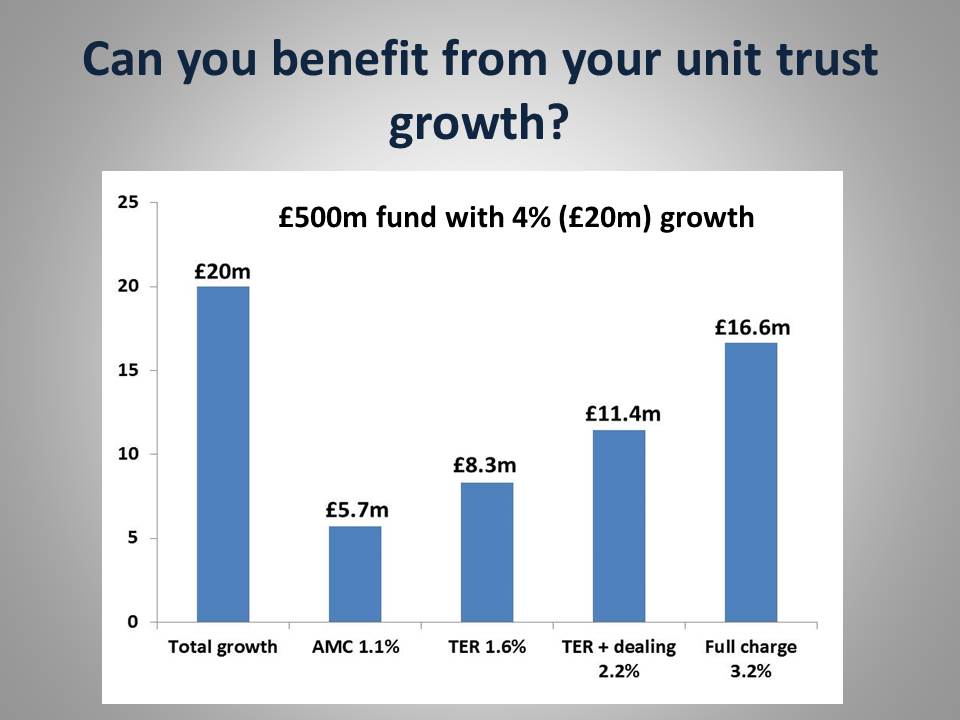
Here comes the problem. While your unit trust may grow by 4% a year, you pay charges on the total amount of money in the unit trust (not on just the growth). This means that virtually all the supposed growth in your unit trust goes into the pockets of your unit trust manager (click to see more clearly)
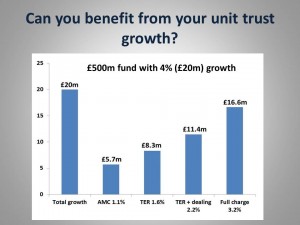
So, if you had money in a £500m unit trust which grew by 4%, that would give the unit trust £20m. But with charges of 3.2%, over £16m of this growth would be taken by your unit trust manager. That would leave £3.4m for unit trust savers – annual growth of a laughably paltry 0.8%.
On behalf of the multimillionaire members of the Investment Management Association, I’d like to thank you for your generosity.
By David Craig, on May 11th, 2014 Habeas Corpus is a basic principle of British justice. It prevents the state from locking you up without having to persuade a court that it has good reason for doing so. It is vital to any decent system of law.
The European Arrest Warrant (EAW) is a direct breach of Habeas Corpus. Habeas Corpus is virtually unknown on the continent of Europe. In many countries it is routine to detain suspects and only then to start investigating the crime – if one was actually committed. People can be kept in gaol without charge or trial for a year or more. And when they are released, because no case can be made against them, they have no redress.
In much of Europe, there is no jury system that we would recognise. In the few cases in which juries are used, they do not have total independence to make up their own minds, free of instructions from judges, and to acquit in defiance of the facts and the law if they believe the law to be wrong.
Under the EAW, you can be arrested and transported to one of these countries without any assessment of the claims made against you by a British court. They don’t even have to show that it is a crime in this country. There is no attempt made to verify that the claims are not frivolous, malicious or corrupt (click to see more clearly)

If that doesn’t concern you, it should.
It used to concern EU-Quisling Cast-iron Dave. When he was in opposition, he called the EAW “utterly objectionable“, but that was probably just another ‘sincerely and deeply held belief’ that could be jettisoned in the name of political expediency.
But Cast-iron Dave has gone even further in slaughtering British justice on the altar of ‘ever closer union’. Another principle of British justice is that you’re innocent until proved guilty. But Dave enthusiastically supports HMRC’s plan to be able to raid the bank accounts of people the bungling HMRC believe owe tax without obtaining a court order. We used to be innocent of tax avoidance until HMRC could prove us guilty. Now we can all be found guilty by HMRC (without any court order), they can confiscate our money with little to no proof of wrongdoing and it will then be up to us to spend thousands or even tens of thousands of pounds and possibly several years trying to prove our innocence.
But don’t worry. These new powers will never be used against the likes of Amazon, Google, Starbucks or any of Dave’s tax-avoiding mates in the City. After all, the wealthy and powerful have the resources to challenge HMRC in the courts and win.

No, the new powers will only be used to ruin ordinary people, usually because the recidivist incompetents at HMRC have made a total cock-up of their tax calculations. HMRC believes the new powers will allow them to collect a few hundred million extra in tax. HMRC could collect an awful lot more if they took action against some of the firms in the chart above.
As for British justice which used to protect the individual against abuse of power by the state. Well, in the new EUSSR, we can all be found guilty with little to no proof and our protections against an ever more totalitarian state are being stripped away by our rulers who believe we exist to serve their interests rather than the other way round.
By David Craig, on May 10th, 2014 Some photos of British soldiers giving the thumbs up over the dead bodies of Taliban fighters killed in a raid on Camp Bastion have appeared

The elites are apparently outraged and Amnesty International are squealing that this is a “war crime”.
But when photos like these appear

Those who claim to represent morality cower away in their luxurious offices (paid for by our taxes or our donations), terrified of offending a certain group in our society.
The cowardice and hypocrisy of our rulers are more than sickening.
By David Craig, on May 9th, 2014 (On a lighter note today, here’s an article I have on the Daily Express website)
If you’re ever with someone who is trying to sell you something – a home, car, insurance, clothes, new phone or whatever – here are 10 common tricks and traps you should look out for.
The Probe On your first contact with any salesperson, they’ll usually ask you a few questions. These have two main goals. Most obviously, they’re trying find out what you’re looking for. But they’re also aimed at finding out how serious you are about buying. For example, a car dealer would want to work out if you’re a tyre-kicker (someone who is just looking around but not intending to buy) or a fish (someone who can be caught and reeled in).
The Psychology Test To be successful in selling to you, a seller must quickly work out what kind of a person you are so they can adjust their sales pitch to appeal to someone like you. If you’re a positive, extrovert, glass-half-full person, then they’ll probably try to sell the dream – stress how what they’re selling will improve your life. But if you’re more of a glass-half-empty worrier, then the seller will sell security – focus more on the features and performance of what’s being sold.
The Make-a-Friend Sellers will have many tricks to make us like them as the more we like someone, the more likely we are to buy from them. One of the most frequently used techniques is called active listening. With active listening the seller will use all kinds of non-verbal gestures such as leaning forward, inclining their head slightly to one side, widening their eyes, pursing their lips thoughtfully and stroking their chin to show their interest in us. Some sellers even sit in front of the mirror at home practising their active listening skills.
The Trust Me Many salespeople are trained to portray themselves as trusted advisers helping us make the right buying decision rather than being seen as commission-hungry vultures slavering to get hold of our money. One of many ways of achieving this is the same side of the table. Rather than standing or sitting opposite the customer creating a situation where the seller and buyer are like adversaries facing each other, the seller changes their position so they’re standing or sitting almost beside the customer as if they’re working together with the customer to solve the customer’s problem – which house, car, TV, phone or insurance to buy.
The Persuaders Having managed to get us interested in buying something, the seller then needs to get us to make the decision to move ahead. To put pressure on us, they might try the closing door – suggest there’s only a limited time to get the deal they’re offering; or the phantom buyer – tell us there are other people interested in buying what we want even if this isn’t true; auction fever – use other real or phantom buyers to make us feel we have to offer a higher price if we’re to get what we want; or even the deliberate mistake – when adding up the price of something, they deliberately ‘forget’ some small part so that the buyer, thinking they’re smarter than the seller, rushes to complete the deal.
The One-Step Negotiation In the West, we’re used to most things we buy having fixed prices and so often feel uncomfortable haggling over price. Sellers understand this and will often quote an inflated price then allow us to negotiate a small reduction. Relieved at having supposedly achieved a price cut, most of us will then buy. Very few buyers will do two- three- and even four-step negotiations.
The Absent Authority If we do try to do more than a one-step negotiation, then a seller might use the absent authority trick. They could say something like, ‘I’d love to offer this at the price you want, but I’m not allowed to. If you want, I can ask my manager to see what they say’. Then off they’ll go to apparently fight for you against their tough sales manager. After a few minutes, they’ll come back with a small concession claiming this is the best they can do. But as the manager is an absent authority, you can’t negotiate any further.
The Feel-Felt-Found If a buyer is worrying about the price or features or reliability of what’s being sold, the seller might try the feel-felt-found. They may say, ‘I know how you feel. Many of our best customers felt like that, but when they bought this they found they were delighted at having gone ahead’.
The Close Most sellers will have the ABC (Always Be Closing) drummed into them by sales trainers and their sales managers. This means that at all stages of the sales process, sellers must be absolutely focused on the end result – closing the sale and getting their commission. Any seller who can charm customers, get them interested but doesn’t get the close will either have extremely skinny children or else no job at all.
SSI Once a seller has closed the sale, then it’s time for SSI (Sell Second Item). If we’re taking a car, SSI might be all kinds of extras, additional warranties and GAP and payment protection insurances. If we’re buying a suit, SSI might include a couple of shirts, ties and a belt. With TVs or phones, SSI would be a care plan – paying a lot of money for an extended guarantee. And with a home, an estate agent might pressure us to take out a mortgage with the mortgage broker used by their agency.
David Craig is the author of DON’T BUY IT Tricks and Traps Salespeople Use and How to Beat Them (Thistle Publishing. Available only from Amazon)
By David Craig, on May 8th, 2014 As the BBC bleats and moans about the brave, freedom-loving, peace-loving Syrian rebels being forced out of Homs and being betrayed by the world, I thought it might be worth producing an infographic guide to the Syrian conflict.
On the one side we have President Bashar “Basher” Al-Assad (click to see more clearly)

And on the other, we have the courageous warriors of the Syrian opposition (click to see more clearly)

Conclusions:
1. As usual it seems that our useless leaders may have backed the wrong side
2. I suspect most people in Britain feel we should leave the Syrians to their mutual slaughter and hope that both sides lose.
By David Craig, on May 7th, 2014 For many years our banks have wanted to make us pay them to run our current accounts for us. But they realised this would cause howls of protest at ‘greedy bankers’. But about 15 years ago, our banks had a collective brainwave – convince us that it would be a good idea for us to willingly pay for our current accounts.

So our banks introduced what they call ‘packaged accounts’ – current accounts with a few bells and whistles attached. These could be things like a bit of car breakdown cover, some travel insurance, maybe mobile phone insurance and being given the opportunity to put money in special savings accounts that are only available to customers who pay for their current accounts.

And our banks managed to persuade an astonishing eleven million of us to pay for these accounts.
These ‘packaged accounts’ will be good value for some of us. But eleven million of us? I doubt it. For example, some people will be too old to use the travel insurance, others may already be paying for car breakdown cover from being members of the AA (15 million members) or RAC (7 million members) or a similar organisation and the terms and conditions on the mobile phone insurance are often so restrictive that it’s next to useless.
These problems have been spotted by the claims companies who made fortunes from PPI mis-selling compensation and now some of them are heading for what they hope is another bonanza from ‘packaged accounts’ mis-selling

So, if you or anyone you know are generously giving your bank somewhere between £150 and £300 a year to run your current account for you, is it really worth it?
And, if you decide to stop paying your bank for your current account, then why not use just a little of the money you save to buy copies of my two most recent books – GREED UNLIMITED and DON’T BUY IT!
|
|