|
|
By  David Craig, on August 24th, 2014 Recently I’ve been researching and starting to write a book THE GREAT CHARITY SCANDAL aimed at exposing the lies, greed and waste in Britain’s bloated 195,000-strong, 950,000-employee charity industry.

Now I’ve got my agent’s reader’s report on my book proposal – it’s not hugely complimentary:
“The sample material is rushed and under-researched, often illogical, and crucially with no sense that he plans to do any of the real detailed research that this requires. Too much of it is guesswork, plus irrelevant asides about immigration, the EU, etc. Another concern is that his total of charities surely includes all kinds of worthy organisations whose tax status happens to be charitable, but which actually perform different roles: schools, churches, hospitals, emergency services, community groups, nurseries, universities, etc. If this is true, then it’s far less of a concern that we have 1 charity employee for every 65 of us, if it includes all these people.”
And I thought it was going rather well. Oh well, in the words of the immortal Freddie Mercury ‘another one bites the dust’.
In the meantime, while most people in Britain have seen their salaries frozen or worse since the 2008 economic crash, the highest-paid employees at some of our best-known anti-poverty charities have managed to avoid poverty themselves with some quite comfortable pay rises (click to see more clearly)
 However, with my charity expose heading towards the bin, our charity bosses can sleep soundly in the knowledge that nobody will find out the true extent of their greed, lies and waste. However, with my charity expose heading towards the bin, our charity bosses can sleep soundly in the knowledge that nobody will find out the true extent of their greed, lies and waste.
By David Craig, on August 20th, 2014 As regular readers will know, I’ve started writing a new book, possibly called THE GREAT CHARITY SCANDAL exposing the massive waste of Britain’s almost unbelievably huge charity industry. I don’t yet know if any publisher will take the book or whether I’ll have to resort to something like crowdfunding to get the book out.
Although, given how few people bought my last two books GREED UNLIMITED and DON’T BUY IT! perhaps I’m wasting my time and should just go on holiday instead? Though that would be a pity as someone needs to expose the scandal of Britain’s greedy, monstrous, over-sized, self-serving charity industry.
Anyway, as I’ve written previously, Britain has more than 195,289 charities. In my humble opinion, that’s at least 150,000 too many. So I decided to look at the stated aims of 6 of our ‘best-loved’ charities, almost all of which are really quite generous to their bosses with the money the public donates in the misguided belief that most of this money will actually be used for real ‘charitable activities’.
Here are what those 6 charities state as their aims (as usual, click on picture to see more clearly)

Oh look! They all seem to be doing pretty much the same thing. What a surprise! Who would have thunk it? And these are just the top 6 poverty charities. There are almost 100 more smaller charities also bravely tackling poverty with our money.
So, do we really need all these charities, all with their executives and managers and fundraisers and communications experts and expensive campaigns and chuggers and door-to-door collectors and charity shops and offices and computers and smartphones and generous expense accounts to fly round the world to visit the poor and so on and so forth?
My answer – no!
Though, if you want to save all these charity bosses and managers (many of whom couldn’t get a job in any normal company) from poverty, please keep on giving. The Lords of Poverty need your money to keep them in the style to which they have become accustomed.
By David Craig, on August 19th, 2014 Oxfam were at it again. Yesterday evening they were appealing for more of our money to feed the good people of the Sudan where the population doubles about every 20 years:

So, here’s an extremely politically-incorrect article from the Irish Independent suggesting that constantly doubling the population of the poorest, most-infertile, most backward African countries every 20 years or so is not such a great idea.
“Somalia is not a humanitarian disaster; it is an evolutionary disaster. The current drought is not the worst in 50 years, as the BBC and all the aid organisations claim. It is nothing compared to the droughts in 1960/61 or 73/74.”
“And there are continuing droughts every 5 years or so. It’s just that there are now four times the population; having been kept alive by famine relief, supplied by aid organisations, over the past 50 years. So, of course, the effects of any drought now, is a famine. They cannot even feed themselves in a normal rainfall year.”
“Worst yet, the effects of these droughts, and poor nutrition in the first 3 years of a child’s life, have a lasting effect on the development of the infant brain, so that if they survive, they will never achieve a normal IQ. Consequently, they are selectively breeding a population, who cannot be educated, let alone one that is not being educated; a recipe for disaster.”
“We are seeing this impact now, and it can only exacerbate, to the detriment of their neighbours, and their environment as well. This scenario can only end in an even worse disaster; with even worse suffering, for those benighted people, and their descendants. Eventually, some mechanism will intervene, be it war, disease or starvation.”
“So what do we do? Let them starve? What a dilemma for our Judeo/ Christian/Islamic ethos as well as Hindu/Buddhist morality. And this is beginning to happen in Kenya, Ethiopia, and other countries in Asia, like Pakistan. Is this the beginning of the end of civilisation?”
“AFRICA is giving nothing to anyone outside Africa – apart from AIDS and new diseases.”
“Even as we see African states refusing to take action to restore something resembling civilization in Zimbabwe, the begging bowl for the Sudan is being passed around to us out of Africa, yet again.”
“It is nearly 25 years since the famous Feed The World campaign began in Ethiopia, and in that time Ethiopia’s population has grown from 33.5 million to 78+ million today. So, why on earth should I do anything to encourage further catastrophic demographic growth in that country?”
“Where is the logic? There is none. To be sure, there are two things saying that logic doesn’t count.”
“One is my conscience, and the other is the picture, yet again, of another wide-eyed child, yet again, gazing, yet again, at the camera, which yet again, captures the tragedy of children starving.”
“Sorry. My conscience has toured this territory on foot and financially. Unlike most of you, I have been to Ethiopia; like most of you, I have stumped up the loot to charities to stop starvation there. The wide-eyed boy-child we saved, 20 years or so ago, is now a low IQ, AK47-bearing moron, siring children whenever the whim takes him and blaming the world because he is uneducated, poor and left behind.”
“There is no doubt a good argument why we should prolong this predatory and dysfunctional economic, social and sexual system but I do not know what it is. There is, on the other hand, every reason not to write a column like this.It will win no friends and will provoke the self-righteous wrath of, well, the self-righteous hand wringing, letter writing wrathful individuals; a species which never fails to contaminate almost every debate in Irish life with its sneers and its moral superiority. It will also probably enrage some of the finest men in Irish life, like John O’Shea, of Goal; and the Finucane brothers, men whom I admire enormously.”
“So be it. But, please, please, you self-righteously wrathful, spare me mention of our own Irish Famine, with this or that lazy analogy. There is no comparison. Within 20 years of the Famine, the Irish population was down by 30%. Over the equivalent period, thanks to western food, the Mercedes 10-wheel truck and the Lockheed Hercules plane, Ethiopia’s population has more than doubled.”
“Alas, that wretched country is not alone in its madness. Somewhere, over the rainbow, lies Somalia, another fine land of violent, AK 47-toting, khat-chewing, girl-circumcising, permanently tumescent layabouts and housing pirates of the ocean.”
“Indeed, we now have almost an entire continent of sexually hyperactive, illiterate indigents, with tens of millions of people who only survive because of help from the outside world or allowances by the semi-communist Governments they voted for, money supplied by borrowing it from the World Bank!”
“This dependency has not stimulated political prudence or commonsense. Indeed, voodoo idiocy seems to be in the ascendant, with the president of South Africa being a firm believer in the efficacy of a little tap water on the post-coital penis as a sure preventative against AIDS infection. Needless to say, poverty, hunger and societal meltdown have not prevented idiotic wars involving Tigre, Uganda, Congo, Sudan,Somalia, Eritrea, etcetera.”
“Broad brush-strokes, to be sure. But broad brush-strokes are often the way that history paints its gaudier, if more decisive, chapters. Japan, China, Russia, Korea, Poland, Germany, Vietnam, Laos and Cambodia in the 20th century have endured worse broad brush-strokes than almost any part of Africa. They are now — one way or another — virtually all giving aid to or investing in Africa, whereas Africa, with its vast savannahs and its lush pastures, is giving almost nothing to anyone, apart from AIDS.”
“Meanwhile, Africa’s peoples are outstripping their resources, and causing catastrophic ecological degradation. By 2050, the population of Ethiopia will be 177 million; the equivalent of France, Germany and Benelux today, but located on the parched and increasingly protein-free wastelands of the Great Rift Valley. So, how much sense does it make for us actively to increase the adult population of what is already a vastly over-populated, environmentally devastated and economically dependent country?”
“How much morality is there in saving an Ethiopian child from starvation today, for it to survive to a life of brutal circumcision, poverty, hunger, violence and sexual abuse, resulting in another half-dozen such wide-eyed children, with comparably jolly little lives ahead of them?”
“Of course, it might make you feel better, which is a prime reason for so much charity!”
“But that is not good enough. For self-serving generosity has been one of the curses of Africa. It has sustained political systems which would otherwise have collapsed. It prolonged the Eritrean-Ethiopian war by nearly a decade. It is inspiring Bill Gates’ programme to rid the continent of malaria, when, in the almost complete absence of personal self-discipline, that disease is one of the most efficacious forms of population-control now operating. If his programme is successful, tens of millions of children who would otherwise have died in infancy will survive to adulthood, he boasts.”
“Oh good: then what? I know, let them all come here (to Ireland) or America (not forgetting Australia!) Yes, that’s an idea.”
By David Craig, on August 18th, 2014 Not every blog on this site can deal with big, important world events. But sometimes, looking at a seemingly small issue can expose much larger areas of concern.
Britain has 195,289 charities. In my humble opinion, that’s at least 150,000 too many.
In the Sunday Times yesterday, there was a worrying article “Legal highs set to kill more than heroin“. In this article a charity called The Angelus Foundation was featured. According to the Charity Commission website: ‘The Angelus Foundation aims to raise awareness of and educate young people and their parents on the dangers of legal highs and club drugs in order to keep them and their peers safe“. The Angelus Foundation was set up by Maryon Stewart after the death on 2009 of her daughter, a medical student, from a legal high.
Being a bit of a twat, I decided to look at the financial accounts of the Angelus Foundation. I’m not an accountant, but if I understood the accounts correctly, here’s what I found;
In 2013, the foundation had income of £296,975. It spent a (for me worrying) £155,020 – 52% of money raised – generating this income. However, that still left £140,974 – 47% of its income – to be used for ‘charitable activities’. Then there was a very modest £1,860 used for ‘governance costs‘.
But let’s look at what was included in the £140,974 of ‘charitable activities’.
Well, there were ‘consultancy fees’ of an impressive £49,800 – 35% of the money spent on ‘charitable activities’. But what was this consultancy? As far as I can make out, this was money paid to none other than Maryon Stewart. I quote from the accounts ‘The directors have agreed that Maryon Stewart be remunerated for her services to the charity. Services were provided during the period under the terms of a Consultancy Agreement. Under this agreement Maryon Stewart received £49,800 for the period”. Maryon Stewart also, if I understood correctly, got £47,186 for consultancy in 2012.
Now, I believe Maryon Stewart is a highly prolific writer and broadcaster on health issues. So probably the £49,800 for consultancy in 2013 (and £47,186 in 2012) was well spent. But there might be some people who would be concerned about a charity giving 35% of its ‘charitable activities’ expenditure to its founder.
Another expense for ‘charitable activities’ was £7,172 for ‘travel’. Most of this seems to me to have gone to Maryon Stewart, “expenses reimbursed to Maryon Stewart during the period amounted to £6,381 and largely comprised of travel and subsistence costs”. Though these seem to have come down from the £13,101 paid out in 2012.
Also under ‘charitable activities’ was ‘admin support’ – “Maryon Stewart also provides an administrative assistant to the Foundation who is employed by her company (The Really Useful Health Company)”. The charge for administrative assistance in the period was £25,155″. In 2012, this was £23,183. Some people might not think that administration was a ‘charitable activity’. But then, what do they know? (click to see chart more clearly)

Also under ‘charitable activities was £6,000 for ‘rent’. As the accounts report, “In addition Maryon Stewart provided office space for the foundation at a rent of £6,000 for the period”. The cost in 2012 was also £6,000.
Another ‘charitable activity’ was, as far as I can make out, £500 given to Maryon Stewart’s son – “Maryon Stewart’s son was paid £500 for taking photos”.
Other ‘charitable activities’ included ‘filming’ – £9,676; ‘focus groups’ – £3,138; ‘publicity’ £3,464; ‘IT expenses‘ – £3,117; ‘refreshments’ – £1,116; ‘sundry expenses’ – £1,562…..
In fact, the only costs I could find that were absolutely clearly ‘charitable activities’ linked to this charity’s purpose were ‘events’ – £13,795. This equates to just under 5 pence of every £1 raised. I struggled (probably because I’m exceptionally stupid) to find anything else that looked like real, genuine, direct ‘charitable activities’. Most of the costs seemed to me to be incurred providing the £13,795 of ‘events’. But, that’s probably due to my ignorance.
I have no experience of charity work and so know little about charities. But in my utter stupidity and ignorance, I can’t help worrying about who actually benefits from the Angelus Foundation. And I suspect there are tens of thousands of other charities which use the money they collect in similar ways.
I leave it up to my dear readers as to whether they feel the Angelus Foundation deserves their money.
By David Craig, on August 16th, 2014 (My thanks to a reader for this)
We’ve all seen the tragic film and photos of wounded and dead Palestinian children – the kind of film and photos the Israel-loathing, Islamophiliac media like the BBC, ITV news and Channel 4 love to show. The kind that get people such as the (IMHO) loathsome, self-serving, holier-than-thou, hypocrites like Jon Snow, Rageh Omaar, Paula Guerin, Liz Doucet and so many others foaming at the mouth.
But there are other photos of Palestinian children that our mainstream media choose not to show. Here are some (click on photos to see more clearly)
 And here are some more: And here are some more:
 And here are more: And here are more:
 And here are even more: And here are even more:
 No wonder many Israelis must be having sleepless nights as they consider their ‘future’. No wonder many Israelis must be having sleepless nights as they consider their ‘future’.
By David Craig, on August 15th, 2014 Oxfam claims that £8.40 of every £10 donated goes directly to ‘saving lives’. I’ve previously warned readers about Oxfam as I believe that less than half the money given to our ‘best loved’ charity actually get spent on ‘charitable purposes’ www.snouts-in-the-trough.com/archives/6022
Anyway, Oxfam were on our TV screens again yesterday evening asking us to donate money for sad-looking people in Gaza (click to see more clearly)

But hold on a minute, maybe some people in Gaza actually have an awful lot of money. And maybe much of that money came from stealing previous aid millions that we gave and from various extortion schemes on Hamas businesses. And maybe some of those very very very rich Gazans are either Hamas leaders or former Hamas leaders. And could Hamas’s continuous war against Israel just be a get-rich-quick scheme for Hamas bosses?
Dr Musa Abu Marzook, a key fundraiser for Hamas, was reported to be one of Hamas’s wealthiest billionaires with personal wealth of $2bn to $3bn. Nice work if you can get it.
Another Hamas leader-turned-tycoon is Khaled Mashaal. “Estimates around the world are that Mashaal is currently worth $2.6bn, but the numbers mentioned by the Arab commentators (based on their many sources) are much higher, varying from $2bn to $5bn invested in Egyptian and Persian Gulf banks, and some in real estate projects in the Persian Gulf countries,” an expert in Middle East affairs claimed.
Another ‘lucky’ tycoon is Hamas Prime Minister Ismail Haniyeh. “He is a scion of a family from the Al-Shati refugee camp, and his capital is estimated at $4m,” the same expert says, adding, “He registered most of his assets in the Gaza Strip in the name of his son-in-law, Nabil, and in the name of a dozen of his sons and daughters and a few less well known Hamas leaders. They all have homes in good neighborhoods in the Gaza Strip, where the value of every home is at least $1m.”
Yet another wealthy Hamas official – Iman Taha – is not on the organization’s highest levels, but he, too, (and other junior managers) is accused of feeding from the trough. “He was a poor rebellious kid from the al-Borg refugee camp, but he recently built a home in central Gaza worth at least $1m. He’s responsible for coordination between oversea Hamas and Hamas in the Gaza Strip, and he’s not even a leading figure, but he’s already among the millionaires.”
The question of where these officials got their money exposes the corrupt system used by Hamas through its control of the money pipelines in the Gaza Strip. They treated the money as their own personal possession. “Most of the money that went into the pockets of people in the Gaza Strip was obtained through tunnel deals and the creation of a flourishing smuggling market, which it is believed has created several hundred millionaires in the Gaza Strip, although most of the people there don’t live like that. The man pulling the strings from Egypt with the tunnels is none other than the number two man in the Muslim Brotherhood, Khairat el-Shater. His connection with Hamas was ostensibly for Islamic religious purposes, but they actually built a prosperous business, which earned phenomenal profits”.
The Asharq Al-Awsat (Middle East) newspaper, one of the most prestigious in the Arab world, recently reported that at least 600 millionaires were living in the Gaza Strip – the same people sitting on the money pipelines there.
I wonder why Oxfam doesn’t mention this in its tear-jerking TV campaign. Could Oxfam be deliberately deceiving us about the real situation in Gaza in order to keep its own bosses and workers in their well-paid, well-pensioned jobs?
By David Craig, on August 14th, 2014 Regular readers will have spotted that I’m still up in London doing my filial duty. And recently I’ve noticed a change in my 88-year-old mother that I’ve seen in the ageing parents of many of the people I know.
My mother, like most of her friends, retired at a time when many people had final-salary pensions for them and their wives and when, for those who weren’t on final-salary schemes, the interest rates paid on inflation-linked annuities were around 12% to 14%. They are closer to about 3.5% today. So, many of them are quite well off compared to the almost non-existent pensions anyone retiring in the next 20-30 years will get.
Many times, my mother has noticed with surprise how some of her friends are making ridiculous efforts to save money when they might as well spend what they have ensuring themselves a comfortable life. My mother has always been very generous and would always insist on paying for things and paying you back if you spent money on her.
But within the last year something seems to have flipped in her brain and she seems to be going to extraordinary lengths to save often pennies. These include going to poundshops to save a few pence, even when it means my wife (who looks after her a few days a week) has to spend about £4 on bus fares to save £0.15 or so on some tins of tuna fish or packets of pasta.

Previously when I paid some of my mother’s phone or electricity bills or bought her something like phones or a new oven, she always used to pay me back. Now she immediately ‘forgets’ about them. And now when we go out to a restaurant and the bill arrives, my mother never seems to notice it.
Other symptoms of GGS (also known as “Grasping Grandad Syndrome”) are elderly people laboriously counting out coins to pay for their supermarket shop while a long queue is getting increasingly impatient behind them and grand-dads and grannies who have been used to good restaurants, starting to eat the worst, cheapest, preprepared supermarket food, drinking from £4 ‘special offer’ bottles of indigestible wine and keeping old bits of food, milk and butter in their fridges long after they should have been chucked.
The same “Grasping Granny Syndrome” (GGS) appears to have affected a lot of people of my mother’s age. So, don’t be surprised if any of your relatives are affected by GGS. The only problem is – I don’t think there is any known cure.
Has anyone else noticed GGS in their relatives or acquaintances? Click on title to leave a comment or see comments.
By David Craig, on August 13th, 2014 One can’t be doomy and gloomy every day. So, today I’ll warn readers about Granny’s fierce “my family is better than your family” competition.
I guess we’re all pretty competitive and many of us spend our lives trying to keep one step ahead of the Jones’s. But I had thought that, as people approached their dotage, this competitive streak would lessen and people would relax about their lives. How wrong I was.
My mother is now 88 years old and possibly not in full possession of her marbles. And I’ve recently realised there is a well-hidden but vicious competition going on all the time between her and her similarly mature acquaintances. Whenever she’s out playing bridge or at a coffee morning or at the club or whatever, there’s always some vile old bat who spends much of the time boasting about what a wonderful family she has and how successful all her children are and how she has fabulous grandchildren and how her whole family loves visiting her and how often they visit her and how happy they all are.
Naturally, when my mother then reflects on how her children are all in quite moderate jobs and how one of them is a failed writer who cannot even get the people who read his blogs to buy his hopeless books, this naturally makes my mother rather sad.
My wife has worked looking after the elderly and apparently this “my family is better than your family” competition is even worse should you manage to pack Granny off to a care home or retirement home or something similar. Then there is a very strict status hierarchy based on which mad old bat gets the most visits from their family members. Those who get few to no visits, of course, almost have the status of ‘untouchables’.

So, if one of your grandparents or parents is heading towards God’s Waiting Room, you can’t relax and expect them to slip quietly into the final stretch of their golden years. Nope, they’ll probably be fighting in a brutal daily struggle for status against the other doddering old biddies and if they’re going to be able to score some points and hold their head up high, then that means you and your family are going to have to troop up with wearying regularity always delighted to endure the faint smell of yesterday’s urine in order to enhance your progenitors’ social standing.
In fact, I’m in London now trying to help my mother save face with her neighbours and ‘friends’. So when people phone she can talk about how she’s being visited “yet again” by her son and daughter-in-law. Be warned.
By David Craig, on August 12th, 2014 Writing in the Economist in 1955 Cyril Northcote Parkinson gave us what came to be known as Parkinson’s Law: ‘Work expands so as to fill the time available for its completion’.
While employed in the British Civil Service, Parkinson observed that a bureaucracy will grow at a rate of five to seven per cent a year ‘irrespective of any variation in the amount of work (if any) to be done’. One example he gave was from the Royal Navy where, between 1914 and 1928 the number of ships fell by 68 per cent and the number of sailors by 32 per cent. At the same time, the number of dockyard managers went up by 40 per cent and the number of Admiralty officials increased by 78 per cent (click to see more clearly)
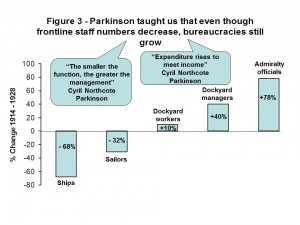
Parkinson had identified and quantified how bureaucracies and professional organisations always seem to find real or fictitious work for themselves which leads to the apparent necessity for them to keep growing, keep hiring more staff and as a result keep paying themselves ever more because of the increasing amount of work they either have to do or else create for themselves.
We can now see this phenomenon in the British private sector. In the thirty three years from 1980 to 2013, the number of solicitors in Britain rocketed up from about 37,800 to over 120,000; the number of accountants from around 100,000 to above 325,000 and estate agents from around 165,000 to more than 562,000. At the same time, the number of those employed in construction was fairly stagnant and the number working in manufacturing halved (click to see more clearly)
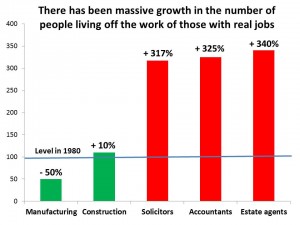
There was a similar situation in politics. In 1997, we had 650 MPs at Westminster. In spite of the fact that we keep reducing the power of the British Parliament by handing over ever more decision-making to the rapidly expanding and increasingly expensive Brussels bureaucracy, by 2014 we also had 129 Members of the Scottish Parliament, 108 Members of the Legislative Assembly of Northern Ireland and 60 Members of the Welsh Assembly in addition to our 650 Westminster MPs. In fact, we had so many politicians In Britain doing ever less law-making, that the Westminster Parliament started shortening its sessions each year as it ran out of anything useful to do.
This also happened throughout the public sector. The budget for the Financial Services Authority, the regulator for the financial services industry, for example spiralled up from £29 million in 1997 to over £526 million a year by 2013, the year in which it was scrapped. In 2006/7, the year before the financial crisis, the budget for Ofwat, the regulator for the water industry, was £11.5 million. By 2012/13 it had reached £20.1 million and then rose again in the following year to £27.9 million – more than doubling in just seven years. Meanwhile over at Ofgem, the regulator for the gas and electricity markets, its costs leapt up from £38.8 million to £73.3 million by 2012/13 and then to £83.3 million by 2013/14 – a similar picture of an increasingly bloated bureaucracy that we saw at Ofwat.
And in our supposedly ‘cash-strapped’ NHS there were about 200,000 hospital beds and 25,000 managers in 1997 when New Labour first came to power giving us around 8 beds per manager. Yet by 2014 we had just under 140,000 hospital beds and about 38,000 managers – a mere 3.7 beds per manager. This was a truly astonishing collapse in managerial productivity, while, of course, managerial salaries in the ‘cash-strapped’ NHS more than doubled in spite of the amount of real, useful work being accomplished apparently more than halving.
By David Craig, on August 10th, 2014 Watching yet more chaos in Iraq, some people might be wondering where the massive, US-trained Iraqi army is. I found this expert assessment of Iraq’s military (see below) quite interesting. It shows that Iraq’s current problems are, as usual with these primitive, Third-World hell-hole countries, purely due to the stupidity, tribalism, greed, corruption and incompetence of Iraq’s leaders.
When will we ever learn that these primitive hell-holes don’t ‘do democracy’? When will our useless leaders understand that the only way to govern primitive hell-holes is with a strong leader and a merciless security force?
Here’s the assessment of Iraq’s military:
“Iraq’s army was once a formidable military that waged an eight-year war with Iran. The US spent over $20 billion to train and equip Iraqi security forces. But in June 2014 once-proud Iraqi army simply collapsed and failed to defend the country’s second-largest city. Tens of thousands of Iraqi troops abandoned their posts and fled.
By 2014 the Iraqi army suffered from unhappiness among soldiers as a result of the underpayment or nonpayment of wages for months, particularly in the north and west. Here the army suffered from declining morale and desertions in the early months of 2014. This came as it battled the Islamic State of Iraq and the Levant (ISIL), which had seized control of Fallujah and Ramadi at the beginning of 2014. The Army made no gains against a foe that was well armed and highly motivated.
Desertion rates depended on whether units were deployed outside their home areas or were operating against insurgents of their own religious or ethnic background. Desertions were reported to be particularly high among Sunni soldiers from Sunni-dominated central and northern Iraq. There were significant loyalty issues in predominantly Sunni Arab units commanded by Shi’ite officers, following the purges of Sunni officers over the previous three years under the Maliki government. The Iraqi army in the north and west also suffered from low morale among Shi’ite soldiers from the south of the country, who had neither a regional nor communal affinity with the populations they were defending. Over 90 percent of the Iraqi Army is composed of Shi’ites.
Before these troops disintegrated in Mosul in June 2014, the Iraq army was losing as many as 300 soldiers a day to desertion, death, and injury. When they abandoned Mosul in mid-June, military personnel abandoned their vehicles, discarded their weapons, discarded their uniforms onto the street, and changed into civilian clothes.
By 14 June 2014 the situation in the Sunni north-western parts of Iraq amounted to the collapse of the forces of the army and federal police. With the fall of Nineveh Mosul, operational command virtually ceased, with the defeated remnants of the 2nd Infantry Division of the Iraqi army and the third motorized division of the federal police in Iraq running south or towards the Kurdish autonomy. The road between Baghdad and Mosul was cut, and in the province of Salah al-Din, militants from the Islamic State in Iraq and the Levant (Sham) launched an offensive and captured the Tikrit administrative center as well as Suleiman Bek, Baiji (along with a large oil refinery there), etc. The situation for the Iraqi forces operational command “Tiger” was extremely unfavorable, with the 4th Infantry Division in Tikrit defeated and / or running. Also according to reports from the Kurds, the 12th Infantry Division in Kirkuk was close to panic, with mass desertion and abandonment of combat positions.
The role of the officer corps remained confused. According to some accounts, the Maliki government had promoted officers based on political loyalty, producing a militarily imcompetent officer corps. By other accounts, Iraqi soldiers reported that their officers had ordered them to surrender rather than fight.
International media reported that two division of Iraqi soldiers — roughly 30,000 men — fled an insurgent ISIS force of approximately 1,000. Iraqi troops who fled the advance of Islamic State of Iraq and Syria (ISIS) fighters into Mosul denied that they abandoned their posts, saying that they had received orders to flee from up the chain of command.”
https://www.globalsecurity.org/military/world/iraq/nia.htm
|
|


 However, with my charity expose heading towards the bin, our charity bosses can sleep soundly in the knowledge that nobody will find out the true extent of their greed, lies and waste.