
 David Craig, on March 18th, 2026
Wednesday-Thursday blog
My blog is not intended to be about me and my boring little life. My aim is to find stories, or aspects of stories, which are not properly covered by the mainstream media. But today’s blog wil be an exception.
I imagine most of us have had some form of rudimentary training in CPR (Cardiopulmonary Resuscitation). You kneel over a dummy torso of a person, try a bit of pushing on the dummy’s chest to the beat of the BeeGees song ‘Staying Alive’ and breathe a bit into the dummy’s mouth holding its nose or something like that. Google tells us:
- “CPR (Cardiopulmonary Resuscitation) is an emergency procedure combining chest compressions and rescue breaths to maintain blood flow and oxygenation when the heart stops. Act immediately if a person is unresponsive and not breathing: call emergency services (e.g., 1669/911), push hard/fast (2–2.4 inches, 100-120 bpm) in the center of the chest, and use an AED if available.”
We’re also told to continue CPR until a trained medic arrives.
A few weeks ago I was on holiday in a country known for its hot weather, perfect beaches, excellent spicy food and what is euphemistically called its “vibrant nightlife”. During my daily afternoon walk along a beach, I saw a man lying face down at the water’s edge, his head lolling from side to side as each wave came in. Standing over him was a woman – I assume his wife – calling his name.
I ran over and tried to drag him out of the water, but he was too heavy. I ran to get help and a big muscled shaven-headed guy ran down to assist me. We pulled the drowned man out of the water, rolled him onto his back and began CPR. I have a feeling I may have dislocated the drowned man’s shoulder during this. But I guess that was the least of his problems.
During CPR there seemed to be no reaction, except that some kind of foam started coming from the drowned man’s mouth. That made it rather difficult to do the breathing part of CPR. I have since found out that the foam was sea water mixed with fluid from the man’s lungs.
As far as I could see, the drowned man was well and truly dead. His face was purple which suggested that his heart hadn’t pumped any blood for at least 30 minutes. Moreover, he cannot have drowned at the water’s edge. So his body must have drifted onto the shore after drowning and that would have taken some time.
We’re told that we should do CPR till trained medical help arrives, but I’ve since found out this is nonsense. Google tells us:
- “CPR can save someone if started immediately, ideally within 1–3 minutes of the heart stopping. Brain damage is likely if CPR is not started within 5 minutes, and death is probable after 8–10 minutes. Immediate bystander CPR can double or triple survival chances, with efforts sometimes successful up to 10 minutes post-arrest”
I understand why we’re told to do CPR till medical help arrives as instructors don’t want untrained people like myself making judgements on whether it is worth continuing CPR. But I felt uncomfortable continuing CPR after I was sure the drowned man was dead. CPR can be quite violent and in some way it felt we were abusing the drowned man’s body. Moreover, there is a risk during CPR of breaking a few ribs and maybe even forcing a broken rib to puncture a lung. Though, of course, that’s unimportant compared to saving the person’s life.
Some things I learnt were that CPR training should have included:
- doing CPR is much more complicated in real life/death than we’re led to believe during training
- our CPR training should have gone through the most typical situations CPR is used – heart attacks, electric shocks, drowning etc – and the differences we were likely to experience in each scenario
- honesty about survival chances in the first 10 minutes of administering CPR
- honesty about the degree of violence which needs to be used
- how to identify signs that a person is dead
- how to overcome the issues of being reluctant to do violence to a dead person’s body
The drowned man turned out to be a 79-year-old Danish man on holiday with his wife. I imagine he must have had a heart attack while swimming and then drowned but, of course, I don’t know exactly what happened. Here’s the poor guy whose life I didn’t manage to save:
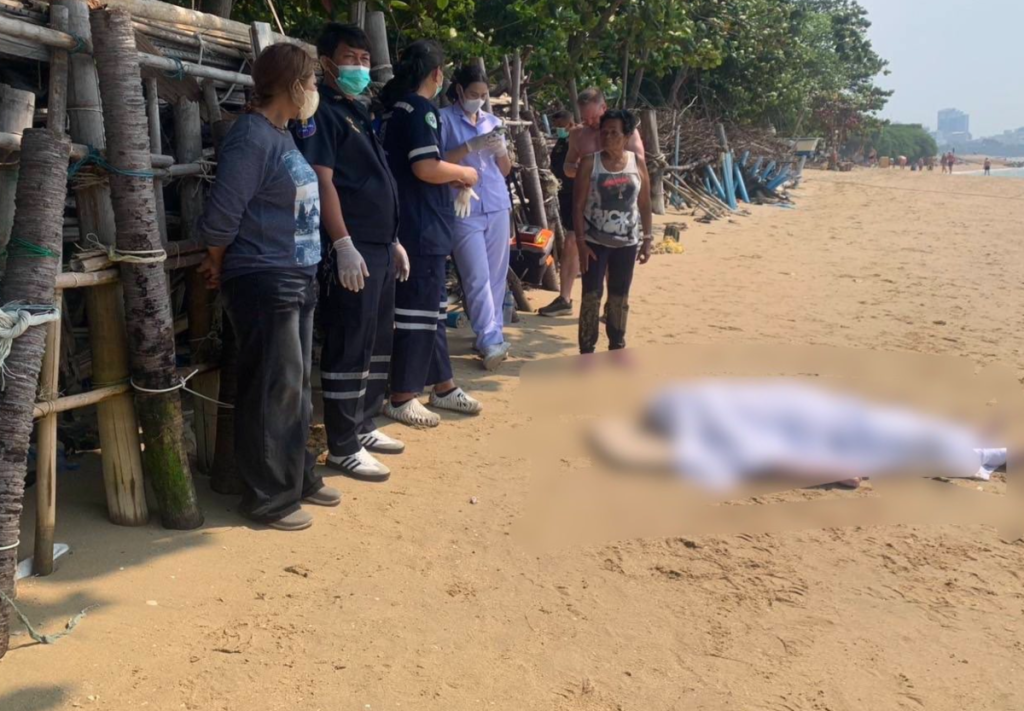
You’ll see the kind of wooden structure behind the onlookers and medics. That’s where there were a few rudimentary food and drink stalls and massage beds. The problem was that the people up on the structure couldn’t see the beach, so nobody noticed the drowning/drowned man. If the people up on the structure could have seen the beach, perhaps someone could have noticed the drowning man earlier and more could have been done to save him. It was only because I was walking along the beach that I saw him. And by then, of course, it was too late to save him.

 Category:




















Leave a Reply