|
|
By  David Craig, on October 26th, 2013 As it’s the weekend, I thought I’d lighten up a bit from the usual doom and gloom and set a quiz that has no real answers. Below are some photos of (IMHO) rather unsavoury characters from the periods in office of two former, one current and one future prime minister. I was just wondering which of the characters featured, really ran, runs or will run Britain.
Tony Blair 1997 – 2007

Gordon Brown 2007-2010

David Cameron 2010- 2015

Ed Miliband 2015-2020

As for the Grangemouth saga – there’s one thing I don’t understand. Apparently, when the management announced they were reopening the site and investing the £300m they had promised, there was a great cheer from the workers when they heard the news. But these were the very same workers who, a few days earlier, had voted to reject the company’s rescue plan and thus voted for site closure. Do you have to be stupid to be a member of Unite? Or does membership just make you more and more stupid? I think we should be told.
By David Craig, on October 25th, 2013 I’ve just read one of the most chilling articles I have ever seen. It was in the international (English language) version of the German magazine Der Spiegel. The headline was “Fanning The Flames of the Euro Crisis: Europe’s 10 Most Dangerous Politicians”. The article included a “rogues’ gallery” of Europe’s 10 supposedly “most dangerous politicians“.

I don’t know who half of them are, but they include Nigel Farage from the UK, Marine Le Pen from France, Geert Wilders from Holland and Timo Soini from Finland
What they all have in common is that they have all dared to criticise the EU bureaucracy and their great European project. The grovellingly europhiliac Der Spiegel accused these 10 “most dangerous politicians” of being “populists who are whipping up sentiment – and thereby worsening the crisis”. Furthermore, Der Spiegel was outraged that these 10 “most dangerous politicians” were “playing with fire that could threaten the entire European project”. And Der Spiegel ranted that the 10 “most dangerous politicians” were criticising the EU “to attract as many voters as they can for their own gain. All of this, of course, comes at the expense of a united Europe”.
Der Spiegel was particularly outraged that Marine Le Pen had said: “Frau Merkel and her friends, Van Rompuy and the European Commission are in the final stages of creating a European Soviet Union. We are about to lose our status as a free nation”. What Der Spiegel didn’t mention was that respected former Soviet leader Mikhail Gorbachev was quoted about six years ago as saying: “The most puzzling development in politics during the last decade is the apparent determination of Western European leaders to re-create the Soviet Union in Western Europe.”
What is frightening about this article is the mindset it reveals. The Europhiliacs, like Der Spiegel, seem to believe that everything the EU does is right and anyone who dares question our masters in Brussels must therefore be wrong and “dangerous”. It never occurs to the Europhiliacs that people like Farage and Le Pen and Wilders might represent their compatriots’ desire to be free of the crushing weight of the corrupt, wasteful EU bureaucracy that is crippling European economies, crushing industry, destroying jobs and ruining lives (particularly in countries where youth employment is above 50%).
Already the Europhiliacs are calling those who criticise the EU “dangerous”. The EU bureaucrats overthrew elected governments in Italy and Greece and replaced them with more obedient EU lackeys. In Greece, the admittedly rather unpleasant but democratically-elected members of Golden Dawn have been arrested and the Greek Parliament has voted to deprive the anti-EU party of any state funding. I wonder how long it will be until our EU masters decree that any criticism of them is “damaging to European solidarity”, “risks inflaming hatred” and therefore should be a criminal offence?
Here’s the article https://www.spiegel.de/international/europe/ten-politicians-who-worsen-the-euro-crisis-with-aggressive-rhetoric-a-848762.html
Oh, and here’s a comment I quite liked from a reader of a national newspaper: “Our Lords and Masters have a new, slightly less ambitious goal: the euro survives. Nothing else. Prosperity is unnecessary. Stability is unnecessary. Growth is unnecessary. However weak, however ineffectually it replaces such strong currencies as the Deutschmark and the Franc, the euro shall be considered a success if it continues to exist as a currency, like the Angolan Kwanza or the Bangladeshi Taka, and all policy shall be directed to that end. Nations in Europe exist to serve the currency, not the currency to serve the nations. This is not economics. This is religion”
By David Craig, on October 24th, 2013 If you despair of the fact that idiot Cameron has just (in April 2013) increased our foreign aid by £2.6bn from £7.9bn a year to £10.5bn a year, then this story may make you weep. Apparently the world’s most valuable individual prize – the Mo Ibrahim Prize for Good Governance in Africa – has not been awarded yet again.
The $5m (£3.2m) prize is supposed to be awarded each year to an elected African leader who governed well, raised living standards and then left office. Laughably, although there are 55 countries in Africa, this is the fourth time in five years there has been nobody who was considered to have deserved this award.

Sudan-born telecoms entrepreneur Mr Ibrahim launched the prize in an attempt (obviously fruitless) to encourage African leaders to leave power peacefully. So this is not some prize dreamt up by arrogant Westerners patronisingly given to Africans. It is a prize developed by Africans for Africans and yet the Africans awarding this prize could not find anyone worthy of receiving it for four of the last five years.
Three people have won in the seven years since the prize was launched: Cape Verde’s Pedro Verona Pires; Festus Mogae from Botswana and Mozambique’s Joaquim Chissano.
The $5m prize is spread over 10 years and is followed by $200,000 a year for life. But this prize money is probably less than most African leaders steal from their impoverished citizens each week. So for them, it’s hardly worth winning

The world gives around $50bn a year in aid to Africa. But it’s estimated that around five to ten times this amount is deposited in offshore tax havens by African leaders. As far as I can see, the average African leader will steal at least $5bn during his or her time in power. As China pours money into Africa to buy minerals to feed its industry and agricultural land to feed its people, the next few decades look like being very lucrative indeed for Africa’s much-respected rulers. For ordinary, usually-impoverished Africans, things don’t look quite so rosy.
Now, the bleeding heart liberals and the Guardianistas of this world often claim that Africa needs a Marshall Plan to escape from its backwardness and poverty. But the Marshall Plan gave Europe $15bn (the equivalent of $148bn in today’s money) over four years to rebuild after World War ll. With its $50bn a year in Western aid, Africa receives a four-year Marshall Plan every three years and has done for the last 60 years. So that makes twenty Marshall Plans that have poured into Africa. Yet around 90% of Africa’s people still live in abject poverty. I wonder why.
Oh, and to cheer us all up, here’s a Bird and Fortune sketch in which an African dictator, George Mparrbe, is being interviewed about what he’s doing with all the Chinese money flowing into his country https://www.youtube.com/watch?v=uwQWi4bahas Enjoy
By David Craig, on October 23rd, 2013 Two days ago on my car radio I heard Jonathon Porritt being interviewed on World At One by a sycophantically grovelling and depressingly ill-informed BBC supposed “journalist” about the Government’s decision to build a new nuclear power station. Porritt is a supporter of the Green Party, was formerly Director of Friends of the Earth and for decades has campaigned on environmental issues.
If I heard correctly, one of the absurd claims made by the great Greenie Porritt was that “the Government has put all its eggs in the nuclear basket”. Another was that nuclear power was much more expensive than the Greenies’ wonderful “renewable energy” – windfarms, solar, biomass, tidal etc. This was backed up by Caroline Lucas, member of Parliament for the Greens, who also shared her great wisdom with us saying, “This is a terrible deal for billpayers.”
So today, I’ll just try to refute these two common Greenie (IMHO) lies.
We currently get about 18 % of our power from nuclear power stations. Fifteen of our sixteen reactors will be closed by 2023, leaving just Sizewell B operating. Sizewell B provides about 2% of our energy and the new Hinkley Point reactor will provide about another 7%. So, when Hinkley Point is running in 10 or 11 years time, we’ll get just 9% of our power from nuclear. That’s half of what we get at the moment and doesn’t look to me like, as Porritt claimed, “the Government has put all its eggs in the nuclear basket”. Can Porritt not do simple arithmetic? Doesn’t he realise that 9% is half of 18%? Or was he just exaggerating to make a point? Or was he deliberately lying, hoping that none of the listeners would have the time or energy to get the real facts? Who knows? But this does suggest we can’t trust some of the things the great Greenie says.
Then there was claim number 2 – that nuclear would be more expensive than Jonathon Porritt’s and Caroline Lucas’s beloved windfarms and solar and biomass and tidal. Let’s test that. The wholesale energy price in Britain is currently around £44/MWh. The new Hinkley Point nuclear power station will be guaranteed £92.50/MWh – over double the current wholesale price. In comparison, producers of onshore wind power already get £100/MWh: offshore wind £155/MWh: solar £125/MWh….(see chart)

I didn’t include wave and tidal power as, at £305/MWh, they would be well off the scale of the chart. So, if my figures are correct, nuclear looks like being cheaper than the Greenies’ forms of “renewable energy” and if I heard Porritt correctly, he was being more than economical with the truth.
Though, of course, we don’t really need any of Porritt’s cherished but completely inefficient windfarms, or his ghastly solar farms in Britain where the sun seldom shines, or his ludicrously environmentally-damaging biomass. We’ve got lots of coal, there will be a glut of gas in a few years and new cheaper nuclear technologies will soon be feasible. But we’re committing economic suicide by increasing the amount of expensive “renewable energy” because our worthless politicians listen to people like Porritt and needlessly force up energy prices making our industries uncompetitive and destroying jobs.
However, if Wikipedia is to be believed, Jonathon Porritt is entitled to claim a baronetcy awarded to his father, becoming The Hon.Sir Jonathon Porritt, 2nd Baronet, but has so far declined to do so. So I guess Porritt has a few million tucked away somewhere. And Caroline Lucas will have her wonderful MP’s pension and will probably get a well-paid quango job and/or pushed up into the Lords if she’s chucked out of Parliament. They’ll probably live like multimillionaires for the rest of their lives. So why should they worry that their demented policies are bankrupting British companies and throwing British workers on the dole?
By David Craig, on October 22nd, 2013 Some readers have contacted me to say that some of my posts are so negative that readers lose the will to live. I apologise for this, but the purpose of this site is to expose the greed, stupidity, incompetence, lies and corruption of our rulers. So, it’s quite difficult to come up with positive stories. However, today I’ll take a break from all the doom and gloom and mention a new vice I’d highly recommend to anybody of any age – tribute bands.
For those who don’t know, tribute bands are groups who tour playing the music of some of the greatest rock and pop groups – groups like Pink Floyd, Dire Straits, Queen, Fleetwood Mac and so on.
There are at least four very good reasons to go and see a tribute band:
1. Some of them are unbelievably good, so good that they sound like the real groups whose music they’re playing
2. They tend to play in small theatres. When you go to see a major group, you’re often in a massive stadium hundreds of yards away from the group and you can only see them if there’s a large screen (which sort of defeats the purpose of going to the concert). With tribute bands you can often be sitting just 3 or 4 rows away from the group. It’s amazing to be so close to, for example, someone playing all of Dire Straits best guitar pieces.
3. Tickets usually only cost about £20 or less and by going to see them you’re also supporting your local small theatre or music venue
4. With a major group, you often have to sit through almost an hour of a supporting group. With tribute bands you’ll get over two hours of your favourite music.
So here are the tribute groups I’ve seen which I’ve really enjoyed:

I’d recommend you Google them, find out their tour dates and see them if you get a chance. You’ll have a great evening.
(Tomorrow – Jonathon Porritt and the great “green” energy scam)
By David Craig, on October 21st, 2013 Our masters in Westminster claim that they have a target to bring inflation down to around 2%. But I’ve been flicking through the laughably-named Office for Budget Responsibility’s (OBR) 189-page Economic and Fiscal Outlook and found a very different story.
There are two main measures of inflation RPI (Retail Price Index) and CPI (Consumer Price Index). There are two main differences between RPI and CPI. Firstly, RPI includes some things like housing, council tax, road tax and TV licence which are not in CPI. And secondly, the RPI is an “arithmetic” mean whereas the CPI is a “geometric” mean (explanation here https://www.significancemagazine.org/details/webexclusive/1314363/RPI-versus-CPI—The-Definitive-Account.html) Apparently this difference in the way of calculating inflation will always make the RPI around 1% higher than the CPI.
The supposedly independent OBR predicts that CPI will fall to the targeted 2% by 2016. Although, given that the Bank of England predicted achieving 2% every quarter for about five years and never achieved this, we shouldn’t take the supinely subservient OBR’s forecast too seriously. But what is interesting is the Government’s, sorry I meant the OBR’s forecast for RPI. This is expected to go in exactly the opposite direction to CPI (see chart)
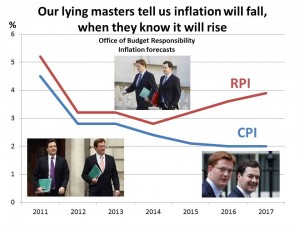
This rise is quite important for us. Firstly because inflation erodes the value of our savings. If we had £10,000 in 2010, according the CPI, this would buy £8,280 worth of goods by 2017. However, using RPI, our £10,000 would only buy £7,740 of goods by 2017.
Moreover, when working out how much money to take from us or give back to us, the Government chooses whichever of the two inflation measures suits it best. So, when telling us how high inflation is, the government uses the lower CPI to make it look like they are in control of the economy. It also uses the lower CPI for the indexation of most tax rates, allowances and thresholds, in order to take more money from us, and for the uprating of benefits and public-sector pensions, in order to give less money to us. However, the Government uses the much higher RPI for things like student loan payments and the revalorisation of excise duties in order to get more money from us.
Oh, and thanks to a reader for pointing out that the Bank of England uses RPI (the higher index for inflation) when calculating what its staff should get each year with their pensions.
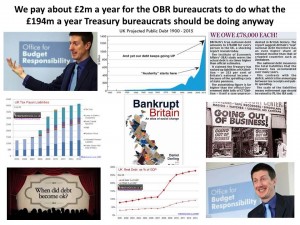
As for the supposedly “independent” OBR – for a financially-incontinent British government, that is doubling our national debt in just five years from £700bn to £1.4trn, to create an “Office for Budget Responsibility” is a bit like Democratic People’s Republic of North Korea creating an Office for Freedom of Speech and Human Rights.
By David Craig, on October 20th, 2013 The leaders of the Coalition tell us that their policies are working, that Britain is on the road to recovery and that they just need a bit more time to “finish the job”. But what job is that? Saving the British economy? Or completing Brown’s and Balls’s highly successful project to bankrupt Britain? To find out, why not take our “Bankrupting Britain” quiz?
1. By how much is our national debt increasing every minute of every day? A: £2,300 B: £23,000 C: £230,000
2. Under the Coalition’s “austerity” plans, what will happen to public spending between now and the 2015 election? A: Go down by £60bn B: Stay flat C: Go up by £60bn
3. If Cameron and Osborne win the 2015 election and continue their “austerity” programme, what will happen to public spending by 2018? A: Go down by £90bn B: Stay flat C: Go up by £90bn
4. By the 2015 General Election, our national debt per private-sector worker will be? A: £600 B: £6,000 C: £60,000
5: As teachers strike for better pensions, how much do generous, inflation-protected public-sector pensions cost each private-sector taxpayer? A: £32/year B: £320/year C: £3,200/year
6: As teachers strike for better pensions, how much will generous, inflation-protected public-sector pensions cost each private-sector taxpayer by 2018? A: £64/year B: £640/year C: £6,400/year
7. How much would you or I have to save each year into our pension to get the same pension as an MP? A: £20,000 B: £40,000 C: £60,000
8. The interest we now pay each year on our national debt is equivalent to the annual budget of? A: The police B: The police and the military C: The police, the military and schools
9: There are about 920,000 Romanians and 170,000 Bulgarians in Spain and about 997,000 Romanians and over 70,000 Bulgarians in Italy. Britain has much more generous benefits and more jobs than Spain or Italy, so how many Romanians and Bulgarians will flood into Britain? A: Don’t know (that’s what the government claims) B: At most 50,000 (as a couple of ministers have admitted) C: 1,500,000 (my estimate)
10: David Cameron’s April 2013 increase in foreign aid of £2.6bn from £7.9bn to £10.5bn a year is enough money to pay for? A: The 40,000 troops being fired to save money B: The 32,400 police being fired to save money C: Both the 40,000 troops and the 32,400 police being fired to save money
11. Trick question – Which of these pictures most accurately reflects our economic situation?

Answers: 1 – C 2-C 3-C 4-C 5-B 6-B 7-C 8-C 9-C 10-C 11 – All of them
By David Craig, on October 19th, 2013 A reader sent me an interesting comment/question on yesterday’s blog about our rip-off energy companies: “I’m normally with you David but this one makes me uneasy. Are you saying that a profit of 22% is too much and that governments should step in whenever a company makes that kind of profit? Where would you draw the line on this? 10% 15% 20%? Does this apply only to energy companies or to businesses in all sectors? There’s more to all this than meets the eye. There’s clearly a margin for competition to come along and undercut there but it seems that it isn’t happening. Why not?”
The reader seems to be asking two main questions: 1. What profit levels should the energy companies be allowed? 2. With such high profit margins, why is there not more competition?
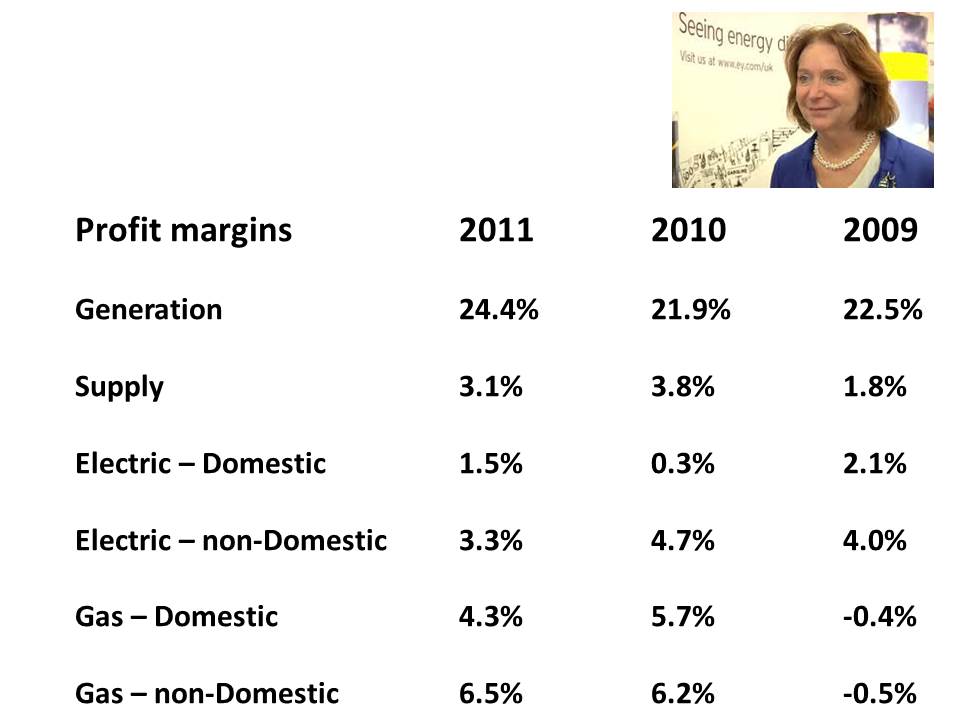
Let me deal with the 2nd question first – why is there not more competition? The energy business consists of two main parts – “upstream” which is power generation and “downstream” which is power transmission and supply to customers. What the Big Six companies do is push up their profit margins to at least 24% on the “upstream” part (power generation)
This has two wonderful consequences;
1. They can claim they make small profits They charge themselves so much for the power they produce (or gas they supply to themselves) that they can only make a small profit – about 5% – on their “downstream” business. So, when they raise prices as they do every year, their PR people can come on TV and claim that they make very little profit (5% or so) while conveniently forgetting the massive profits made in the “upstream” part which is about two thirds of their costs
Oil companies play a similar game – pushing their profits into “upstream” (oil extraction) so they can claim they make very small profits on their filling stations.
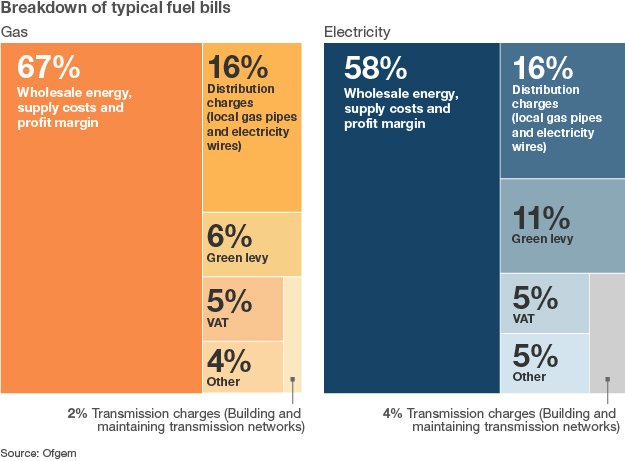
2. They keep out competition It’s very difficult for a new competitor to enter the “upstream” business as it costs so much to build a new power station or gas platform. Competitors can easily enter the “downstream” part. But they have to buy their power and transmission from the Big Six. As the first chart shows, the Big Six charge so much for power (where they make their 24% profit margins) that the profit margins on “downstream” are very small, giving little room for would-be competitors to undercut Big Six prices.
So, when our useless politicians tell us to switch suppliers, we’ll actually save very little as the Big Six have stitched up the market between them.
As for the first question What profit margins should power companies be allowed? When an essential service like power is being controlled by an oligopoly of just six (mainly foreign-owned) companies, then there is a need for a real regulator (not the worthless Ofgem) to prevent market abuse. I believe that companies like French EDF, Spanish Iberdrola and German E.0n are only allowed to make profits of somewhere between 3% and 5% in their home markets. But according to my calculations, they’re making about 17% in Britain – 3 to 5 times as much as they’re allowed in their home markets, which of course is why foreign companies are so keen to buy Britain’s “cash cow” energy companies
As for the future of our energy prices, it’s going to be a case of up, up, up thanks to the horror of the ludicrous Climate Change Act which was supported by all three major parties.
The current “strike price” for electricity is around £44 per MWh. But the offshore wind generating companies (mostly foreign) are going to receive £155/MWh (ie more than THREE times as much) for their intermittent totally unreliable electricity!
Wave and tide generated electricity will cost us £300/MWh – ie SIX times the current price. And nuclear will be at least twice the current price and probably much higher.
And the deranged Ed Davey tells us that his Green policies will result in a reduction in fuel bills of £144p/a by 2020.
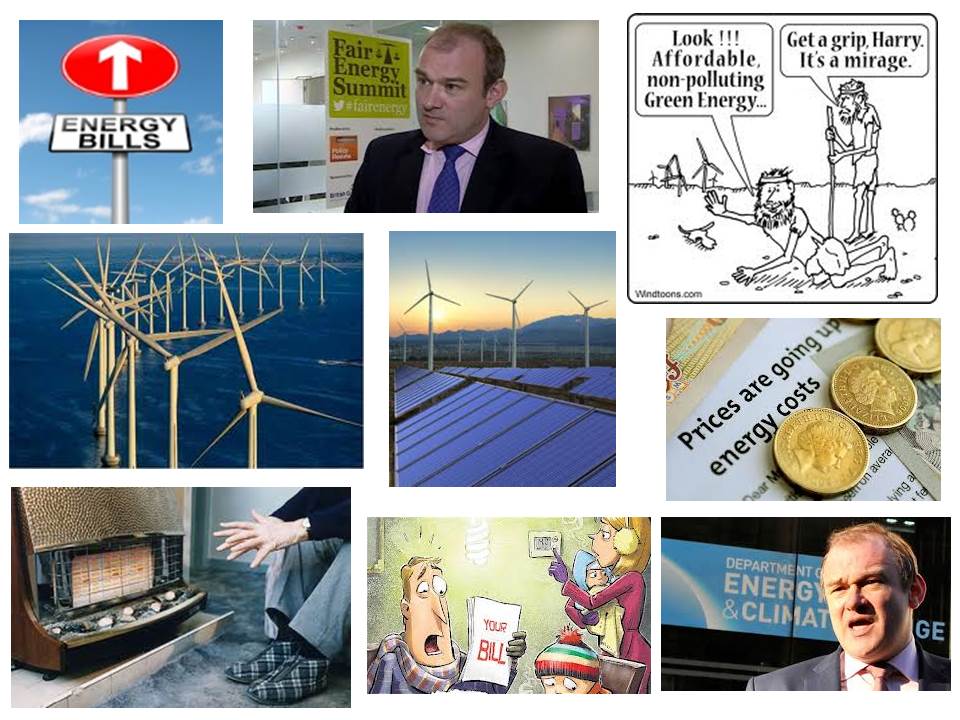
By David Craig, on October 18th, 2013 As the energy companies push up their prices by 8% to 10% just before we all turn our central heating on, we’ve heard the usual lies about how they’re forced to increase prices due to the rising cost of wholesale energy. So, let me tell you the truth. When wholesale prices rise, our bills rise. When wholesale prices fall, our bills do not fall. We are being fleeced.

But what about Ofgem, the supposed regulator? Like all our useless, self-serving supposed regulators (Ofwat, Ofcom, the FSA, the FCA, the Care Quality Commission, Monitor etc), Ofgem has been looking after itself. Ofgem’s budget doubled from £38.8m in 2006-07 to more than £78.7m by 2012. But Ofgem has done little to nothing for us, the people it is meant to protect from the predatory energy companies.
Meanwhile the energy companies have been making eye-watering profits from us. EDF – a company 83% owned by the French government – made profits of £1.58bn on a turnover of £7.1bn – a profit margin of an astonishing 22%. Of course, the energy companies claim they only make 5% profit on their energy supply businesses. But this completely glosses over the fact that they also generate electricity which they then sell to their supply businesses. So, while the supply businesses may only be making a profit of this modest 5%, their generating businesses are coining it in.

Iberdrola, the Spanish company that owns Scottish Power, made so much money in Britain that it loaned £800m to one of its US subsidiaries when American regulators – real regulators not like our worthless Ofgem – put pressure on the subsidiary to stick to its investment commitments.
So, don’t believe the energy companies’ lies and don’t believe their subservient politicians’ lies. We are being fleeced by the Big Six energy companies. Britain is one of the most lucrative markets for energy companies. That’s why so many foreign companies have bought our energy suppliers – they can make four to five times as much profit in Britain than they can in their own properly regulated home markets.

By David Craig, on October 17th, 2013 The West is moving towards negotiating a deal with Iran’s new leader, the one the Islamophiliacs at the BBC call a “moderate”. This deal will probably be heralded as a “great breakthrough” and as bringing a “new era of peace” to the troubled Middle East. But in fact it will probably allow Iran to develop its first nuclear weapon. And when it does and attacks Israel, all those who allowed this will express shock and surprise. So it might be worth looking at what is really happening behind the scenes.
These are the key movers and shakers in Iran

There’s the former president Mahmoud “Mad” Ahmajinedad who has repeatedly pledged to wipe Israel off the face of the earth. Then there’s the nice new “moderate” president Rouhani with his happy welcoming smile as he thinks back through all his fond memories of when, as Iran’s chief negotiator on its nuclear weapons programme, he lied to and fooled the West for years to buy Iran time to get its hands on the bomb. And there’s the Supreme Leader Ayatollah Khamenei who calls the shots and decides what really happens. Ayatollah Khamenei should not be confused with Ayatollah Khomenei (that’s his picture in the background) who did more than any other person to take Iran from the 20th century back to the Stone Age.
Here’s what the boss, Ayatollah Khamenei, really thinks: “Israel is a cancerous tumor in the Middle East. Israel is a satanic media outlet with bombers. Every Muslim is required to arm themselves against Israel.”
“I have already noted the usurper state of Israel poses a grave threat to Islam and Muslim countries. Islam and Muslim states must not lose this opportunity to remove the corruption from out midst. All of our problems are because of Israel – Israel of America. The first step should be the absolute destruction of Israel.”
Like most Arabs, Khamenei blames Israel for everything that is wrong in the Arab world. Here’s a map of the Middle East

Yup, you can hardly see Israel as it’s so small. The land area of Israel is just 21,000km2 compared to 6,042,000km2 for the main Arab countries that surround Israel. So the Arab countries are 288 times larger than tiny Israel. The population of Israel is just 7.9 million (about the same as the population of Cairo) compared to 279 million for the major Arab states. Yet somehow, in the warped minds of Khamenei and most other Arab clerics and leaders, tiny Israel is responsible for all the problems in the Middle East. And the Islamophiliacs at the BBC swallow this ludicrous story.
I believe psychologists call this process of blaming others for our own self-induced problems “Attribution”. To continue to do this is a sign of a severe personality disorder and even mental instability. And we’re about to let psychotics have nuclear weapons?

|
|